
Molecular Flow Blog Posts

Simulating the Pressure in an Ultrahigh Vacuum System
The ETpathfinder research facility in the Netherlands was built in anticipation of the proposed Einstein Telescope (ET), a third-generation observatory of gravitational waves.
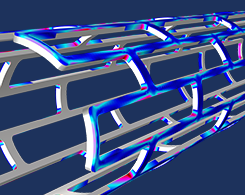
8 Uses of COMSOL Multiphysics® in the Biomedical Industry
Read about 8 real-world examples of how engineers and researchers in the biomedical industry are using simulation to advance their innovative designs.
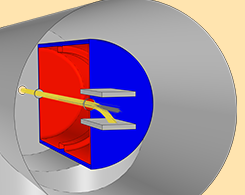
Efficiently Analyze Charge Exchange Cell Designs Using Applications
Due to their neutral ion beam, charge exchange cells are used in processes ranging from ion implantation and semiconductor fabrication to synchrotron devices and medical research.
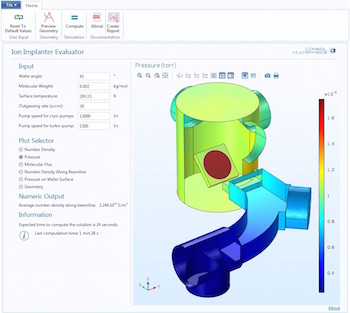
App: Evaluating the Design of an Ion Implanter
In the semiconductor industry, ion implanters are used to implant dopants into wafers. By building a simulation app, device designers can quickly and easily test a wide range of parameters.
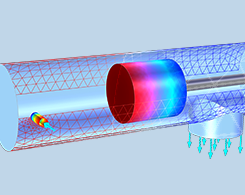
Simulating UHV/CVD and Silicon Growth on a Wafer Substrate
Ultrahigh vacuum chemical vapor deposition (UHV/CVD) is performed at pressures below 10-6 Pa, or about 10-8 torr. In this process, molecular flow is used to achieve gas transport.
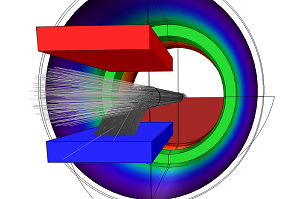
Modeling Beam Neutralization with a Charge Exchange Cell
A charge exchange cell refers to an area of high-density gas that is placed in the path of an ion beam. You can model a charge exchange cell to analyze its neutralization efficiency.
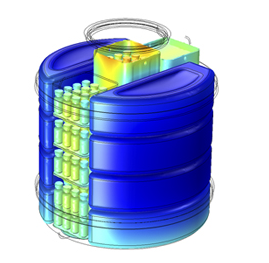
Portable Cordless Vaccine Storage Device
Their goal? To optimize the design of a passive vaccine storage device. Their tactic? Combining experimentation with the modeling of thermal and vacuum systems in COMSOL Multiphysics®.
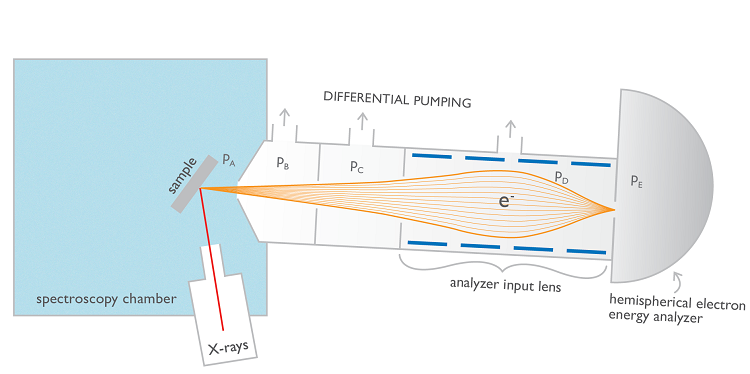
Differentially Pumped Vacuum Systems for Spectroscopic Imaging
X-ray photoelectron spectroscopy is an imaging technique used extensively in R&D to characterize the chemical and electronic properties at the surface of a material. Learn about this technique.


