
The Application Gallery features COMSOL Multiphysics® tutorial and demo app files pertinent to the electrical, structural, acoustics, fluid, heat, and chemical disciplines. You can use these examples as a starting point for your own simulation work by downloading the tutorial model or demo app file and its accompanying instructions.
Search for tutorials and apps relevant to your area of expertise via the Quick Search feature. Note that many of the examples featured here can also be accessed via the Application Libraries that are built into the COMSOL Multiphysics® software and available from the File menu.
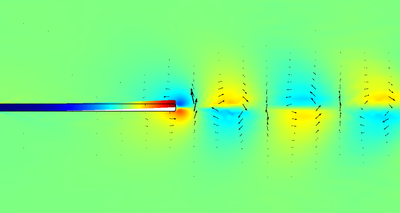
This is a small 2D demonstration model that couples the Linearized Navier-Stokes, Frequency Domain, Solid Mechanics, and Turbulent Flow (k-epsilon) physics interfaces to model the vibrations of a plate located in a 2D viscous parallel plate flow. This type of model is used to model fluid ... Read More
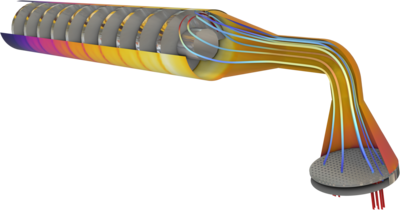
This tutorial example of the pasta extrusion process shows how to simulate the non-isothermal flow of dough in the metering zone of a pasta extruder accounting for the temperature dependent material properties of the hydrated semolina dough. Read More
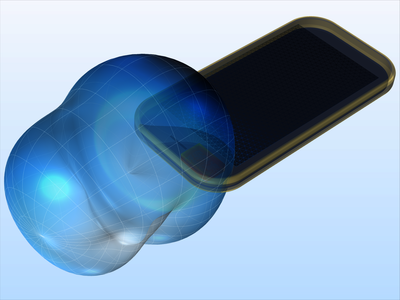
Electrical components in wireless communication systems are designed to be small and lightweight while maintaining decent performance and efficiency. Antennas are essential components in mobile devices and are required to fit in the limited space allowed by industrial specifications. To ... Read More
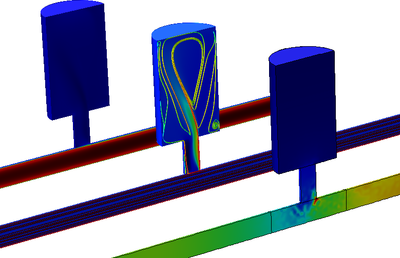
Helmholtz resonators are used in exhaust systems, as they can attenuate a specific narrow frequency band. The presence of a flow in the system alters the acoustic properties of the resonator and the transmission loss of the subsystem. In this tutorial model, a Helmholtz resonator is ... Read More
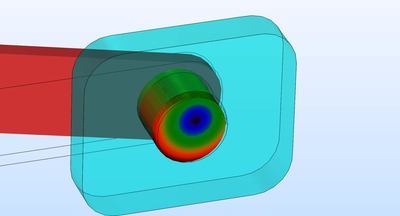
Joints between two components of a mechanical system are sometimes not perfectly fitting. For the ease of assembly and to allow relative movement between the components, a small gap called clearance is provided between the joining components. The presence of clearance on joints can ... Read More
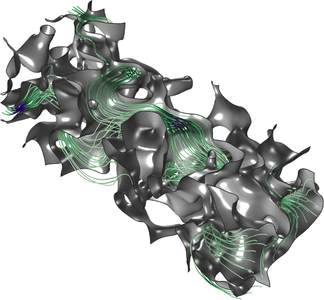
Modeling flow through realistic porous structures is difficult due to the complexity of the structure itself. Often, resolving the flow field in detail is not feasible; therefore, a macroscopic description of the pore scale structure, which utilize averaged quantities such as porosity ... Read More
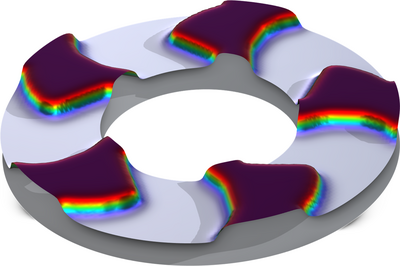
In this tutorial model, a step thrust bearing is topology optimized to maximize the bearing capacity. A step thrust bearing consists of a stepped bearing surface on which the end of the shaft rotates. The entire assembly is submerged in a lubricant. The shaft collar is assumed to be ... Read More
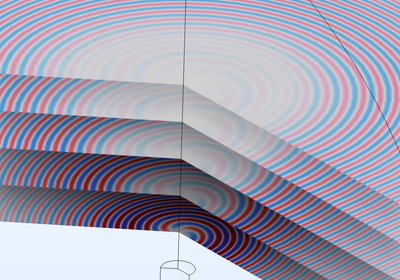
Model of the sound radiation from a circular duct with uniform flow. The convected acoustic problem is described using the linearized potential flow equations, solved in the frequency domain. The acoustic inlet is treated including higher order modes using the Port boundary condition and ... Read More
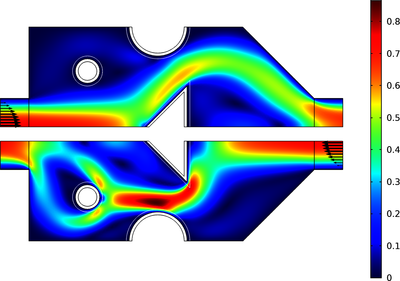
The topology optimized Tesla microvalve is used as inspiration for a parametrized geometry. The optimization of this geometry takes erosion and dilation of the geometry into account by optimizing over a parametric sweep. In this example the optimization is driven by the worst of the 3 ... Read More

When evaluating the efficacy of treatments for ocular diseases, modeling and simulation can be used for pharmacokinetic analysis by visualizing drug concentration and how it spreads through the eye over time. In this simplified pharmacokinetic model of a human eye, a small patch is ... Read More