
The Application Gallery features COMSOL Multiphysics® tutorial and demo app files pertinent to the electrical, structural, acoustics, fluid, heat, and chemical disciplines. You can use these examples as a starting point for your own simulation work by downloading the tutorial model or demo app file and its accompanying instructions.
Search for tutorials and apps relevant to your area of expertise via the Quick Search feature. Note that many of the examples featured here can also be accessed via the Application Libraries that are built into the COMSOL Multiphysics® software and available from the File menu.
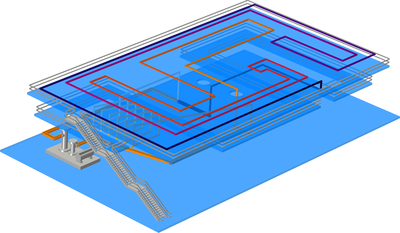
This example demonstrates how to model coupled flow, heat transfer, and structural deformation and stress in a pipeline network. Gravity loads from the pipe and fluid are also taken into account. Read More
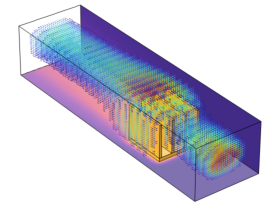
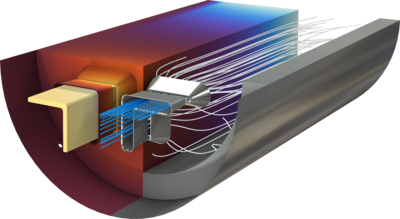
This tutorial model uses a heat sink geometry from the Part Library. The tutorial shows different approaches to heat transfer modeling when studying the cooling of an electronic chip. In the first part, only the solid parts are modeled, while the convective airflow is modeled using ... Read More

Due to abuse, such as internal or external short circuits or excessive heating, an individual battery cell may go into thermal runaway, during which the battery cell generates a significant amount of heat. If enough heat is transferred between adjacent cells during a thermal runaway ... Read More
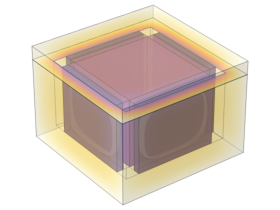
This example solves the heat transfer in an isothermal box aimed at transporting refrigerated articles such as medical materials for 24 hours. In this case, the box has to keep the contents cold for a long period of time while respecting storage temperature restrictions between 2°C and 8 ... Read More
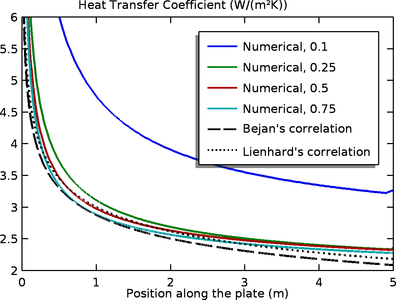
This verification model of nonisothermal turbulent flow over a flat plate compares the heat transfer coefficient obtained from simulation with theoretical values based on Nusselt number correlation functions that can be found in the literature. Read More
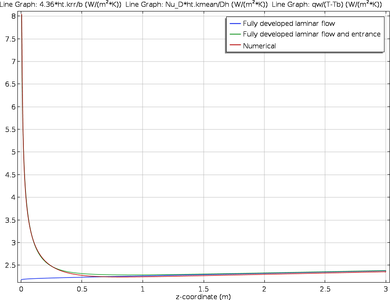
This verification model of nonisothermal laminar flow through a circular tube compares the heat transfer coefficient obtained from simulation with theoretical values based on Nusselt number correlation functions that can be found in the literature. Read More
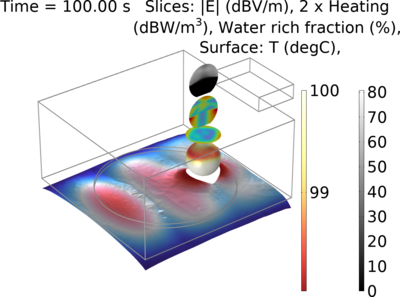
A spherical water-rich load (potato) is placed on the rotating glass tray of a microwave oven some distance from the center of rotation. 1 kW of 2.45 GHz microwave power is applied via a waveguide feed. The plate rotates at 9 degrees per second. The heat transfer model involves the ... Read More
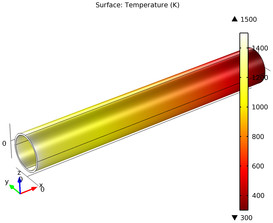
The heat distribution in a hollow pipe, whose ends are held at two different temperatures, is studied. The outside surface is assumed to be thermally isolated and the inner surfaces have radiation boundary conditions. The role of convection in the heat transfer is taken to be ... Read More
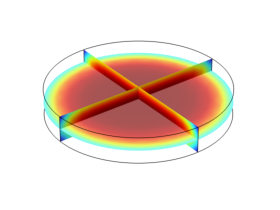
When producing glass, the glass melt is cooled down through radiation to form the final shape, subjecting it to stresses. Numerical treatment of radiative heat transfer, using the Radiative Transfer Equation (RTE), helps to optimize this process. COMSOL Multiphysics provides three ... Read More
In massive forming processes like rolling or extrusion, metal alloys are deformed in a hot solid state with material flowing under ideally plastic conditions. Such processes can be simulated effectively using computational fluid dynamics, where the material is considered as a fluid with ... Read More