
The Application Gallery features COMSOL Multiphysics® tutorial and demo app files pertinent to the electrical, structural, acoustics, fluid, heat, and chemical disciplines. You can use these examples as a starting point for your own simulation work by downloading the tutorial model or demo app file and its accompanying instructions.
Search for tutorials and apps relevant to your area of expertise via the Quick Search feature. Note that many of the examples featured here can also be accessed via the Application Libraries that are built into the COMSOL Multiphysics® software and available from the File menu.
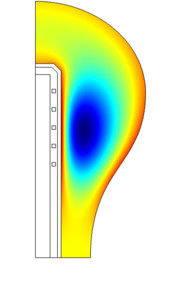
This model simulates an electrodeless lamp with argon/mercury chemistry. The low excitation threshold for mercury atoms means that even though the mercury is present in small concentrations, its behavior dominates. There is strong UV emission from the plasma at 185 nm and 253 nm. The UV ... Read More

This model simulates a beam of light being split into components of different frequencies when passing through a medium where the refractive index depends on frequency. COMSOL-wise, the model showcases two important technical aspects: A user-defined implementation of the frequency ... Read More
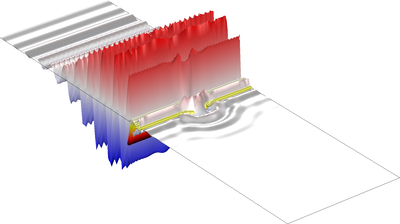
This tutorial shows how to solve the full time-dependent wave equation in dispersive media such as plasmas and semiconductors. The 2D TM in-plane wave model solves for the vector potential from the wave equation and for an auxiliary electric polarization density from an ordinary ... Read More
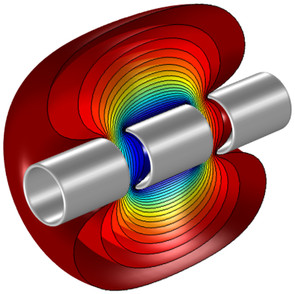
An Einzel lens is an electrostatic device used for focusing charged particle beams. It may be found in cathode ray tubes, ion beam and electron beam experiments, and ion propulsion systems. This particular model consists of three axially aligned cylinders. The outer cylinders are ... Read More
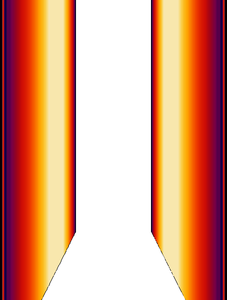
This tutorial shows how to use the Surface-to-Surface Radiation interface to simulate radiative heat transfer with radiation between diffuse emitters and diffuse-and-specular reflectors. This model is separated in two parts. The first part focuses on a validation test for the radiative ... Read More
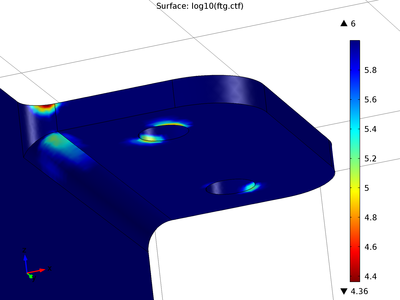
The S–N curve, also called the Wöhler curve, is one of the most popular methods for fatigue evaluation. The curve relates stress amplitude to the limiting fatigue life and can be obtained directly from a set of standard fatigue test. Many times our applications are subjected to ... Read More
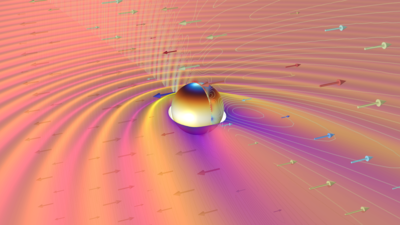
This verification model uses the Electromagnetic Waves, Boundary Elements interface to simulate the RCS of perfectly conducting sphere. The simulated result is compared to analytical calculation to verify the accuracy. Read More
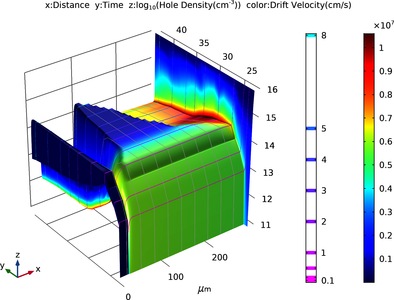
This tutorial performs steady-state and transient analysis of the response of a PIN diode to constant and pulsed radiation, respectively. The effect of radiation is modeled as spatially uniform generation of electron-hole pairs within the device. At high dose rates the separation of the ... Read More

This model demonstrate how to simulate ray tracing in a pinhole camera viewing a solar eclipse. To keep the model dimensions in check, the Sun and Moon are approximated using planar discs with the appropriate angular size (~0.5 degree) relative to the pinhole. In this example, the ... Read More
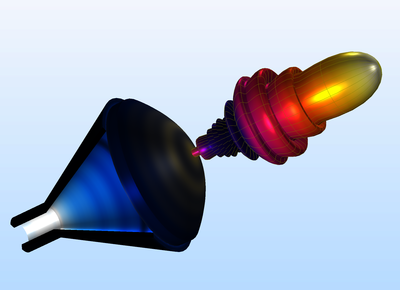
An axisymmetric 3D structure such as a conical horn antenna can be simulated in a fast and efficient way using only its 2D layout. In this model, the antenna radiation and matching characteristics are computed very quickly with respect to the dominant TE mode from the given circular ... Read More