
The Application Gallery features COMSOL Multiphysics® tutorial and demo app files pertinent to the electrical, structural, acoustics, fluid, heat, and chemical disciplines. You can use these examples as a starting point for your own simulation work by downloading the tutorial model or demo app file and its accompanying instructions.
Search for tutorials and apps relevant to your area of expertise via the Quick Search feature. Note that many of the examples featured here can also be accessed via the Application Libraries that are built into the COMSOL Multiphysics® software and available from the File menu.

A large reflector can be modeled easily with the 2D axisymmetric formulation. In this model, the radius of the reflector is greater than 20 wavelengths and the reflector is illuminated by an axial feed circular horn antenna. The simulated far-field shows a high-gain sharp beam pattern Read More
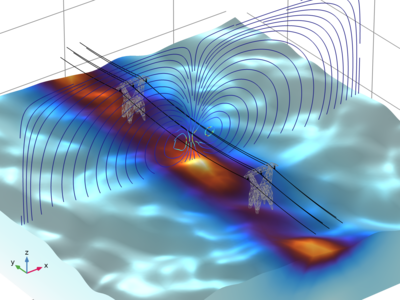
Power lines are commonly used as a means of transmitting electrical power across large distances. In this tutorial, towers transmitting high voltage three-phase AC power are modeled, and the resulting magnetic field is computed. The towers have two shielding lines. Read More
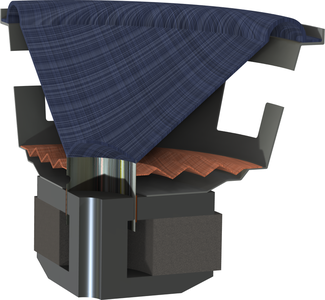
This tutorial shows how to best solve full 3D vibro-electroacoustic multiphysics models of loudspeakers. The model is based on a 3D representation of the existing 2D axisymmetric Application Library model loudspeaker_driver found in the software. The setup of the physics is essentially ... Read More
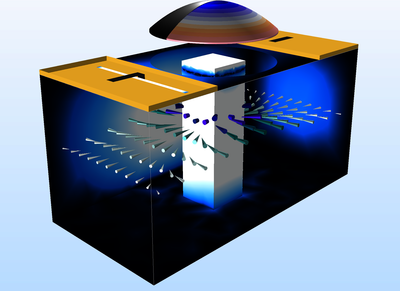
An evanescent mode cavity filter can be realized by adding a structure inside of the cavity. This structure changes the resonant frequency lower than the dominant mode of the unfilled cavity. A piezo actuator is used to control the size of a small air gap which provides the tunability of ... Read More
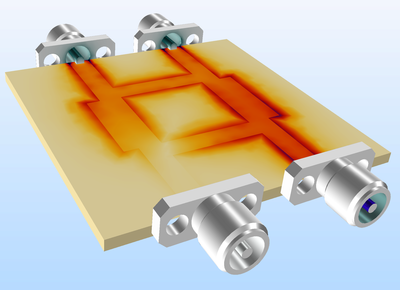
A Branch Line Coupler (Quadrature 90° Hybrid) is a four-port network device with a 90° phase difference between two coupled ports. The device can be used for a single antenna Transmitter/Receiver system or an I/Q signal splitter/combiner. The objective of this model is to compute the S ... Read More
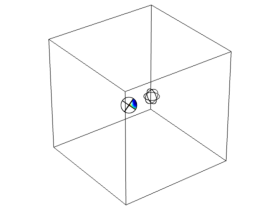
This model verifies that the onset of streamer formation between two spheres separated by atmospheric pressure dry air at a distance of 2cm occurs at 51.8kV. The electrical breakdown is detected by integrating Townsend coefficients along the electric field lines between the two spheres. ... Read More
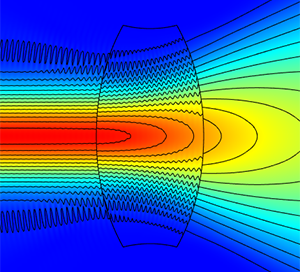
In this example, the properties of an engineeredmaterial are modeled by a spatially varying dielectric distribution. Specifically, a convex lens shape is defined via a known deformation of a rectangular domain. The dielectric distribution is defined on the undeformed, original ... Read More
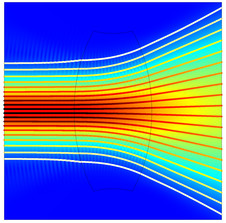
This example demonstrates how to set up a spatially varying dielectric distribution. Here, a convex lens shape is defined via a known deformation of a rectangular domain. The dielectric distribution is defined on the undeformed, original rectangular domain and is mapped onto the deformed ... Read More
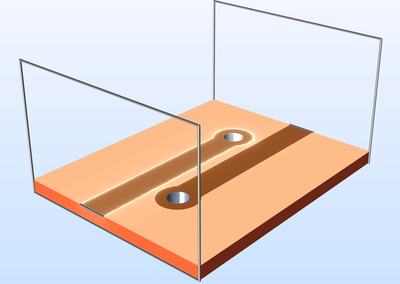
There are multiple ways to excite and terminate transmission lines using different types of port and lumped port features. In this example, transverse electromagnetic (TEM) type ports and a via type lumped port are used to simulate two adjacent microstrip lines. One via end is terminated ... Read More
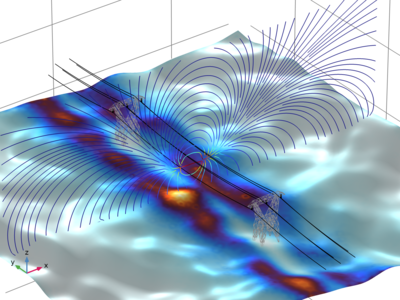
Power lines are commonly used as a means of transmitting electrical power across large distances. In this tutorial, towers transmitting high voltage three-phase AC power are modeled, and the resulting electric field is computed. The towers have two shielding lines. The model also ... Read More