
The Application Gallery features COMSOL Multiphysics® tutorial and demo app files pertinent to the electrical, structural, acoustics, fluid, heat, and chemical disciplines. You can use these examples as a starting point for your own simulation work by downloading the tutorial model or demo app file and its accompanying instructions.
Search for tutorials and apps relevant to your area of expertise via the Quick Search feature. Note that many of the examples featured here can also be accessed via the Application Libraries that are built into the COMSOL Multiphysics® software and available from the File menu.

An interesting question was raised in the 1950s by the mathematician Ernst Straus that, in an arbitrarily shaped empty room with side walls made of perfect mirrors, will a point light source always illuminate the whole room? This question was answered by the Nobel Prize-winning ... Read More

Optical computing has been a promising paradigm alternative to the current electronic computers. This model simulates an optical 4-by-4 unitary matrix multiplication device based on a network of six Mach–Zehnder interferometers (MZIs). A more detailed description of this model can be ... Read More
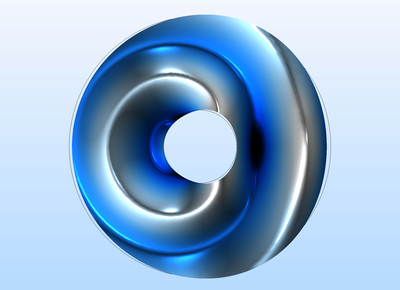
This example model calculates the bistatic radar cross section (RCS) per unit length of a circle using the Electromagnetic Waves, Time Explicit physics interface. A 2D circle is excited by a 200 MHz sinusoidal signal modulated by a temporal Gaussian pulse. A wideband RCS frequency ... Read More
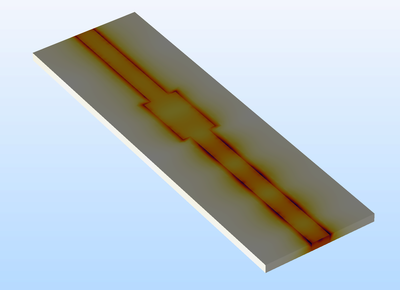
While transient analyses are useful for time domain reflectometry (TDR) to handle signal integrity (SI) problems, many RF and microwave examples are addressed using frequency domain simulations generating S-parameters. However, from the frequency domain data it is difficult to identify ... Read More
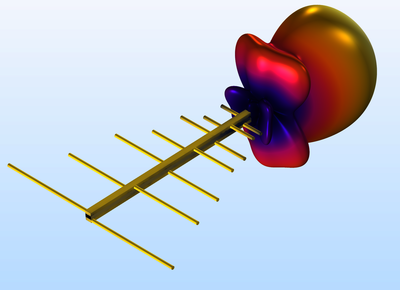
The shape of a log-periodic antenna resembles that of a Yagi-Uda antenna, but is composed of a coplanar array to achieve a wider bandwidth. It is also known as a wideband or frequency-independent antenna. All metallic parts are modeled using the perfect electric conductor (PEC) boundary ... Read More
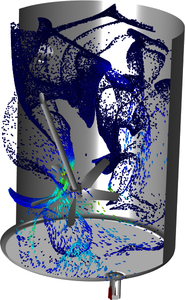
Continuous mixing is used in process equipment to mix components in a single pass. Compared to batch mixing, this operation has the advantage that the tank filling and emptying steps are eliminated, implying that the process can be run without interruptions. A disadvantage of continuous ... Read More
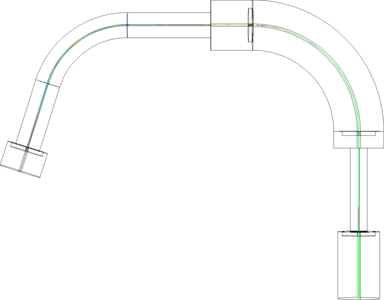
This tutorial utilizes the Particle Beam feature to examine the performance of a high-precision spectrometer. An ion beam is subjected to electric and magnetic forces, and only a fraction of the incoming beam is transmitted to the detector. The Particle Counter feature is used to compute ... Read More
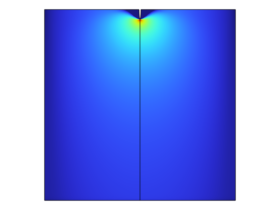
This tutorial model presents a study of a negative corona discharge in dry air at atmospheric pressure in a point-to-plane configuration. An elliptical electrode with millimeter dimensions creates a high intensity electric field where the corona discharge occurs. A ground plane is placed ... Read More
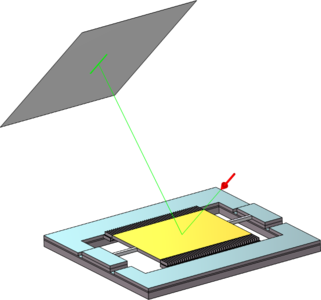
MEMS scanning mirrors are a type of MEMS device that realizes optical path control by controlling mirror torsion through a microdriver. The torsion can be single axis or double axis. MEMS scanning mirrors are widely used in laser projection, laser radar, laser processing, and other ... Read More
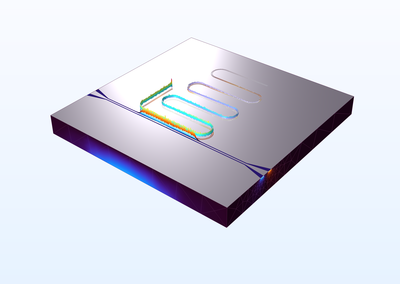
Developments in the last decade have made circuit quantum electrodynamics (cQED) the leading architecture for quantum computation. cQED is the solid-state version of cavity QED, which studies the basic light-matter interactions at the quantum level. This model examines one of the main ... Read More