
The Application Gallery features COMSOL Multiphysics® tutorial and demo app files pertinent to the electrical, structural, acoustics, fluid, heat, and chemical disciplines. You can use these examples as a starting point for your own simulation work by downloading the tutorial model or demo app file and its accompanying instructions.
Search for tutorials and apps relevant to your area of expertise via the Quick Search feature. Note that many of the examples featured here can also be accessed via the Application Libraries that are built into the COMSOL Multiphysics® software and available from the File menu.
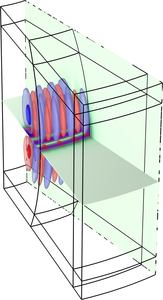
Dielectric microspheres can support whispering gallery modes with high optical quality factors. This model illustrates how to compute the different eigenmodes and resonance frequencies. The resonance frequencies are either filtered by their spatial localization in the resonator or by ... Read More
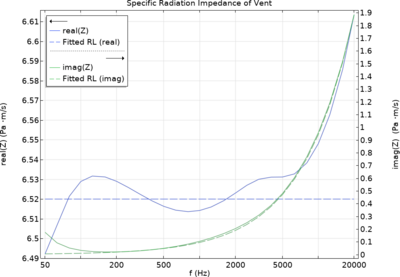
This model computes the specific acoustic radiation impedance of a very small circular vent in a flanged configuration. The model includes thermoviscous losses. The radiation impedance is fitted using a simple RL circuit which gives a simple lumped representation. The results are used ... Read More
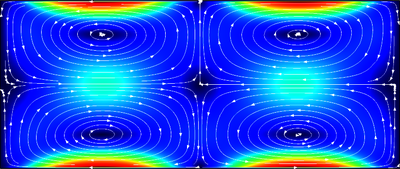
Recent advances in the fabrication of microfluidic systems require handling of live cells and other micro particles as well as mixing. All this can, for example, be achieved using acoustic radiation forces and the viscous drag from the streaming flow. Streaming: Due to the nonlinear ... Read More
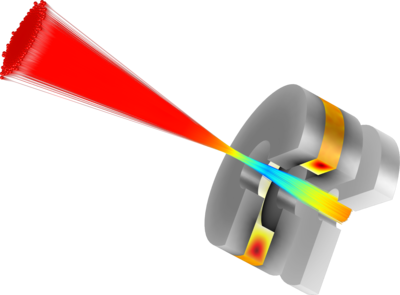
A scanning electron microscope samples images by scanning a target with a high-energy beam of electrons. The subsequent electron interactions produce signals such as secondary and back-scattered electrons that contain information about the sample surface topography. Electromagnetic ... Read More
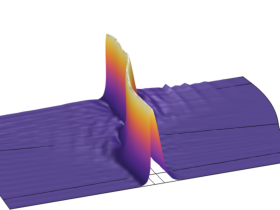
This model demonstrates how to simulate the propagation of guided waves in a dielectric S-bent optical waveguide. The model demonstrates that the phase approximation, required by the Electromagnetic Waves, Beam Envelopes interface, can be numerically calculated by solving an additional ... Read More
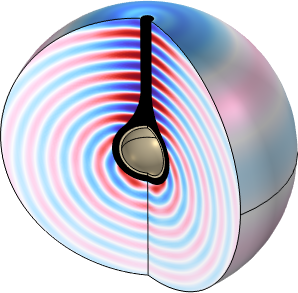
A spherical hydrophone consisting of a PZT ceramic, a coating material, and a cable is modeled in 2D axisymmetry. The Receiving Voltage Sensitivity (RVS) is computed for an incident plane wave and compared to an analytical solution from the reference for an ideal spherical hydrophone. ... Read More
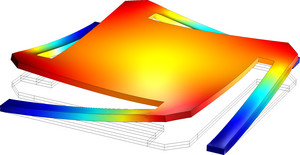
One method of creating spring-like structures or inducing curvature in thin structures is to plate them to substrates that are under the influence of residual stresses. The plating process can control this stress even for similar materials. One such device is the electrostatically ... Read More
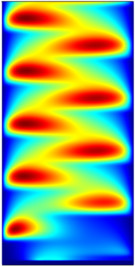
This model simulates electrical breakdown in an atmospheric pressure gas. Modeling dielectric barrier discharges in more than one dimension is possible, but the results can be difficult to interpret because of the amount of competing physics in the problem. In this simple model the ... Read More
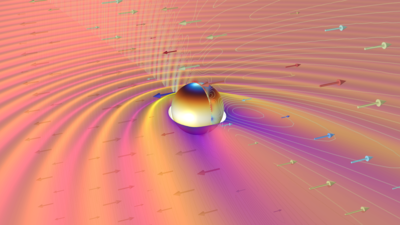
This verification model uses the Electromagnetic Waves, Boundary Elements interface to simulate the RCS of perfectly conducting sphere. The simulated result is compared to analytical calculation to verify the accuracy. Read More
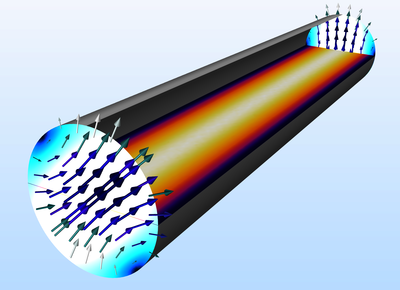
This model of a circular waveguide demonstrates how to use ports with numerical solution of the port modes. It illustrates how to align the polarization of degenerate port modes and in particular how to model and excite the TE11 mode of circular waveguides in 3D. Read More