
The Application Gallery features COMSOL Multiphysics® tutorial and demo app files pertinent to the electrical, structural, acoustics, fluid, heat, and chemical disciplines. You can use these examples as a starting point for your own simulation work by downloading the tutorial model or demo app file and its accompanying instructions.
Search for tutorials and apps relevant to your area of expertise via the Quick Search feature. Note that many of the examples featured here can also be accessed via the Application Libraries that are built into the COMSOL Multiphysics® software and available from the File menu.
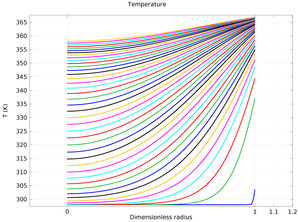
This model approximates 3D spherical transport using a 1D model. Many models of industrial-transport problems allow the assumption that the problem is spherically symmetric. This assumption is of great importance because it eliminates two space coordinates to result in a 1D problem that ... Read More
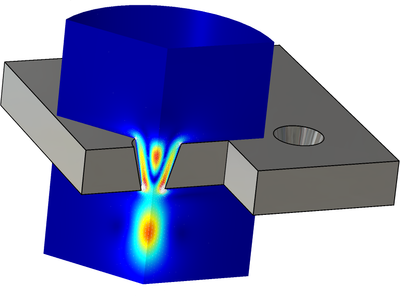
This model analyzes the nonlinear transfer impedance of a tapered orifice that can be part of a perforate or microperforated plate (MPP). The analysis is carried out for various degrees of tapering of the perforate and for a frequency range. A linear analysis is set up in the frequency ... Read More
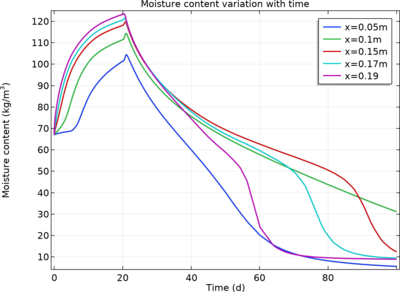
This tutorial shows how to simulate coupled heat and moisture transport in a wall. The wall is modeled considering an air flow between interior and exterior varying with time. The 1D model is the third benchmark test defined in HAMSTAD-WP2 Modeling for the validation of numerical ... Read More

Finding acoustic eigenmodes in problems solved with linearized convected acoustic interfaces can be a challenging task. The solution will most often return several non-acoustic vorticity and entropy modes. These are highly damped waves that do not propagate at the speed of sound but with ... Read More
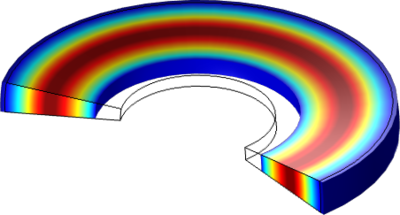
This example illustrates how to combine different Creep material models. Here a Norton–Bailey model (primary creep) is combined with a Norton model (secondary creep). This example is a continuation of the model thermally induced creep. Read More
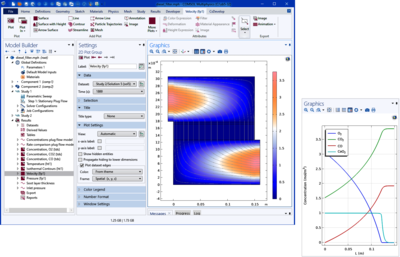
In this tutorial, a filter system for a diesel engine is modeled, including a soot layer development and oxidization. The build-up of the layer is held in check by both catalytic and non-catalytic reactions, where carbon is oxidized to carbon monoxide and carbon dioxide, which in turn ... Read More
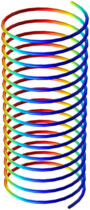
This model computes the trajectory of an ion in a uniform magnetic field using the Newtonian, Lagrangian and Hamiltonian formulations available in the Mathematical Particle Tracing interface. Read More
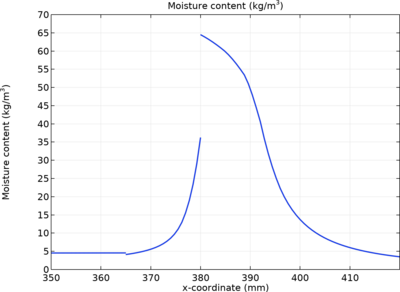
This model shows how to simulate moisture redistribution inside a wall with capillary active interior insulation. The wall consists of three layers: brick, mortar and insulating material. At the beginning of simulation, there is a sudden change in vapor pressure and temperature at ... Read More
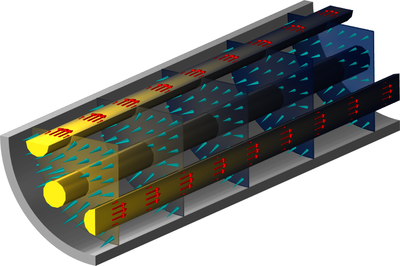
In fuel cell power generators, a steam reformer unit typically produces the hydrogen needed for the cell stack. This example illustrates the modeling of a steam reformer. The reformation chemistry occurs in a porous catalytic bed where energy is supplied through heating tubes to drive ... Read More
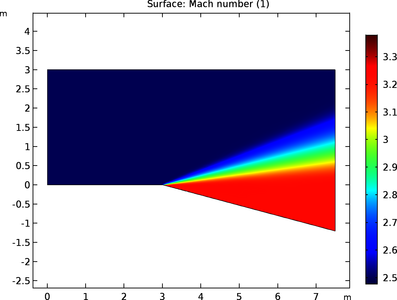
An important and interesting phenomenon with supersonic flows are expansion fans, which take place when the flow encounters a convex or expansion corner. The direction of the flow changes smoothly across the fan, while the Mach number increases. This 2D example models an expansion fan ... Read More