
The Application Gallery features COMSOL Multiphysics® tutorial and demo app files pertinent to the electrical, structural, acoustics, fluid, heat, and chemical disciplines. You can use these examples as a starting point for your own simulation work by downloading the tutorial model or demo app file and its accompanying instructions.
Search for tutorials and apps relevant to your area of expertise via the Quick Search feature. Note that many of the examples featured here can also be accessed via the Application Libraries that are built into the COMSOL Multiphysics® software and available from the File menu.
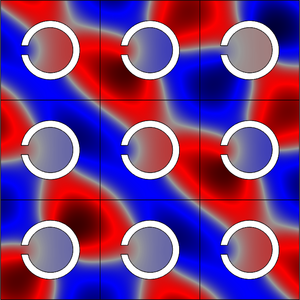
Phononic and sonic crystals have generated rising scientific interest for very diverse technological applications. These crystals are made of periodic distributions of scatterers embedded in a matrix. Under certain conditions, acoustic band gaps can form. These are spectral bands where ... Read More
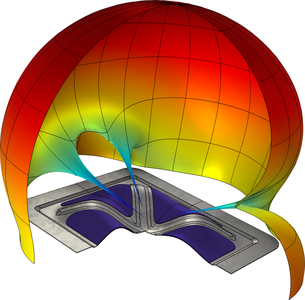
This model presents a method to analyze acoustic damping pads. These pads use a constrained layer of viscoelastic material to dissipate energy and thus reduce the energy radiated as noise. Damping pads are used in many different industries to reduce the noise generated by vibrating ... Read More
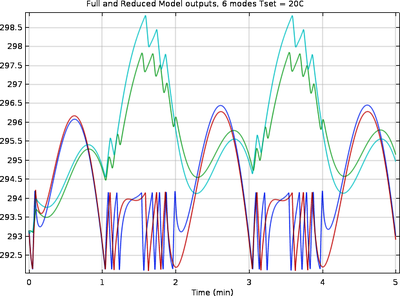
Large FEM simulations can be costly and, if repeated simulations are needed, it can be beneficial to use reduced-order models (ROMs). ROMs are typically valid only in the vicinity of their design conditions and have lower accuracy, but the simulation time is significantly shorter. The ... Read More
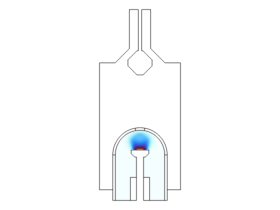
This tutorial model solves for a hydrogen plasma created in a microwave cavity. The model computes the fluid flow and gas heating self-consistently. Read More
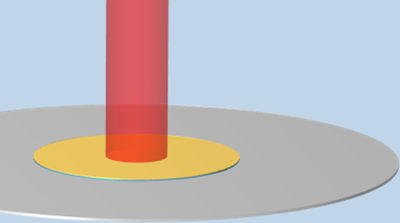
The following model demonstrates the usage of the Radiative Beam in Absorbing Media interface for computing the heating of semitransparent materials. Specifically, the model analyzes how a Gaussian profile laser beam heats two different semitransparent materials deposited onto a silicon ... Read More
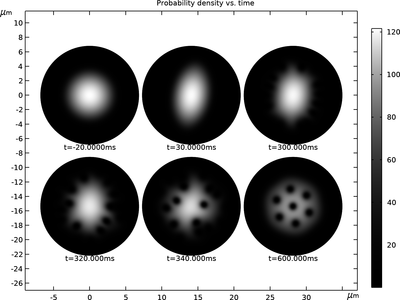
This tutorial model solves the Gross–Pitaevskii Equation for the vortex lattice formation in a rotating Bose–Einstein condensate bound by a harmonic trap. The equation is essentially a nonlinear single-particle Schrödinger Equation, with the inter-particle interaction represented by a ... Read More
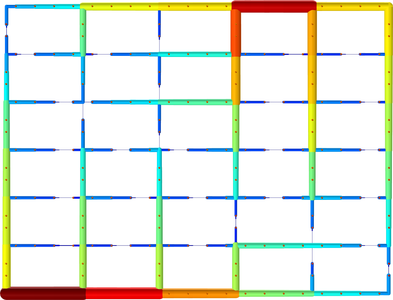
The layout of a district heating network is designed using topology optimization. Read More
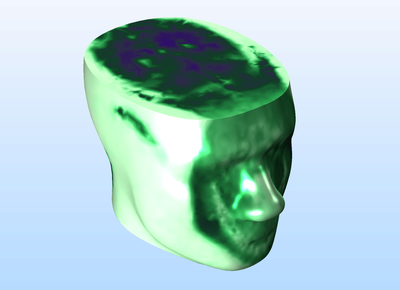
Scientists use the SAR (specific absorption rate) to determine the amount of radiation that human tissue absorbs. This measurement is especially important for mobile telephones, which radiate close to the brain. The model studies how a human head absorbs a radiated wave from an antenna ... Read More
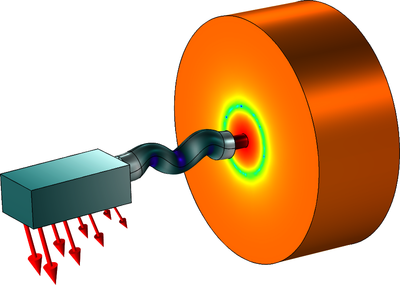
When simulations are involved in the development of mobile devices, consumer electronics, hearing aids, or headsets, it is necessary to consider how the transducers interact with the rest of the system. Here, we show an analysis of the interaction between a vibration isolation mounting ... Read More
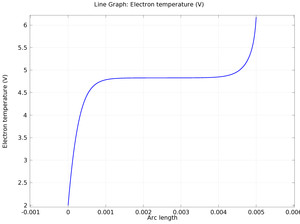
The Drift Diffusion interface solves a pair of reaction/advection/diffusion equations, one for the electron density and the other for the mean electron energy. This tutorial example computes the electron number density and mean electron energy in a drift tube. Electrons are released due ... Read More