
The Application Gallery features COMSOL Multiphysics® tutorial and demo app files pertinent to the electrical, structural, acoustics, fluid, heat, and chemical disciplines. You can use these examples as a starting point for your own simulation work by downloading the tutorial model or demo app file and its accompanying instructions.
Search for tutorials and apps relevant to your area of expertise via the Quick Search feature. Note that many of the examples featured here can also be accessed via the Application Libraries that are built into the COMSOL Multiphysics® software and available from the File menu.
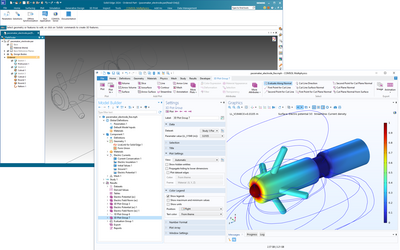
Pacemaker Electrode
This model, dealing with the current and potential distribution around one pair of electrodes, demonstrates how to synchronize and modify geometry in Solid Edge by using the LiveLink interface. Read More

Transverse Modes for a Symmetric Laser Cavity
This model demonstrates how a nonlinear equation system can be setup to solve for the eigenfrequencies of a symmetric laser cavity. The model uses the bidirectional formulation of the Electromagnetic Waves, Beam Envelopes physics interface. The computed eigenfrequencies are verified with ... Read More
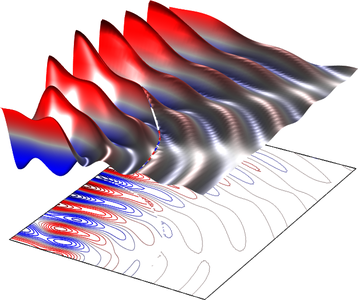
Baffled Piston Radiation
An axisymmetric model of a rigid piston in an infinite baffle is used to exemplify the Exterior Field Calculation feature of the Acoustics Module. The radiation results provided by the COMSOL Multiphysics® software are compared to analytical results for the on-axis radiation ... Read More
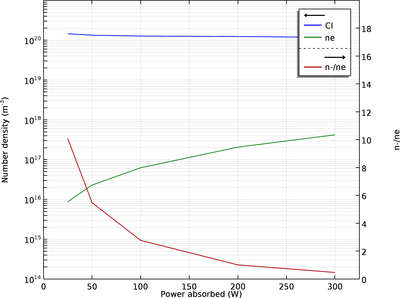
Chlorine Discharge Global Model
Plasma discharges containing chlorine are commonly used to etch semiconductors and metals in microelectronics fabrication. This tutorial model studies chlorine plasma discharges using a global (volume-averaged) diffusion model. Global diffusion models can run simulations in a fraction ... Read More
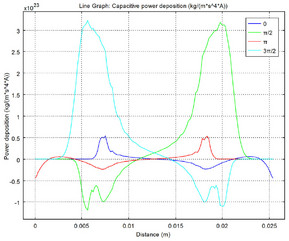
GEC CCP Reactor, Argon Chemistry, 1D
The NIST GEC CCP reactor provides a platform for studying capacitively coupled plasmas. Even the simplest plasma models are quite involved so a 1D example helps in understanding the physics without excessive CPU time. The problem has no steady-state solution, although a periodic steady ... Read More
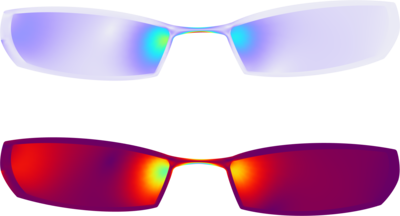
Fatigue Failure of an Eyeglass Frame
In the search for weight reduction, the cross-section of an eyeglass frame is continuously reduced. The thin section over the nose transfers the entire load between the two halves. This example predicts the fatigue life using the combined Basquin and Coffin-Manson model when eyeglasses ... Read More
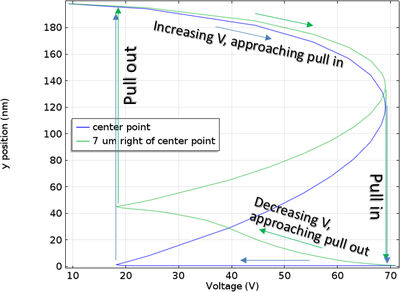
Pull-In and Pull-Out Analysis of a Biased Resonator — 2D
An electrostatically actuated MEMS resonator is simulated. The device is driven by an AC + DC bias voltage applied across a parallel plate capacitor. In this example, the pull-in and pull-out voltages of the resonator are computed. This is done via a quasi-static analysis of the ... Read More
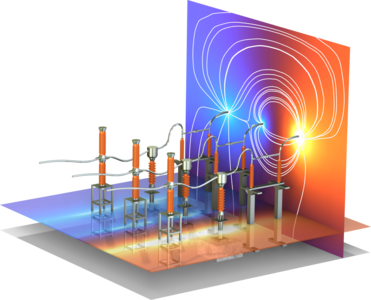
3-Phase AC Breakers & Disconnectors
Breaker and disconnector devices are widely used in AC substations in power systems.In this model, the Electrostatics Interface is used to simulate the electric potential and electric field in a 110kV 3-phase high-voltage switchgear operating at 50 Hz. A surrogate model is also trained ... Read More
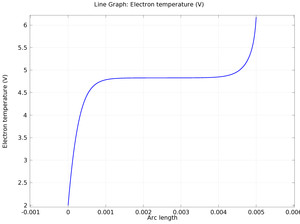
Drift Diffusion Tutorial
The Drift Diffusion interface solves a pair of reaction/advection/diffusion equations, one for the electron density and the other for the mean electron energy. This tutorial example computes the electron number density and mean electron energy in a drift tube. Electrons are released due ... Read More
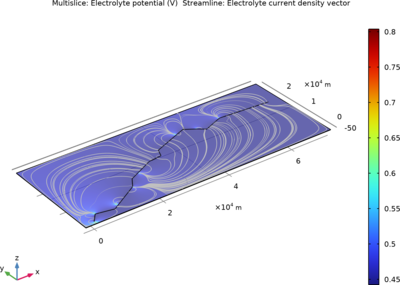
Pipeline Corrosion Protection Using Impressed Current Cathodic Protection
In this example, three parallel pipelines of length 68 km and a horizontal separation distance of 10 m between them are protected against corrosion by an impressed current cathodic protection (ICCP) system using a series of anodes. Each anode is connected to all three pipelines, ... Read More