
The Application Gallery features COMSOL Multiphysics® tutorial and demo app files pertinent to the electrical, structural, acoustics, fluid, heat, and chemical disciplines. You can use these examples as a starting point for your own simulation work by downloading the tutorial model or demo app file and its accompanying instructions.
Search for tutorials and apps relevant to your area of expertise via the Quick Search feature. Note that many of the examples featured here can also be accessed via the Application Libraries that are built into the COMSOL Multiphysics® software and available from the File menu.
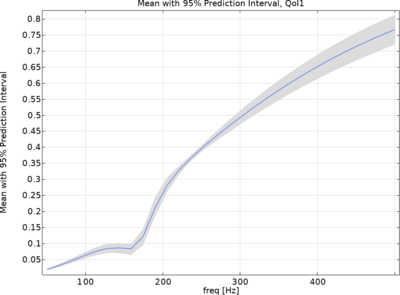
It can in many cases be difficult to get accurate material properties for porous materials. Measuring the properties to high precision can involve lengthy measurements using different techniques. It can therefore be interesting to understand how uncertainties in different material ... Read More

This model demonstrates how to use the chatbot functionality in COMSOL Multiphysics® to add annotations to a model of a pacemaker electrode. To learn more about this model, see our accompanying blog post “Using the Chatbot Window in COMSOL Multiphysics®”. Read More
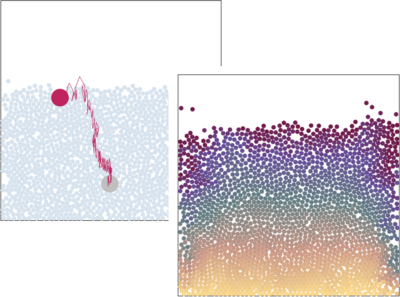
Formally known as size separation in vibrated granular materials, the Brazil nut effect (BNE) (and sometimes the Muesli effect) is a phenomenon that causes large grains to separate from small ones and rise to the top of a granular bed under vibrations. This phenomenon can be studied ... Read More

This document explains how to install and run COMSOL Multiphysics® and COMSOL Server™ with Amazon Elastic Compute Cloud™ (EC2™). This requires that you have first acquired a Floating Network License (FNL) or COMSOL Server License (CSL) from COMSOL. The license manager ... Read More
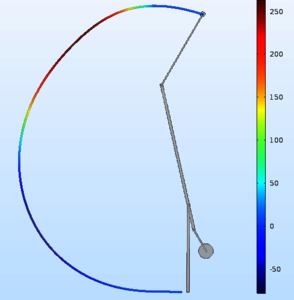
In this multibody dynamics model of a simple counterweight trebuchet, a parametric sweep is used to study throwing distance as function of the sling length. For more details on performing a multibody analysis of a counterweight trebuchet, see this blog post: What Is the Physics Behind a ... Read More

In this verification example, the built-in functionality for calculating dynamic coefficients in hydrodynamic bearings is validated. The results are compared with those obtained using the finite perturbation method to ensure consistency and accuracy. The model showcases how numerical ... Read More
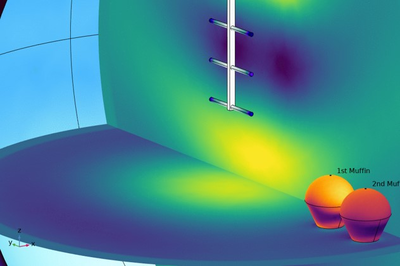
In food industries, microwave heating is gaining attention over a conventional heating treatment because of several advantages such as precise process control, speed of heating, fast turn-on and turn-off time, etc. In this model, a high directional Yagi-Uda antenna is used to heat up ... Read More

This model simulates the initiation of streamers from suspended metal particles, their propagation under a high electric field, and their subsequent merging. The discharge current flows into the metal particles, which are maintained at equal potential. These suspended particles enhance ... Read More
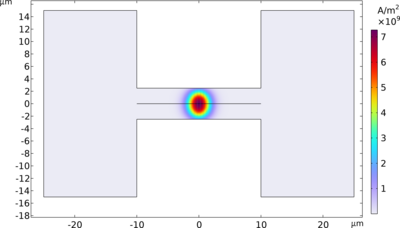
This model uses the Semiconductor and RF modules to describe a photoconductive antenna (PCA). A laser pulse is applied on the surface of undoped LT-GaAs to generate electron-hole-pairs, which move under the influence of an external E-field creating a transient electric current pulse. ... Read More
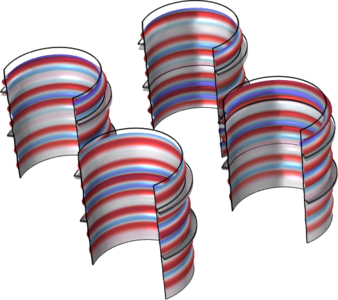
These models illustrate some important topics when modeling buckling imperfection. The Euler 2 Buckling Imperfection model shows a simple case with a cantilever beam buckling under compression. Three different buckling modes are combined as initial imperfections. The other model, ... Read More


