
The Application Gallery features COMSOL Multiphysics® tutorial and demo app files pertinent to the electrical, structural, acoustics, fluid, heat, and chemical disciplines. You can use these examples as a starting point for your own simulation work by downloading the tutorial model or demo app file and its accompanying instructions.
Search for tutorials and apps relevant to your area of expertise via the Quick Search feature. Note that many of the examples featured here can also be accessed via the Application Libraries that are built into the COMSOL Multiphysics® software and available from the File menu.
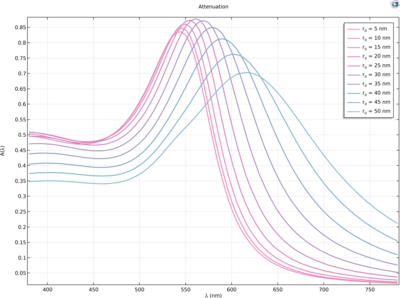
In this extension of the model Optical Scattering off a Gold Nanosphere, the transmission spectra due to spherical nanoparticles of gold with varying radii dispersed in glass are computed and mapped onto the CIE 1931 and sRGB colorspaces. For a description of this model, see the ... Read More

This example demonstrate the modeling of a plug flow reactor for the synthesis of ammonia in the Haber-Bosch process. The catalytic reactor in this process operates under non-isothermal conditions, where temperature and pressure varies substantially along the length of the reactor, in ... Read More
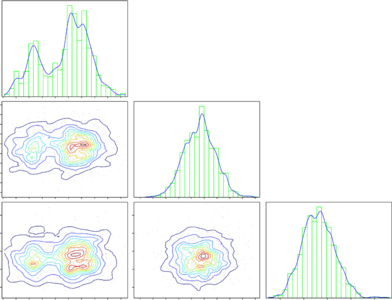
This example demonstrates how to apply inverse uncertainty quantification (IUQ) using the Uncertainty Quantification (UQ) Module in COMSOL Multiphysics to calibrate uncertain material properties of a resistor based on measurement data. When experimental data such as resistance values are ... Read More

Many robot vacuum cleaners nowadays are equipped with lidar for spatial mapping in order to design an optimal cleaning path and navigate in a room without bumping into obstacles. This model simulates the lidar of a robot vacuum cleaner and how it maps out the shape of the room using ... Read More

This app generates random surfaces based on imported CAD models. Surfaces can be created using Gaussian or uniform random fields, analytical expressions, or combinations of random and deterministic fields. The app provides extensive customization options for controlling roughness, ... Read More
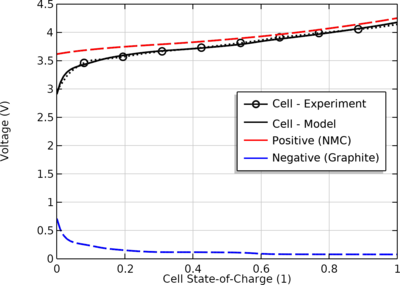
Electrode balancing is an important factor in the design of lithium-ion batteries. In this model, use the experimental open-circuit voltage of a cell and some basic assumptions, followed by an optimization solver, to find a proper electrode balancing. Get more details in this ... Read More

This model presents a way to compute projected area using the Surface-to-Surface Radiation interface of the Heat Transfer Module. By computing illuminated area from a set of directions on a discretized sphere, it is possible to interpolate the projected area onto any angle of incidence. ... Read More

This model compares the solution to the model equations of a tubular reactor using Danckwerts inlet and outlet conditions. A second almost identical model is defined with extra inlet and outlet sections where no reactions occur. The concentration at the beginning of the inlet section is ... Read More

This example exemplifies how to model a Koch snowflake using the Application Builder. A more detailed description of the phenomenon and the modeling process can be seen in the blog post "Using the Application Builder to Create a Koch Snowflake". Read More

This example demonstrates the optimization of fiber orientation in a variable angle tow (VAT) laminate to maximize stiffness under prescribed loading and boundary conditions. The composite laminate consists of a single layer of carbon–PEEK composite with transversely isotropic material ... Read More


