

COMSOL Day: AI for Modeling and Simulation
See what is possible with multiphysics modeling
Join us for COMSOL Day: AI for Modeling and Simulation to learn how AI and machine learning can be used together with multiphysics modeling and simulation.
The technical sessions will cover how the COMSOL Multiphysics® software can be used to generate synthetic simulation data for training AI models, create surrogate models, analyze models using uncertainty quantification, and develop simulation apps and digital twins. We will also look at emerging uses of generative and agentic AI with COMSOL Multiphysics®.
Keynote speakers will share insights from their work and demonstrate how they are incorporating AI into their modeling and simulation workflows. The day will conclude with a panel discussion on current applications and future opportunities for AI in modeling and simulation.
Schedule
Join this session for an overview of COMSOL Multiphysics® and its capabilities for modeling and simulation in a wide range of engineering and scientific applications. In addition to highlighting these capabilities, we will show how physics-based simulation can be used together with AI tools.
We will also preview topics that will be covered in more detail during the COMSOL Day, including the use of synthetic multiphysics data for AI training and generative and agentic AI workflows with COMSOL Multiphysics®.
Multiphysics Modeling of PVT Growth of SiC Crystals Coupled with Data-Driven Process Optimization
Physical vapor transport (PVT) is widely used to grow high-quality silicon carbide (SiC) single crystals for semiconductor applications. The process involves strongly coupled electromagnetic heating, heat transfer, gas phase transport, surface thermodynamics, and source evolution, making modeling and simulation essential for understanding the influence of graphite components and their material properties.
This presentation will introduce a literature-based, industrial-scale PVT reactor model developed in the COMSOL Multiphysics® software. The model combines induction heating, conduction and radiation, porous flow, transport of the main gaseous species Si, SiC₂, and Si₂C, sublimation–recrystallization kinetics, and transient evolution of the SiC source. The results illustrate the competing thermal requirements of the process, the influence of porous-graphite permeability and thermal conductivity on the predicted crystal growth rate, and the increasing importance of source depletion and local recondensation during long growth runs.
The physics-based model is complemented by proprietary SGL Carbon machine-learning and robust-optimization tools developed outside of COMSOL. These tools use internal production data, sensor measurements, and manufacturing recipes to predict and optimize material properties such as permeability and purity. Together, the two approaches link application-side process understanding with targeted graphite-material development.
Physics AI models are only as good as the data used to train them, yet high-quality physics-modeling-based datasets are often scarce, expensive, or difficult to obtain experimentally. In this webinar, we will discuss how the COMSOL Multiphysics® software can be used to generate synthetic data for training physics AI models by simulating single-physics and coupled physics systems for a range of design parameters. There will be simulation examples from structural mechanics, CFD, electromagnetics, acoustics, chemical, and electrochemical engineering.
The presentation will highlight efficient parametric sweeps using design of experiments methods, data extraction, and cluster sweeps, as well as examples of trained physics AI models that can be developed for use in simulation apps, optimization, uncertainty quantification, and digital twins.
To obtain accurate results when designing models, it is important to take uncertainties that occur in real-world scenarios into consideration. By applying probabilistic design, engineers and researchers can look into questions such as how manufacturing tolerances affect the intended performance of a final product and how to prevent the over- and underdesign of devices and processes. The Uncertainty Quantification Module, an add-on to the COMSOL Multiphysics® software, quantifies risk with statistical metrics that are more informative than traditional deterministic methods. Specialized solver technologies and analysis tools are used to expand models and produce more encompassing, accurate, and useful model versions.
Join us in this session to learn about the different methods available in the Uncertainty Quantification Module for performing screening, sensitivity analysis of different parameters, uncertainty propagation analysis, and other types of uncertainty quantification. You will also see how the Uncertainty Quantification Module can be used with any kind of physics simulation, such as structural, chemical, acoustics, fluid flow, and electromagnetics applications.
Developing and Deploying a Deep Neural Operator Digital Twin for Infrastructure System Monitoring
Digital twins are a major advancement in the monitoring and maintenance of industrial and infrastructure systems. These simulations of physical systems are combined with a limited amount of real-world sensor data, offering the possibility of overcoming the invasiveness and the cost constraints of estimating information with conventional measurement devices.
To achieve appropriate prediction speed for deployment in real time, digital twins often use surrogate models trained with machine learning (ML), based on high-precision finite element method (FEM) simulation results. Unfortunately, classical ML models face significant generalization limitations and high sensibility to data quality. However, in the last five years, physics-informed machine learning (PIML) has introduced deep learning approaches with potential to overcome these limitations by incorporating physics knowledge into the deep learning training process. The deep neural operator is a mesh-agnostic PIML model greatly designed to learn the behavior of a physical 3D system over a wide range of conditions.
As a contribution to the uSer-centred civil infrAstructure Reliable Assessment and Healing (SARAH) project, Chiasson-Poirier aims to develop and deploy a digital twin in real time for the structural health monitoring of the supporting pylon of an in-service cable transport system. His keynote talk will focus on the main elements of his model training and validation methodology: combining a deep neural operator surrogate model with training data generated by structural mechanics simulations in COMSOL® across a wide range of conditions and mesh precision; reconstructing the pylon's full internal strain/stress fields based only on local measurements of the strain; and presenting an analysis of preliminary comparative results that demonstrate the advantages of PIML modeling over conventional ML modeling.
Modeling and simulation is no longer limited to the expertise of a few individuals within an organization. The availability of simulation tools throughout the product or process design workflow — from R&D to the factory floor — allows for a more collaborative and innovative approach to problem solving. Now, even those without prior modeling knowledge can contribute to the process, leveraging the expertise of modeling experts and advanced techniques like digital twins and surrogate models.
To facilitate this collaboration, the Application Builder in the COMSOL Multiphysics® software enables modeling experts to create custom apps with user-friendly interfaces that can be employed by scientists and engineers with no modeling experience. In addition, COMSOL Compiler™, an add-on product, enables organization-wide use of standalone simulation apps without licensing restrictions.
By using the Application Builder and COMSOL Compiler™ together with the COMSOL Multiphysics® platform's built-in Model Builder and Model Manager, engineering organizations can establish an efficient, collaborative, simulation-based workflow that is supported by the realistic and predictive capabilities of digital twins and surrogate models.
Join this session to learn how the Application Builder and COMSOL Compiler™ can transform your organization's approach to simulation, making advanced tools accessible and fostering a culture of collaborative innovation.
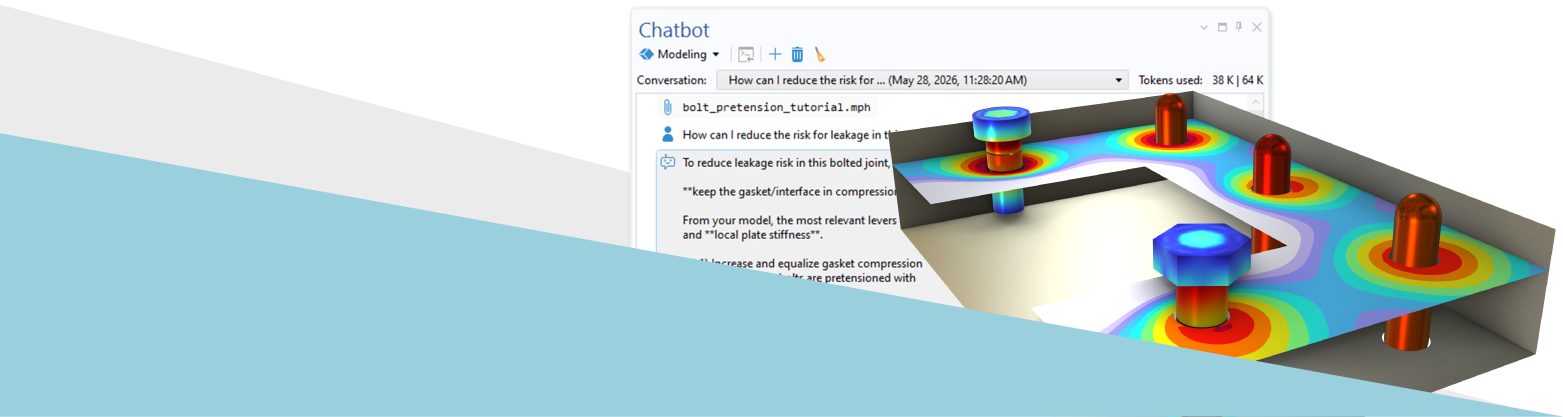
Generative and agentic AI can support engineering simulation by helping users find information, generate code, automate repetitive tasks, and interact with simulation software using natural language. COMSOL Multiphysics® includes tools and programming interfaces that can be used for these types of AI-assisted functions.
The integrated Chatbot window can help generate and debug Java API code, answer questions about modeling features, and review information about model setup. Agentic workflows can extend this functionality by allowing a large language model to create, run, inspect, and evaluate COMSOL models through the COMSOL API.
In this session, we will introduce generative and agentic AI workflows with COMSOL Multiphysics®. We will demonstrate how the Chatbot window can support modeling and programming tasks and show how an AI agent can automate parts of a simulation workflow.
Building D-RAP: A COMSOL Server Digital Twin Ecosystem for Steel Processing
Steel research facilities use physics-based models to interpret experiments, optimize processes, and reduce the cost and risk of physical trials. However, high-fidelity models are often standalone expert tools, which limits their ability to be used across process chains and their accessibility to facility users and external partners.
In this keynote talk, Carlos Moreno from Warwick Manufacturing Group (WMG) at the University of Warwick will discuss how he and his team are developing digital rapid alloy production (D-RAP), an internet-accessible digital-twin ecosystem that includes COMSOL Server. D-RAP brings together research models of hot and cold rolling, run-out-table cooling, continuous annealing, and three-point bending alongside the For-Site model for predicting microstructural evolution and mechanical properties. The digital twins combine structural and thermal simulation with metallurgical models of recrystallization, phase transformation, grain growth, and final properties. Built from WMG research models using Java utility classes and the Application Builder, the applications also use LiveLink™ for MATLAB® where required for calibration, optimization, and data processing. Synthetic data generated from COMSOL simulations can support faster web-based exploration.
COMSOL Server enables browser-based access, centralized application updates, and managed access for researchers and industrial partners. The platform is designed to support process-parameter exploration, comparison with facility measurements, and transfer of material state between process stages. Moreno will cover how it is helping capture WMG modeling knowledge and reduce the risk of physical trials.
The tools available to engineers and researchers for modeling and simulation are changing rapidly. Advances in computing hardware, AI, and numerical methods are making it possible to solve larger models, automate parts of the modeling workflow, and use simulation results in new ways. At the same time, the underlying need to represent the relevant physics and understand the assumptions in a model remains.
In this panel discussion, experts will share their perspectives on how these developments may affect the use of multiphysics simulation in engineering and research. The discussion will cover, for example, AI-enhanced methods for setting up and analyzing models, surrogate modeling and optimization, GPU-accelerated computation, and approaches for working with larger numbers of simulations and simulation-generated data.
Another topic will be how physics-based models can be made useful to those outside of the group that originally developed them. Simulation apps, digital twins, and automated workflows provide different ways of giving more people access to the benefits of multiphysics simulation while retaining the physics and numerical methods on which the models are based. Emerging agentic approaches may provide additional possibilities for interacting with and making use of simulation models.
The panelists will discuss where these technologies are useful today, where there are still limitations, and how the role of the simulation specialist may develop as modeling tools become more automated and more widely used.
Join us for a discussion on how AI tools are changing multiphysics modeling and simulation and what this may mean for users of COMSOL Multiphysics®.
Register for COMSOL Day: AI for Modeling and Simulation
To register for the event, please create a new account or log into your existing account.
You will need a COMSOL Access account to attend COMSOL Day: AI for Modeling and Simulation.
COMSOL Day Details
November 19, 2026 | 10:00 a.m. CET (UTC+01:00)
Keynote Speakers
Laurent Chiasson-Poirier completed his undergraduate degree in mechanical engineering and his master's research in the development of smart MEMS sensors at the University of Sherbrooke, Canada. He has worked as an AI engineer for the last three years at the French Alternative Energies and Atomic Energy Commission's Laboratory for Integration of Systems and Technology (CEA-List) in Grenoble. He is currently pursuing his PhD at the Autonomy and Sensor Integration Laboratory (LAIC) at the CEA's Laboratory of Electronics and Information Technologies (Leti).
Dr. Bojan Jokanović is senior expert in modeling at SGL Carbon, with 20 years of experience in multiphysics simulation, mathematical optimization, and data-driven engineering. His work focuses on combining physics-based modeling, machine learning, and optimization to solve complex industrial problems and support material and process development.
Carlos Moreno is a research fellow in the Advanced Steel Research Centre at the University of Warwick's Warwick Manufacturing Group (WMG). His work focuses on developing physics-based digital twins of steel processing and testing facilities, combining multiphysics simulation with metallurgical models to support process optimization and materials research.
Patrick Namy is the founder and the CEO of SIMTEC (the Marinière team), a leading French COMSOL Certified Consultant. He has a background in mathematics and computer science and is passionate about applying these fields to physics. He particularly enjoys sharing his knowledge with SIMTEC clients to help them become self-sufficient users of COMSOL Multiphysics®.


