
The Application Gallery features COMSOL Multiphysics® tutorial and demo app files pertinent to the electrical, structural, acoustics, fluid, heat, and chemical disciplines. You can use these examples as a starting point for your own simulation work by downloading the tutorial model or demo app file and its accompanying instructions.
Search for tutorials and apps relevant to your area of expertise via the Quick Search feature. Note that many of the examples featured here can also be accessed via the Application Libraries that are built into the COMSOL Multiphysics® software and available from the File menu.
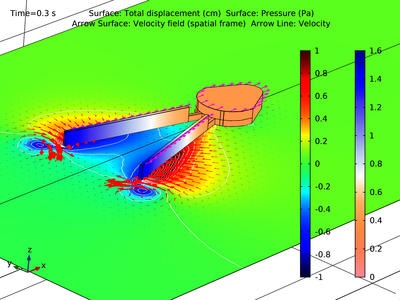
This example illustrates the modeling of a multibody mechanism submerged in a fluid. The mechanism consists of two fins connected to a central rigid body through hinge joints. A transient fluid–structure interaction analysis is performed to simulate the swimming behavior of the ... Read More
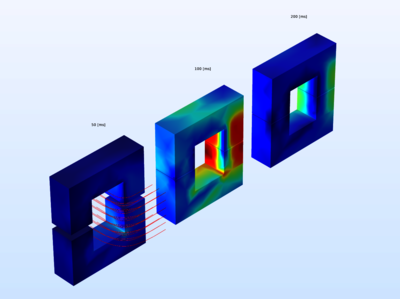
Electrical events, such as an overcurrent or overload, can seriously damage electrical circuits or power lines. To avoid expensive replacements of critical parts, circuit breakers can be installed. These mechanically interrupt the current flow or surge by moving a plunger as soon as a ... Read More
This example illustrates how to model a barrel hinge connecting two solid objects in an assembly. Because the details of the connection are not the focus of the analysis, the hinge is modeled using a Joint feature in the Multibody Dynamics Module. The connected parts can be rigid or ... Read More

This is a benchmark model for flexible multibody dynamics. This model simulates the dynamic behavior of a planar four-bar mechanism when one of the joints has a defect. The out-of-plane motion in the mechanism, caused by the defect in the joint, is compared with the results from the ... Read More
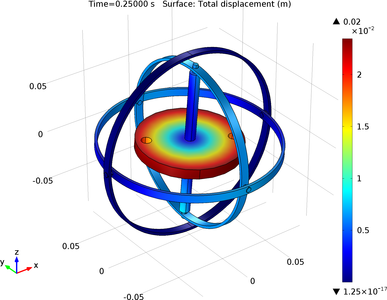
Gyroscopes are used to measure orientation or maintain the stability of vehicles such as airplanes, spacecraft, and submarines. They are also used as sensors in inertial guidance systems. This model demonstrates the modeling of a mechanical gyroscope. It analyzes the response of a ... Read More
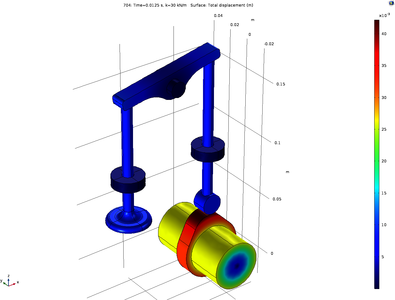
In this example, a spring-loaded valve-opening mechanism consisting of a rocker arm and a radial cam is studied. All of the system components are modeled as rigid and are connected through prismatic, hinge, and slot joints. The cam-follower connection as well as other joint connections ... Read More
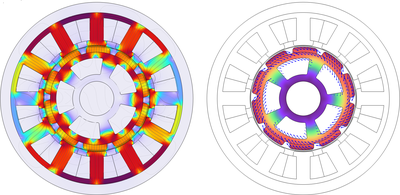
In this example, the coupling between Multibody Dynamics and Rotating Machinery, Magnetic for performing electromagnetic and mechanical analysis is demonstrated. A permanent magnet motor with 10 rotor poles and 12 stator slots is modelled in 2D. The magnets are attached to the ... Read More
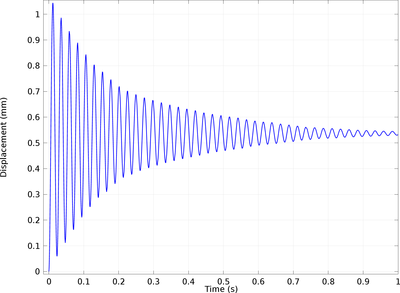
This model studies free and forced vibrations of a deep beam. Eigenfrequency, frequency response, and transient analyses are performed using a Timoshenko beam and the results are compared with analytical solutions. Read More
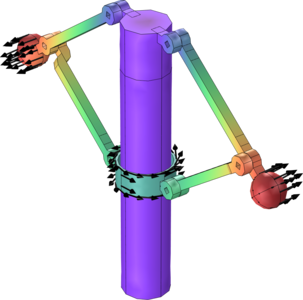
A centrifugal governor is used to control the speed of rotating machinery. One of the most common applications is in controlling the RPM of an engine by regulating the fuel supply. This model illustrates the functioning of a spring loaded centrifugal governor. The dynamics of the ... Read More
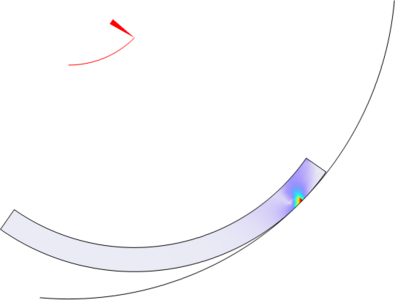
This is a benchmark model involving stick-slip behavior of a ring rolling inside another ring. The displacement of the inner ring is computed and compared to the analytical result. This model also shows how to tackle friction-dominated contact problem. Read More


