
The Application Gallery features COMSOL Multiphysics® tutorial and demo app files pertinent to the electrical, structural, acoustics, fluid, heat, and chemical disciplines. You can use these examples as a starting point for your own simulation work by downloading the tutorial model or demo app file and its accompanying instructions.
Search for tutorials and apps relevant to your area of expertise via the Quick Search feature. Note that many of the examples featured here can also be accessed via the Application Libraries that are built into the COMSOL Multiphysics® software and available from the File menu.
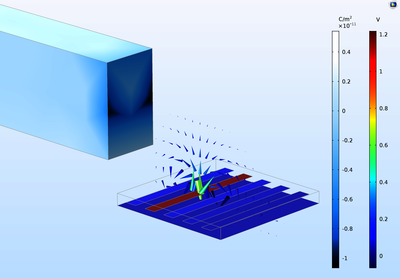
This tutorial model explains how to extract lumped matrices by means of the Stationary Source Sweep study. The capacitance matrix of a five-terminal system is used to infer the position of a metallic object rather like real-world capacitive position sensors. The example illustrates the ... Read More
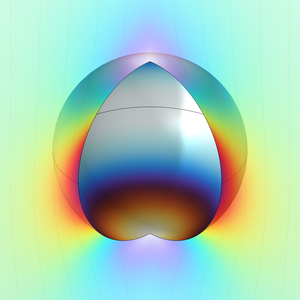
Electroporation is a technique where a localized electric field is used to generate nanometric pores in cell membranes, improving the cell permeability for ions and pharmaceuticals. This model shows the electroporation of a spherical cell by means of a nanosecond electric pulse. The ... Read More
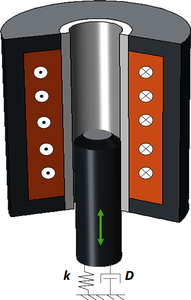
This is a transient model of an electromagnetic plunger consisting of a magnetic core, nonmagnetic guider, multi-turn coil, and magnetic plunger attached to the spring and damper at the far end. The electromagnetic force on the plunger due to the transient current in the coil is ... Read More
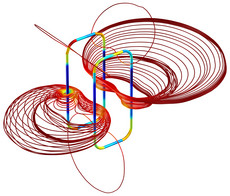
RFIDs are used in a multitude of applications such as tracking or identifying consumer products and their packaging. An RFID system consists of two main parts: A tag or transponder with a printed circuit-board (PCB) antenna A reader unit with a larger RF antennaThe reader antenna ... Read More
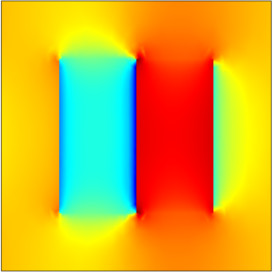
Magnetotellurics is a method for estimating the resistivity profile of the Earth's subsurface using the natural electromagnetic source provided by the ionosphere. This model was defined by Zhdanov et al. in a study published in 1997. In this article, various scientific groups compared ... Read More
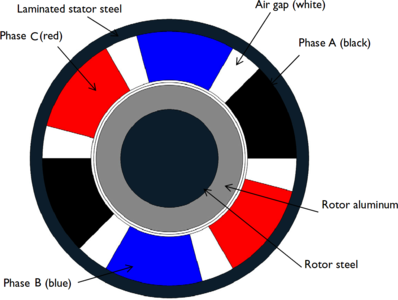
This is an example of a model of an induction motor in which the eddy currents are induced in the rotor by the time harmonic currents on the stator windings and the rotation of the rotor. In this example, we analyze the induction motor in 2D using the transient solver in the Rotating ... Read More

Silicon carbide (SiC) epitaxial furnaces are a specialized equipment for the production and preparation of SiC epitaxial wafers. This example model demonstrates the process of preparing an SiC epitaxial wafer based on the physical vapor transport (PVT) method in a furnace. This involves ... Read More
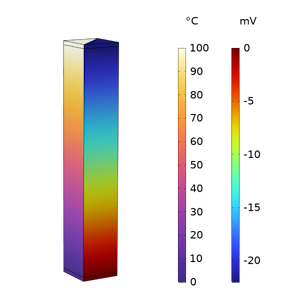
In this model, we show how to model Seebeck effect which works as a thermoelectric generator. Seebeck effect is a phenomena where the difference in temperature of a material leads to a potential difference. The potential drawn in this model was compared with the paper by Jaegle (Example ... Read More
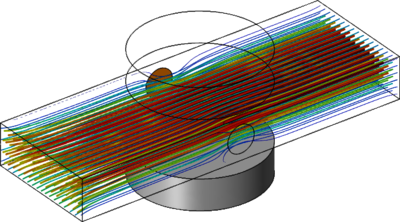
These two models show how to set up a magnetohydrodynamics model using either a fully coupled approach, or a one-way coupled approach. A more detailed description of these models can be seen in the blog post "Building a Magnetohydrodynamic Multiphysics Model in COMSOL®". Read More
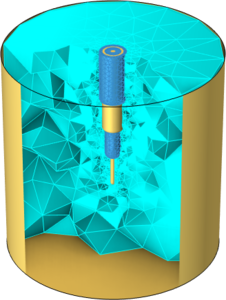
This model compares the results of five different formulations and approaches to solving an RF heating problem consisting of a coaxial cable inserted into a sample of lossy dielectric material. Results show that the different formulations agree over a wide frequency band. To learn more ... Read More


