
The Application Gallery features COMSOL Multiphysics® tutorial and demo app files pertinent to the electrical, structural, acoustics, fluid, heat, and chemical disciplines. You can use these examples as a starting point for your own simulation work by downloading the tutorial model or demo app file and its accompanying instructions.
Search for tutorials and apps relevant to your area of expertise via the Quick Search feature. Note that many of the examples featured here can also be accessed via the Application Libraries that are built into the COMSOL Multiphysics® software and available from the File menu.
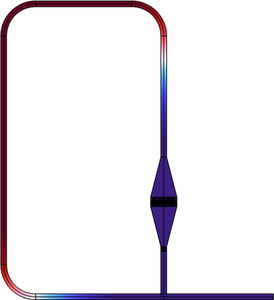
The models simulate the working mechanism of traveling wave thermoacoustic engines. Similary to the standing wave engines, the traveling wave engines make use of the coupling between the fluid motion and the temperature change experienced by the fluid to generate acoustic energy. ... Read More

This tutorial shows an approach to model the acoustic scattering off a submarine including the outer hull. The flooded volumes between the outer hull and the pressure hull are modeled with Pressure Acoustics, Frequency Domain (FEM) and the outside water domains with Pressure Acoustics, ... Read More
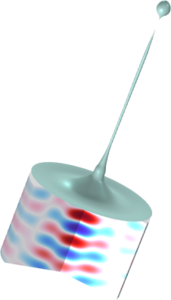
Acoustic droplet ejection is a non-contact, highly controllable method for liquid handling emerging in applications such as printing, biomedical, semiconductor assembly, and mass spectroscopy. The modeling approach assumes separation of acoustic and flow time scales. First, a focused ... Read More
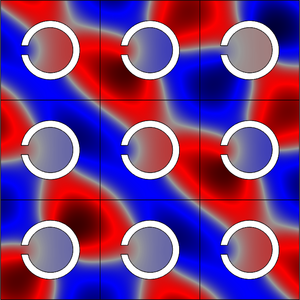
Phononic and sonic crystals have generated rising scientific interest for very diverse technological applications. These crystals are made of periodic distributions of scatterers embedded in a matrix. Under certain conditions, acoustic band gaps can form. These are spectral bands where ... Read More
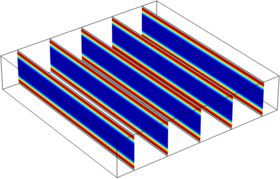
Whenever dimensions in waveguides become small compared to the viscous and thermal boundary layers it is necessary to model acoustics using thermoacoustics. In the present model the thermoacoustic wave field in a shallow uniform waveguide is modeled and compared to an analytical solution. Read More

This model demonstrates how to compute the acoustic properties of an acoustic liner with a grazing flow. The liner consists of eight resonators with thin slits. The background grazing flow is at Mach number 0.3. The sound pressure level above the liner is computed and can be compared to ... Read More
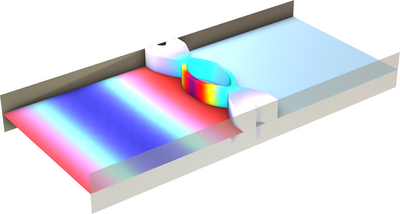
This model demonstrates topology optimization for a problem involving acoustic-structure interaction for a sound partition problem. The objective being to reduce sound transmission for a fixed solid material fraction. The design domain is modeled with a mixed formulation using the Solid ... Read More

Helmholtz resonators are used in exhaust systems, as they can attenuate a specific narrow frequency band. The presence of a flow in the system alters the acoustic properties of the resonator and the transmission loss of the subsystem. In this tutorial model, a Helmholtz resonator is ... Read More


