
The Application Gallery features COMSOL Multiphysics® tutorial and demo app files pertinent to the electrical, structural, acoustics, fluid, heat, and chemical disciplines. You can use these examples as a starting point for your own simulation work by downloading the tutorial model or demo app file and its accompanying instructions.
Search for tutorials and apps relevant to your area of expertise via the Quick Search feature. Note that many of the examples featured here can also be accessed via the Application Libraries that are built into the COMSOL Multiphysics® software and available from the File menu.

The engine block of a car includes a cooling jacket to remove excess heat from combustion. The cooling jacket consists of open spaces in the cylinder block and the cylinder head. When the engine is running, a coolant fluid is pumped through the jacket to keep the engine from overheating. ... Read More
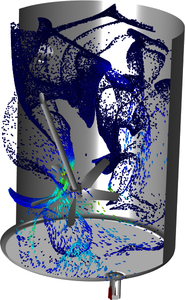
Continuous mixing is used in process equipment to mix components in a single pass. Compared to batch mixing, this operation has the advantage that the tank filling and emptying steps are eliminated, implying that the process can be run without interruptions. A disadvantage of continuous ... Read More
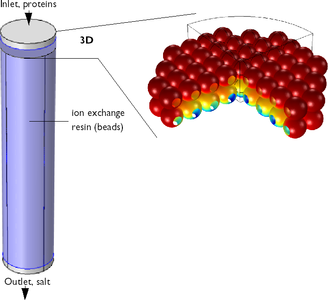
Ion-exchange is a powerful method to separate proteins from solutions and is today readily used in biotechnological and pharmaceutical industry. This model simulates an ion-exchange column for protein adsorption. The fluid phase contains four components: two proteins, solvent, and one ... Read More
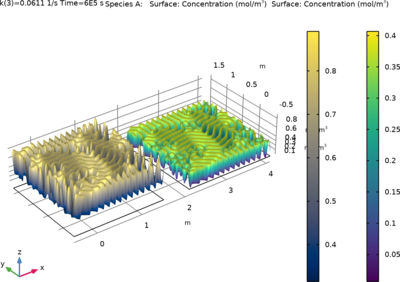
A deceptively simple system of two species and two reactions, describing the autocatalytic conversion of a substance, is shown to display a surprisingly exotic behavior. Starting from a 0D CSTR description, a 2D reaction-diffusion problem is formulated showing rich patterns stemming from ... Read More
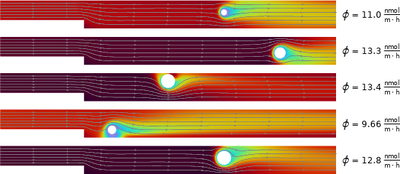
This tutorial illustrates how to use the Uncertainty Quantification (UQ) functionality to answer questions regarding sensitivity and reliability of a flow reactor with thermal decomposition. The tutorial investigates what uncertainties in parameters dominates the survival of a nutrient ... Read More
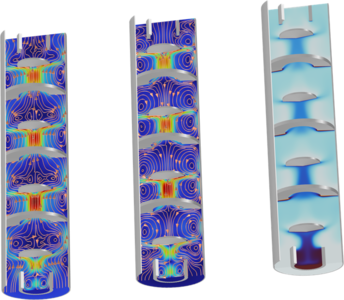
Liquid-liquid extraction is a process used to separate or transfer species between two immiscible liquids. Transfer of species from one phase to the other is driven by a difference in relative solubility. In this model a water filled extraction column is studied. Oil droplets containing ... Read More
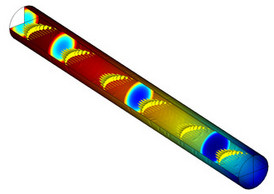
Tubular reactors are often used in continuous large-scale production, for example in the petroleum industry. One key design parameter is the conversion, or the amount of reactant that reacts to form the desired product. In order to achieve high conversion, process engineers optimize the ... Read More
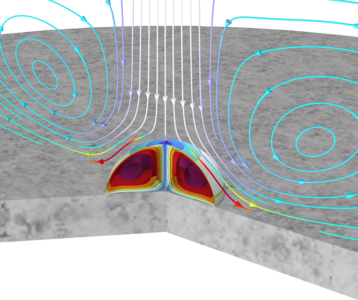
This model describes the evaporation of a droplet that consists of concentrated solution of acetone and water. It accounts for the coupled phenomena of chemical species transport and heat transfer over phase boundaries (liquid-gas boundary) as well as for multiphase flow. The droplet ... Read More


