
The Application Gallery features COMSOL Multiphysics® tutorial and demo app files pertinent to the electrical, structural, acoustics, fluid, heat, and chemical disciplines. You can use these examples as a starting point for your own simulation work by downloading the tutorial model or demo app file and its accompanying instructions.
Search for tutorials and apps relevant to your area of expertise via the Quick Search feature. Note that many of the examples featured here can also be accessed via the Application Libraries that are built into the COMSOL Multiphysics® software and available from the File menu.
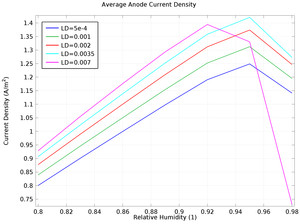
This model simulates atmospheric galvanic corrosion of an aluminum alloy in contact with steel. The electrolyte film thickness depends on the relative humidity of the surrounding air and the salt load density of NaCl crystals on the metal surface. Empirical expressions for the oxygen ... Read More

A simple equivalent circuit model approach is presented for Nickel metal hydride batteries. The 0D model consists of resistor, capacitor, current source and state-of-charge based voltage source (SOC). An Arrhenius type dependence is used to account for self-discharge. All model ... Read More
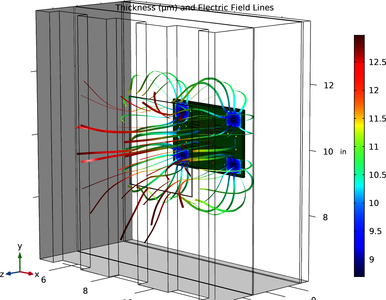
This example simulates electroplating of a printed circuit board (PCB) in 3D using the Secondary Current Distribution interface. In order to achieve thickness uniformity across the PCB, a dummy pattern is included in the design, along with an aperture in the electroplating bath. Read More
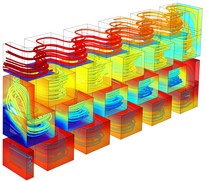
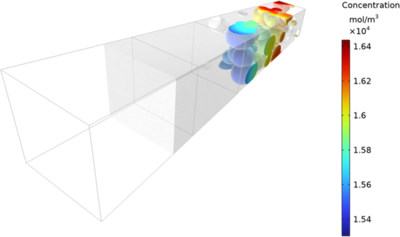
Plate reactors running under continuous conditions have emerged as candidates to replace batch reactors, primarily in fine chemicals and pharmaceuticals production. One of the advantages of the plate reactor design is that it allows for efficient temperature control of the reacting ... Read More
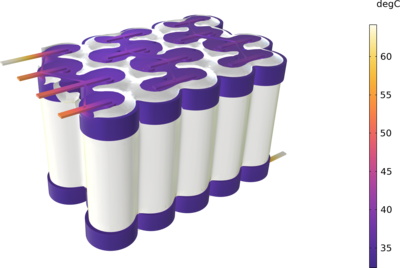
Thermal management of a battery pack is simulated considering two scenarios, air (natural convection) and phase change material (PCM) in the gap between the batteries. The PCM considered is a composite material of paraffin wax and graphite additive. Graphite is typically added for ... Read More
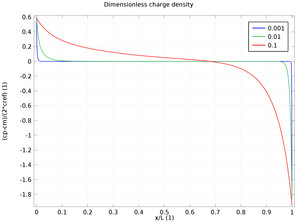
In the diffuse double layer and within the first few nanometers of an electrode surface, the assumption of electroneutrality is not valid due to charge separation. Typically, the diffuse double layer may be of interest when modeling very thin layers of electrolyte including those in ... Read More
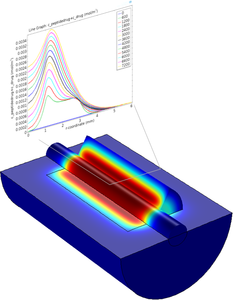
In this example, drug-release from a biomaterial matrix to damaged cell tissue is modeled. Specifically, a nerve guide delivers a regenerating drug to damaged nerve ends. The model involves detailed drug release kinetics, with rate expressions handling drug dissociation/association ... Read More
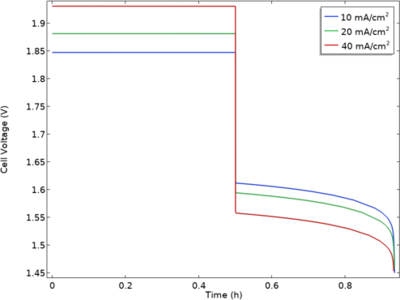
The zinc bromine redox flow battery is an electrochemical energy storage technology suitable for stationary applications. Compared to other flow battery chemistries, the Zn-Br cell potentially features lower cost, higher energy densities and better energy efficiencies. In the cell ... Read More
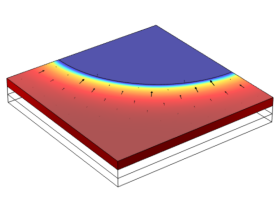
This example extends the Fuel Cell Cathode tutorial to also include liquid water transport in the oxygen electrode. Liquid water is produced using a user-defined expression for vapor condensation, depending on the relative humidity level in the gas phase. An experimental capillary ... Read More
Solid-state batteries (SSB) are a promising technology that could suffer from internal mechanical stresses due to the growth and shrinkage of the electrodes within all-solid components. With this model, the charge-discharge cycling of an SSB is simulated with a focus on the interaction ... Read More


