
The Application Gallery features COMSOL Multiphysics® tutorial and demo app files pertinent to the electrical, structural, acoustics, fluid, heat, and chemical disciplines. You can use these examples as a starting point for your own simulation work by downloading the tutorial model or demo app file and its accompanying instructions.
Search for tutorials and apps relevant to your area of expertise via the Quick Search feature. Note that many of the examples featured here can also be accessed via the Application Libraries that are built into the COMSOL Multiphysics® software and available from the File menu.
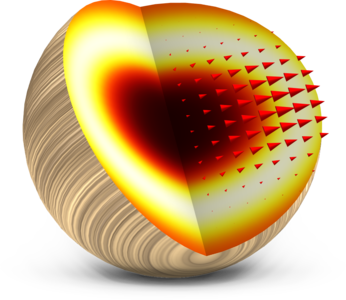
The pyrolysis of a centimeter-sized wood particle presents a fully coupled multiphysics problem with mass transfer, fluid flow, and heat transfer. This example model consists of two parts. The first part demonstrates how to set up a model describing the pyrolysis of a porous, ... Read More
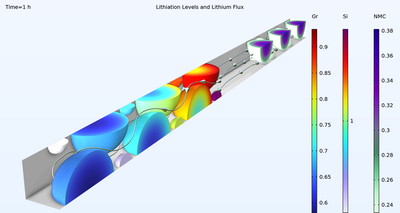
This model describes the behavior of a lithium-ion battery unit cell modeled using an idealized heterogeneous three-dimensional geometry. In contrast to the typical homogenized approach for describing porous electrodes, heterogeneous models define the actual shapes of the electrode ... Read More
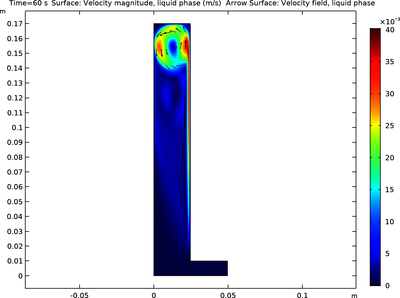
Copper electrowinning is the process of copper extraction from an electrolyte solution and its deposition at the cathode surface, by passing an external current through the electrolytic cell and using an insoluble anode. During the process, oxygen bubbles are generated at the anode ... Read More
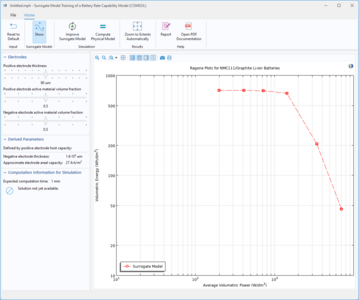
This app demonstrates the usage of a surrogate model function for predicting the rate capability of an NMC111/graphite battery cell. The rate capability is shown in a Ragone plot. The surrogate function, a Deep Neural Network, has been fitted to a subset of the possible input data ... Read More
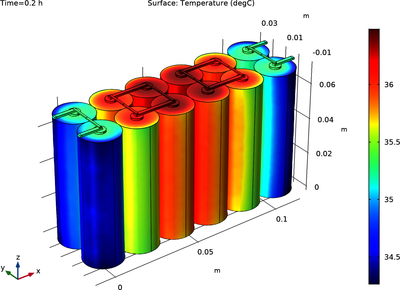
This example demonstrates how to model the temperature distribution in a battery pack during a 4C discharge. The pack is constructed by first coupling two cylindrical batteries in parallel. Six parallel-connected pairs are then connected in series to create the full pack. (This is also ... Read More
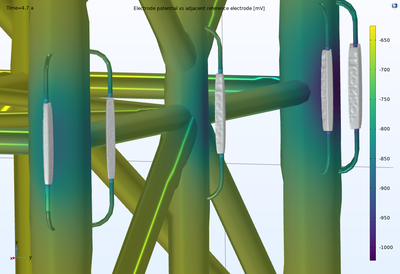
This tutorial models the cathodic protection of an oil rig structure during a time period of 15 years. As a result of the consumption of the sacrificial anodes, the protective capabilities system are reduced over time. The anode shape change in the model is defined by using the Level ... Read More

In a lithium metal battery, lithium metal is deposited during charging on the negative electrode. Mass transport and ohmic effects in the electrolyte cause small protrusions on the metal surface to be subjected to accelerated growth during charging. In worst case scenarios, this leads to ... Read More
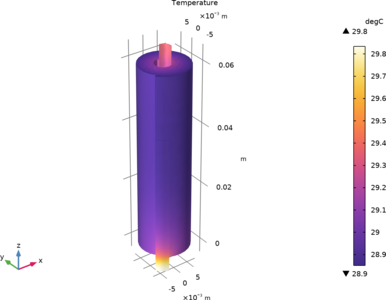
In a cylindrical or prismatic battery cell, the active layers, current collector metal foils and separators are wound into a “jelly roll”. Additional tabs (metal strips) are welded to the current collector foils in order to conduct the current to the exterior of the cell can. The ... Read More


