
The Application Gallery features COMSOL Multiphysics® tutorial and demo app files pertinent to the electrical, structural, acoustics, fluid, heat, and chemical disciplines. You can use these examples as a starting point for your own simulation work by downloading the tutorial model or demo app file and its accompanying instructions.
Search for tutorials and apps relevant to your area of expertise via the Quick Search feature. Note that many of the examples featured here can also be accessed via the Application Libraries that are built into the COMSOL Multiphysics® software and available from the File menu.
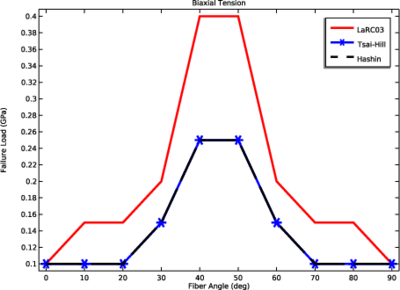
Laminated composite shells made from graphite–epoxy fiber-reinforced plies are widely used in many applications due to their high strength-to-weight ratio. Evaluating their structural integrity under applied loads is essential for ensuring reliable designs. This example demonstrates ... Read More
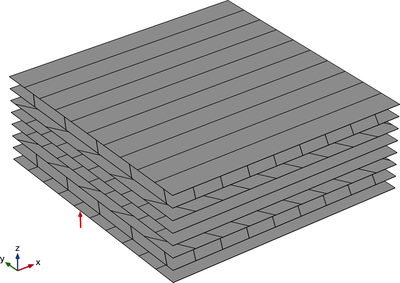
This model serves the purpose of validation and verification of the Linear Elastic Material, Layered model in the Shell interface. In COMSOL Multiphysics, composites are analyzed either based on Layerwise 3D elasticity theory through the Layered Shell interface or based on FSDT-ESL ... Read More

The Highly Accelerated Stress Test (HAST) is a testing technique to precipitate failure of electronic devices under elevated temperature and high humidity environment. This model demonstrates the structural analysis of a plastic encapsulated IGBT module under the HAST testing condition. ... Read More
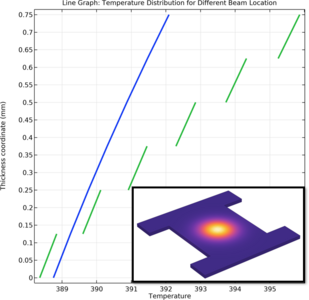
This example uses the thermal expansion of a laminated composite shell model to demonstrate the use of the feature Thermal Contact, Interface, applied on interfaces between layers in a laminated composite shell. The first study is computed neglecting this additional thermal resistance in ... Read More
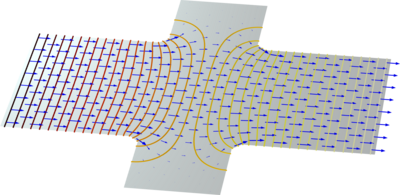
This example uses the Electric Currents in Layered Shells interface and the Layered Shell interface to model a piezoresistive pressure sensor. The tutorial considers the design of the MPX100 series pressure sensors originally manufactured by Motorola Inc. Although the sensor is no ... Read More

This example demonstrates how to model a variable-angle tow (VAT) laminate in which the fiber orientation varies linearly along the global x-direction, with each layer assigned its own fiber angle. The results obtained using the Layered Shell interface are compared with a full 3D ... Read More

This example demonstrates the optimization of fiber orientation in a variable angle tow (VAT) laminate to maximize stiffness under prescribed loading and boundary conditions. The composite laminate consists of a single layer of carbon–PEEK composite with transversely isotropic material ... Read More


