
The Application Gallery features COMSOL Multiphysics® tutorial and demo app files pertinent to the electrical, structural, acoustics, fluid, heat, and chemical disciplines. You can use these examples as a starting point for your own simulation work by downloading the tutorial model or demo app file and its accompanying instructions.
Search for tutorials and apps relevant to your area of expertise via the Quick Search feature. Note that many of the examples featured here can also be accessed via the Application Libraries that are built into the COMSOL Multiphysics® software and available from the File menu.
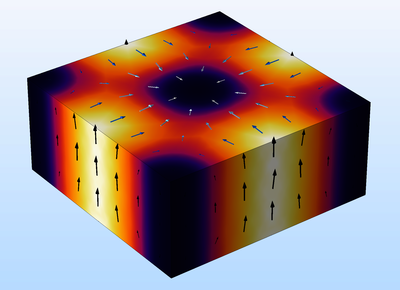
A classic benchmark example in computational electromagnetics is to find the resonant frequency and Q-factor of a cavity with lossy walls. Here, models of rectangular, cylindrical, and spherical cavities are shown to be in agreement with analytic solutions. Read More
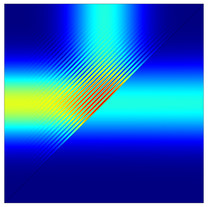
A beam splitter is used to split a single beam of light into two. One way of making a splitter is to deposit a thin layer of metal between two glass prisms. The beam is slightly attenuated within the layer, and split into two paths. In this example, the thin metal layer is modeled using ... Read More
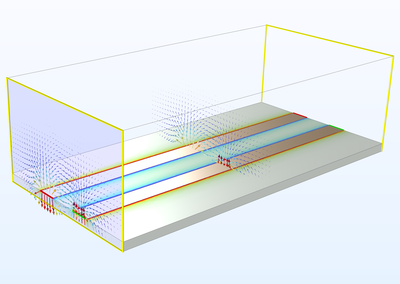
A differential line is composed of two transmission lines excited by two out-of-phase signals. This configuration is known to be useful to enhance signal-to-noise ratio. This example shows how to set up the differential microstrip lines using TEM type ports. Read More
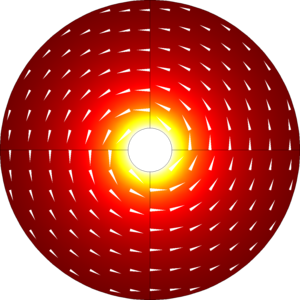
The coaxial cable (coax) is one of the most ubiquitous transmission line structures. It is composed of a central circular conductor, surrounded by an annular dielectric, and shielded by an outer conductor. This model computes the electric and magnetic field distribution inside of the ... Read More
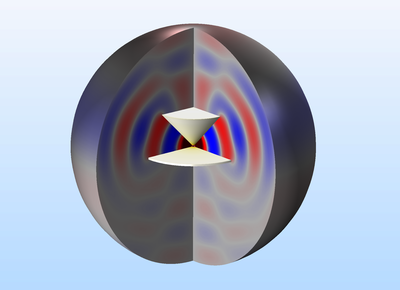
Conical antennas are useful for many applications due to their broadband characteristics and relative simplicity. In this example, we study the antenna impedance and radiation pattern as functions of frequency for a monoconical antenna with a finite ground plane and a 50 ohm coaxial ... Read More
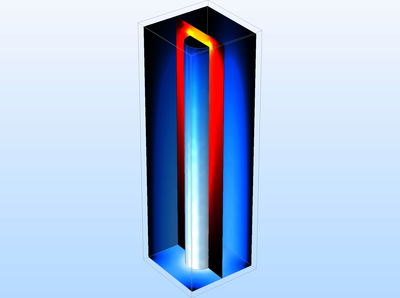
Microwave filters are used to eliminate unwanted frequency components in the output from microwave transmitters. They are typically inserted between a power amplifier and an antenna. The amplifiers are nonlinear and produce harmonics that must be eliminated with filters that have a ... Read More

A large reflector can be modeled easily with the 2D axisymmetric formulation. In this model, the radius of the reflector is greater than 20 wavelengths and the reflector is illuminated by an axial feed circular horn antenna. The simulated far-field shows a high-gain sharp beam pattern Read More
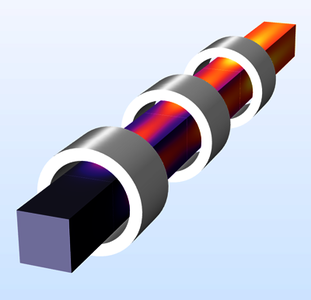
This app demonstrates the following: Geometry parts and parameterized geometries Using tables for user input parameters Visualization on a 2D cross-section of a 3D geometry Improved visualization and user experience when a geometry object (the air object) is hidden. Induction heating ... Read More
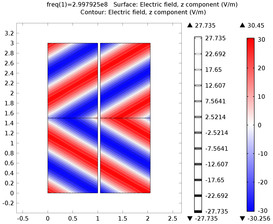
It is possible to engineer the structure of materials such that both the permittivity and permeability are negative. Such materials are realized by engineering a periodic structure with features comparable in scale to the wavelength. It is possible to model both the individual unit cells ... Read More
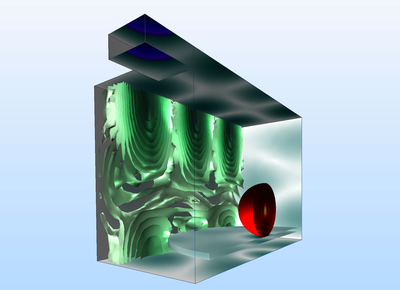
This is a model of the heating process in a microwave oven. The distributed heat source is computed in a stationary, frequency-domain electromagnetic analysis. This is followed by a transient heat transfer simulation showing how the heat redistributes in the food. Read More


