
The Application Gallery features COMSOL Multiphysics® tutorial and demo app files pertinent to the electrical, structural, acoustics, fluid, heat, and chemical disciplines. You can use these examples as a starting point for your own simulation work by downloading the tutorial model or demo app file and its accompanying instructions.
Search for tutorials and apps relevant to your area of expertise via the Quick Search feature. Note that many of the examples featured here can also be accessed via the Application Libraries that are built into the COMSOL Multiphysics® software and available from the File menu.
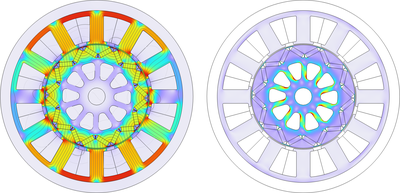
The magnets in an Interior Permanent Magnet (IPM) motor are embedded in the rotor core, where they form narrow regions known as bridges. The thickness of the magnetic bridge is an important parameter to consider in design, both from the electromagnetic and the mechanical perspectives. As ... Read More
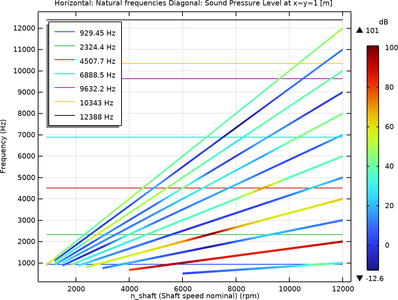
The noise emitted from an electrical machine can have many sources. In this example, acoustic noise from vibrations created by magnetic force variation is studied. Such noise is often audible at twice the excitation frequency but can also occur at higher frequencies or harmonics of the ... Read More
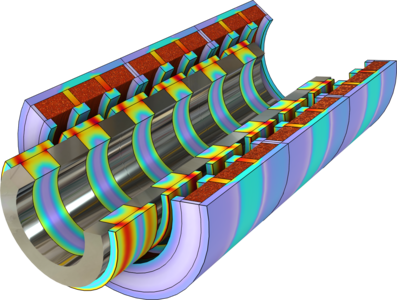
This tutorial shows how to model the tubular permanent magnet generator in 2D axisymmetry. The generator consists of a modular stationary stator and moving/oscillating slider. The stator is made of three-phase multiturn windings and an iron core. The slider is made of permanent magnets ... Read More
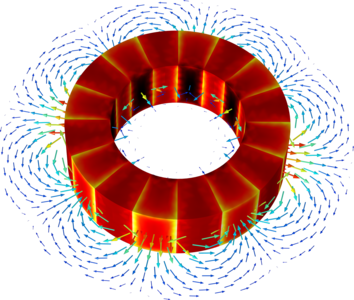
This model presents the static field modeling of an outward flux focusing magnetic rotor using permanent magnets. This magnetic rotor is also often called a Halbach rotor. The use of permanent magnets in rotatory devices such as motors, generators and magnetic gears is increasing. The ... Read More
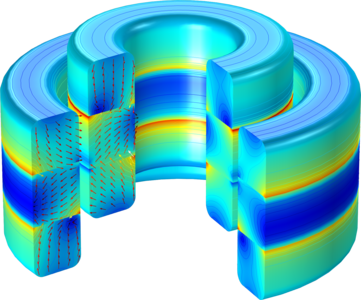
Permanent magnet bearings are used in turbomachinery, pumps, motors, generators, and flywheel energy storage systems, to mention a few application areas; contactless operation, low maintenance, and the ability to operate without lubrication are some key benefits compared to conventional ... Read More
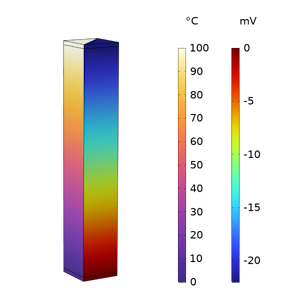
In this model, we show how to model Seebeck effect which works as a thermoelectric generator. Seebeck effect is a phenomena where the difference in temperature of a material leads to a potential difference. The potential drawn in this model was compared with the paper by Jaegle (Example ... Read More
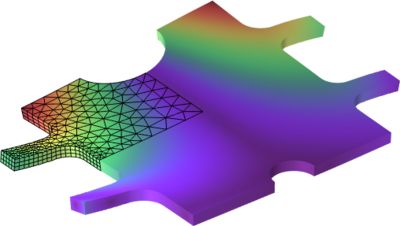
In this tutorial, the vibrational behavior of a small aluminum plate with four waveguide structures is analyzed. This is an example of a structural component located in a device where elastic waves are propagating, like a smart speaker, an electric motor, or a MEMS device. The plate can ... Read More
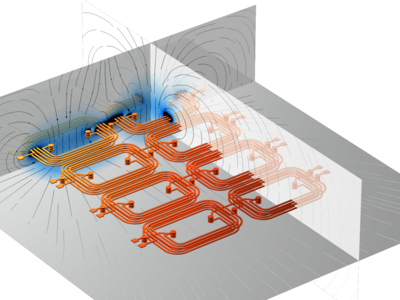
This model demonstrates how to use the Magnetic Fields, Currents Only interface together with the Stationary Source Sweep with Initialization study to compute the inductance matrix of PCB coils with a number of 12. Read More
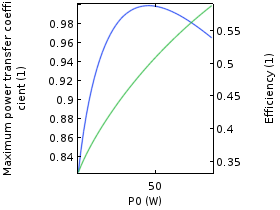
This tutorial drives a capacitively coupled plasma with an L-type matching network at high and low powers. At low power, where the harmonics in the current are low, prefect matching is obtained at the chosen power value. Sweeps over power, frequency, and pressure are performed and their ... Read More
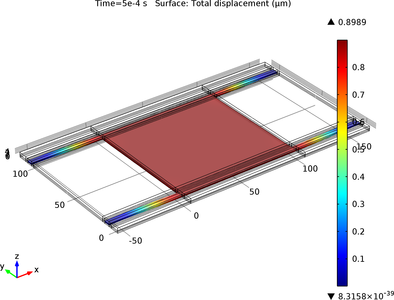
This model analyzes an RF MEMS switch consisting of a thin micromechanical bridge suspended over a dielectric layer. A DC voltage greater than the pull-in voltage is applied across the switch, causing the bridge to collapse onto the dielectric layer with a resulting increase in the ... Read More


