
The Application Gallery features COMSOL Multiphysics® tutorial and demo app files pertinent to the electrical, structural, acoustics, fluid, heat, and chemical disciplines. You can use these examples as a starting point for your own simulation work by downloading the tutorial model or demo app file and its accompanying instructions.
Search for tutorials and apps relevant to your area of expertise via the Quick Search feature. Note that many of the examples featured here can also be accessed via the Application Libraries that are built into the COMSOL Multiphysics® software and available from the File menu.
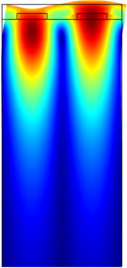
A surface acoustic wave (SAW) is an acoustic wave propagating along the surface of a solid material. Its amplitude decays rapidly, often exponentially, through the depth of the material. SAWs are utilized in many kinds of electronic components, including filters, oscillators, and ... Read More
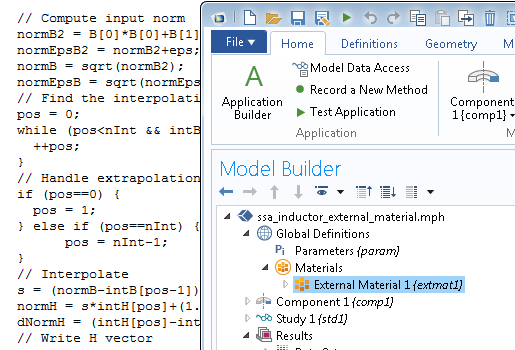
The AC/DC magnetic interfaces support material models defined in external C code. You can access external material functions, written in C code, which have been compiled into a shared library. By writing a wrapper function in C code, you can also use material functions written in another ... Read More

Electromagnetic scattering simulation for an object with continuous rotational symmetry can be performed in 2D axisymmetry instead of 3D to drastically reduce computational time and resources. This model shows how to simulate arbitrary plane wave incidence in 2D axisymmetric models by ... Read More
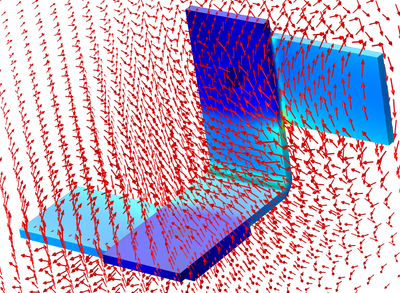
This is a busbar configuration with an AC analysis. The configuration is similar to the introductory tutorial in the book Introduction to COMSOL Multiphysics. However, two conductors are added to represent a more realistic case of magnetic fields surrounding the busbar. The results ... Read More
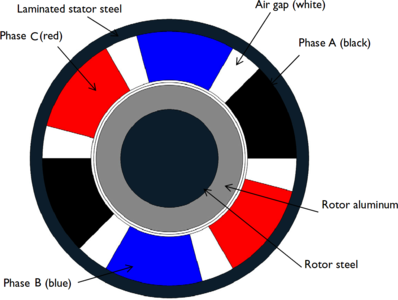
This is an example of a model of an induction motor in which the eddy currents are induced in the rotor by the time harmonic currents on the stator windings and the rotation of the rotor. In this example, we analyze the induction motor in 2D using the transient solver in the Rotating ... Read More
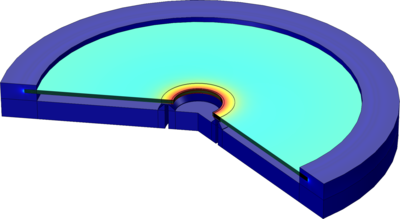
Piezoelectric valves are frequently employed in medical and laboratory applications due to their fast response times and quiet operation. Their energy efficient operation, also dissipates little heat, which is often important for these applications. This model shows how to model a ... Read More

Induction heating is used for various metallurgical processes such as hardening. Here the 3D induction heating of a mechanical joint passing through an induction heating coil is simulated. Curie point effects and temperature dependent resistivity in the iron are taken into account. To ... Read More
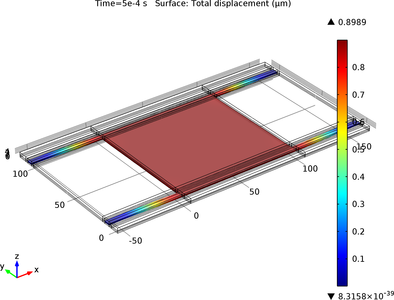
This model analyzes an RF MEMS switch consisting of a thin micromechanical bridge suspended over a dielectric layer. A DC voltage greater than the pull-in voltage is applied across the switch, causing the bridge to collapse onto the dielectric layer with a resulting increase in the ... Read More
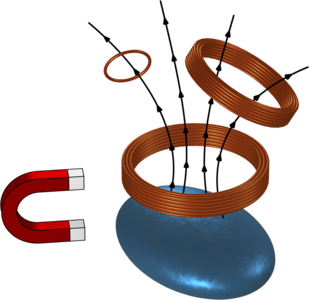
Differential inductance is relevant when a low-frequency electromagnetic system includes magnets, nonlinear magnetic materials, and moving parts. These models present examples of computing the differential inductance and using these within simplified lumped models. To learn more about ... Read More
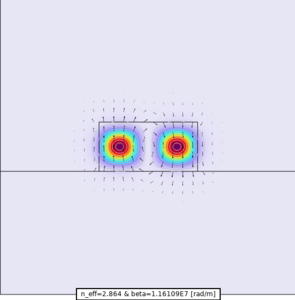
Mode analysis is a basic tool for a wide range of radiofrequency and wave optics calculations because it allows for the investigation of mode characteristics in complex waveguide structures. In this tutorial model, you can find two examples that demonstrate typical settings and best ... Read More