
The Application Gallery features COMSOL Multiphysics® tutorial and demo app files pertinent to the electrical, structural, acoustics, fluid, heat, and chemical disciplines. You can use these examples as a starting point for your own simulation work by downloading the tutorial model or demo app file and its accompanying instructions.
Search for tutorials and apps relevant to your area of expertise via the Quick Search feature. Note that many of the examples featured here can also be accessed via the Application Libraries that are built into the COMSOL Multiphysics® software and available from the File menu.
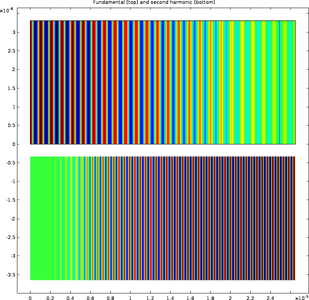
It is more difficult to generate laser emissions in the short-wavelength part of the visible and near visible part of the electromagnetic spectrum than in the long-wavelength part. Nonlinear frequency mixing makes it easier to generate new short wavelengths from existing laser ... Read More
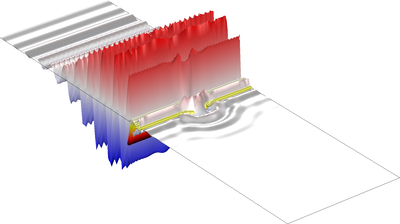
This tutorial shows how to solve the full time-dependent wave equation in dispersive media such as plasmas and semiconductors. The 2D TM in-plane wave model solves for the vector potential from the wave equation and for an auxiliary electric polarization density from an ordinary ... Read More
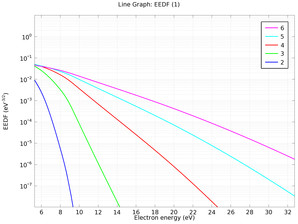
The Boltzmann equation can be solved to validate sets of electron impact collision cross sections. In fact, sets of collision cross sections are traditionally inferred by solving a two-term approximation to the Boltzmann equation and comparing the results to swarm experiments. This model ... Read More
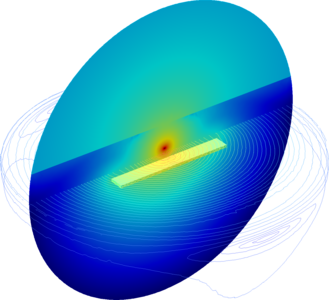
The marine controlled source electromagnetics method (CSEM) for oil prospecting has emerged as a promising technique during recent years. This model demonstrates one variant of it. It uses a mobile horizontal 1 Hz electric dipole antenna that is towed 150 m above the sea floor. An array ... Read More

This is an example of a Fabry-Perot cavity, the simplest optical resonator structure. It is a classical problem in optics and photonics. Two methods are shown for computing the Q-factor. The losses in this model are purely via radiation away from the resonator. Read More
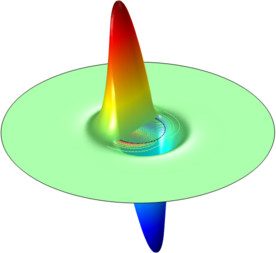
The transmission speed of optical waveguides is superior to microwave waveguides, because optical devices have a much higher operating frequency than microwaves, enabling a far higher bandwidth. This model is an example of a single step-index waveguide made of silica glass. The inner ... Read More
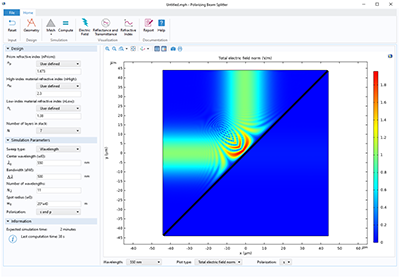
A Gaussian beam is incident on a 45-degree thin-film stack embedded in glass material prisms. The thin-film stack is designed from alternating high and low refractive index materials. The wave will be refracted at the Brewster angle at each internal interface. Thus, mainly p-polarized ... Read More
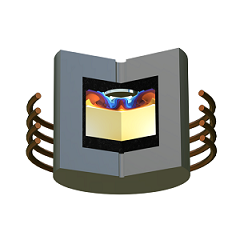
Silicon carbide (SiC) epitaxial furnaces are a specialized equipment for the production and preparation of SiC epitaxial wafers. This example model demonstrates the process of preparing an SiC epitaxial wafer based on the physical vapor transport (PVT) method in a furnace. This involves ... Read More
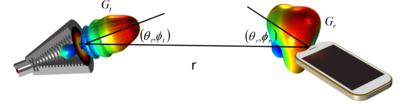
Multiscale modeling is a challenging issue in modern simulation. This occurs when there are vastly different scales in the same model. For example, your cell phone is approximately 10 cm, yet it receives GPS information from satellites 20,000 km away. In these models we examine several ... Read More
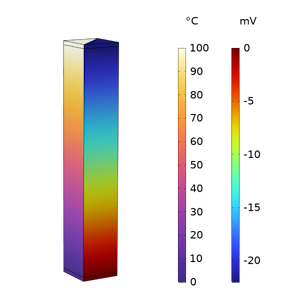
In this model, we show how to model Seebeck effect which works as a thermoelectric generator. Seebeck effect is a phenomena where the difference in temperature of a material leads to a potential difference. The potential drawn in this model was compared with the paper by Jaegle (Example ... Read More


