
The Application Gallery features COMSOL Multiphysics® tutorial and demo app files pertinent to the electrical, structural, acoustics, fluid, heat, and chemical disciplines. You can use these examples as a starting point for your own simulation work by downloading the tutorial model or demo app file and its accompanying instructions.
Search for tutorials and apps relevant to your area of expertise via the Quick Search feature. Note that many of the examples featured here can also be accessed via the Application Libraries that are built into the COMSOL Multiphysics® software and available from the File menu.
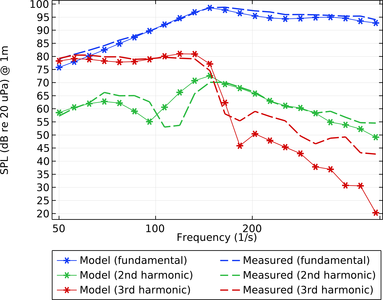
An automotive midwoofer is modeled using the lumped parameter approach. The electrical and mechanical components are modeled using a lumped electric circuit, which is coupled to a finite element model for the acoustics using the Lumped Speaker Boundary feature. The large signal ... Read More
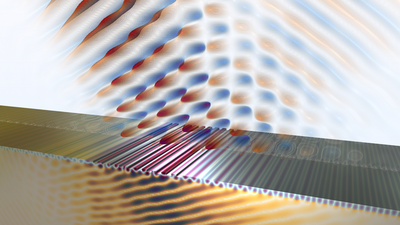
This model simulates the coupling of free-space laser radiation into waveguide modes using an optical grating coupler. The coupling efficiency and the radiation loss are calculated for different angles of incidence of the laser beam. Read More

This example shows an approximate approach to model a dot-in-well solar cell as described by Asahi et al. in the reference paper. The quantum wells and the layers of quantum dots are each treated as lumped energy levels in the band gap. The authors specify transitions between the dot ... Read More
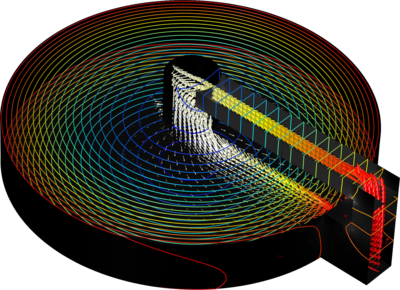
A homopolar generator is composed of an electrically conductive rotating disc placed in a uniform magnetic field that is perpendicular to the plane of rotation. The motion of the conductor through the static magnetic field induces Lorentz currents in the disc. By connecting the outside ... Read More
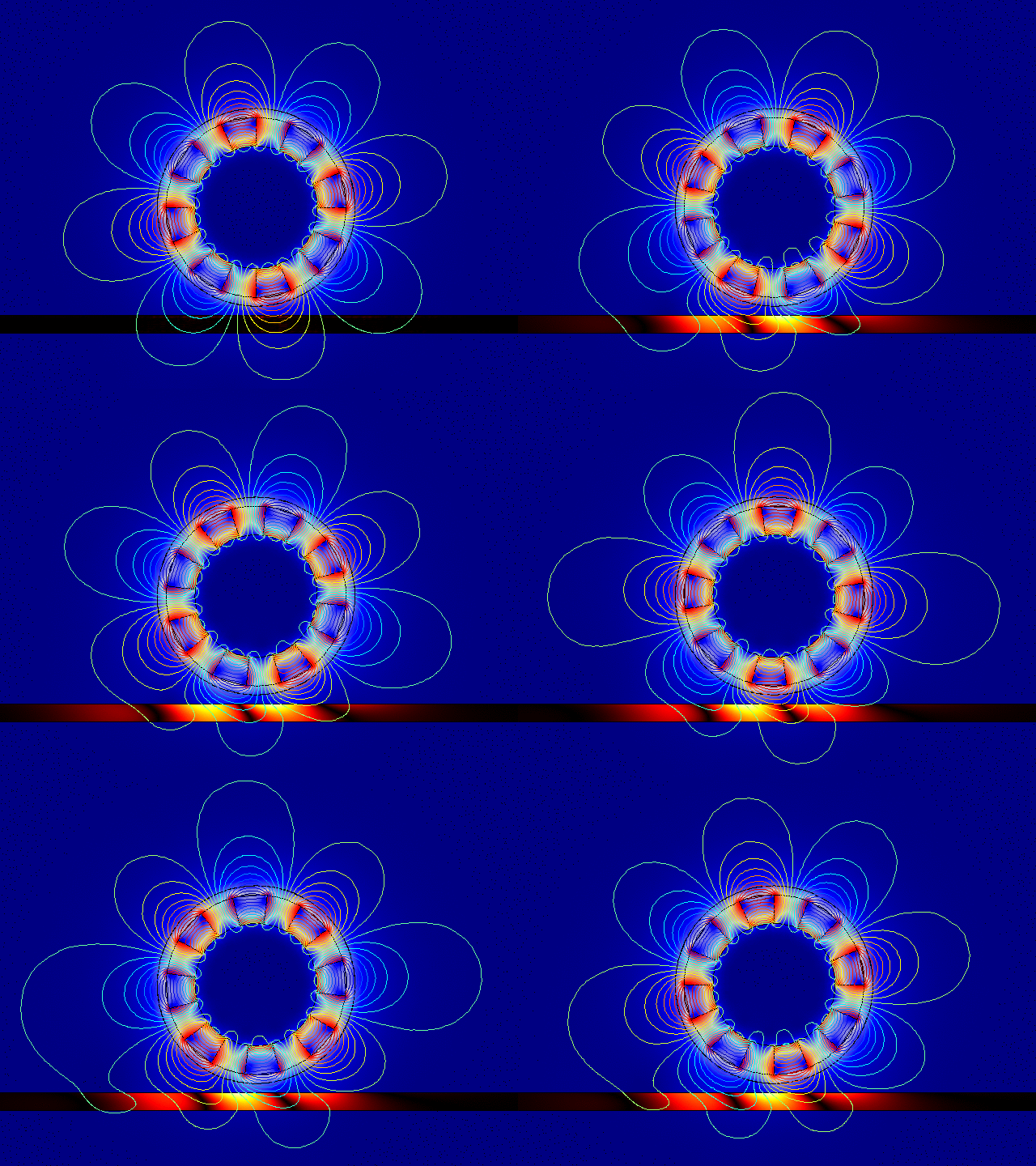
This model illustrates the working principle of an electrodynamic wheel (EDW) magnetic levitation system. EDW magnetic levitation system consists of rotating and/or translationally moving permanent magnet Halbach rotor above a passive conducting guideway/track. Eddy current is ... Read More
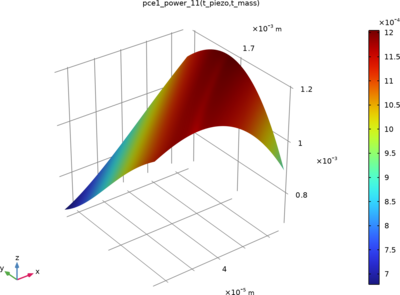
Uncertainty Quantification (UQ) is used to study the effect of manufacturing variation on the performance of Piezoelectric Energy Harvester. This tutorial shows how UQ studies are specified for a frequency domain study that calculates the energy harvester's power output. Read More
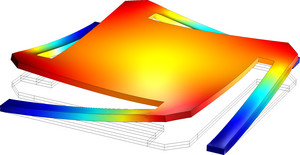
One method of creating spring-like structures or inducing curvature in thin structures is to plate them to substrates that are under the influence of residual stresses. The plating process can control this stress even for similar materials. One such device is the electrostatically ... Read More
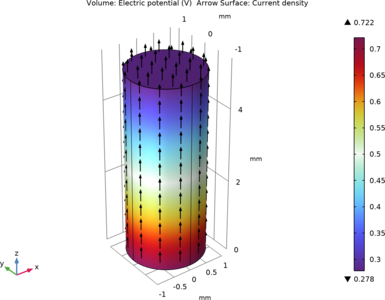
HowTo: Using the EC External I-Terminal The External Couplings in the CIR interface has two flavors that can be used. External I vs. U and External I-terminal. The former has two nodes (it represents a differential external voltage measurement) and when coupling to an EC Terminal ... Read More
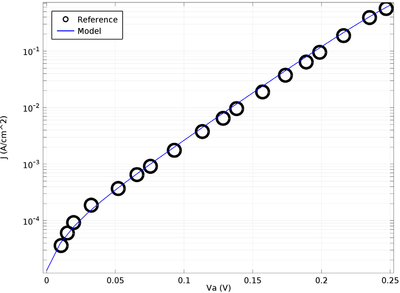
Schottky Contact This benchmark simulates the behavior of an ideal Schottky barrier diode made of a tungsten contact deposited on a silicon wafer. The resulting J-V (current density vs. applied voltage) curve obtained from the model under forward bias is compared with experimental ... Read More
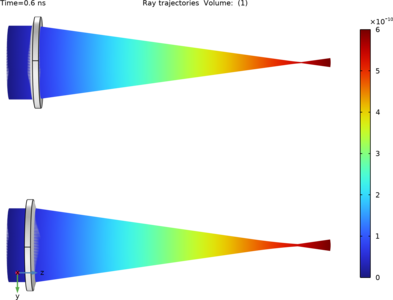
Light collimation or focusing is a basic task often needed when working with lasers in the lab where singlets are used due to their simplicity. If a plano-convex lens is used for the task, there is a correct lens orientation that minimizes aberrations. A useful rule-of-thumb is to ... Read More


