
The Application Gallery features COMSOL Multiphysics® tutorial and demo app files pertinent to the electrical, structural, acoustics, fluid, heat, and chemical disciplines. You can use these examples as a starting point for your own simulation work by downloading the tutorial model or demo app file and its accompanying instructions.
Search for tutorials and apps relevant to your area of expertise via the Quick Search feature. Note that many of the examples featured here can also be accessed via the Application Libraries that are built into the COMSOL Multiphysics® software and available from the File menu.
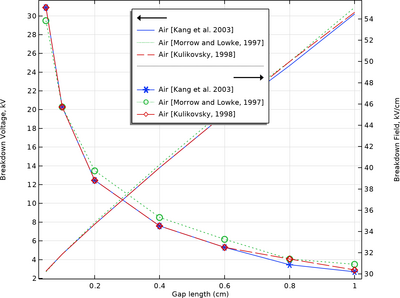
This model calculates the DC breakdown voltage between parallel electrodes in air using a detailed charge transport approach. It is currently one-dimensional for simplicity but can be extended to other gases and dimensions. The results closely match experimental data found in the ... Read More
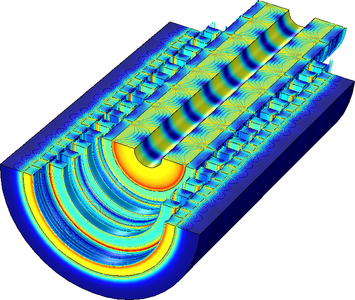
In this model, a linear magnetic gear system with a gear ratio of 11:4 is modeled. The liner magnetic gear is assumed to be infinitely long with the modular structure that is repeating on either side. Only a single modular section is modeled by using the customized linear periodic ... Read More
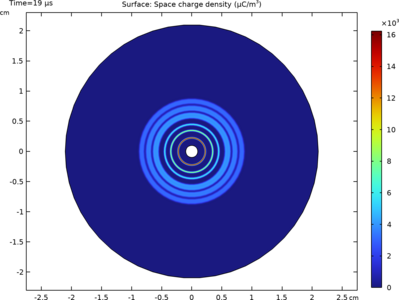
Usually limited to a specific region, corona discharges appear as a consistent luminosity. The attributes of steady glow corona discharges change depending on their polarity. Positive glow corona, also referred to as Hermstein's glow or ultra corona, presents a direct current (DC) aspect ... Read More
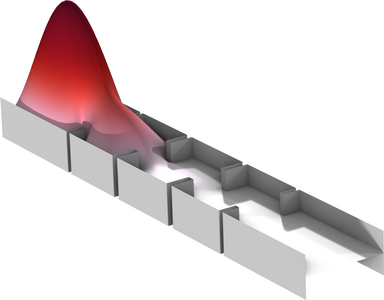
A waveguide filter is designed using shape optimization by moving and scaling rectangles in the geometry. The irises of the initial geometry are optimized to ensure good bandpass response and out-of-band rejection, while maintaining the double mirror symmetry. The EGO optimization solver ... Read More

This model demonstrates a technique for partitioning a mesh based upon the element type. By first meshing with a boundary layer and then partitioning and creating a new mesh, it is possible to avoid modeling the interior volume of inductively heated parts, where the skin depth is small ... Read More
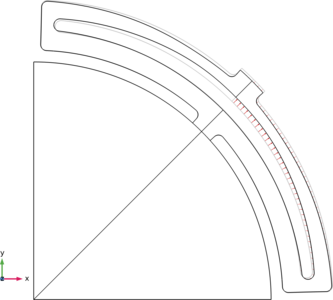
This model demonstrates how to tune the lowest natural frequency of the diaphragm of a MEMS microphone using Shape Optimization. The Stationary then Eigenfrequency study modifies the shape of the suspension springs that support the diaphragm. Although the model is in 3D, shape change is ... Read More

This model simulates the initiation of streamers from suspended metal particles, their propagation under a high electric field, and their subsequent merging. The discharge current flows into the metal particles, which are maintained at equal potential. These suspended particles enhance ... Read More

In this model of a single-beam optical trap, SiO2 nanospheres in streaming water pass by or get captured depending on where they are released from. The electromagnetic force on the particles is calculated in the Electromagnetic Waves, Frequency Domain interface, with a Gaussian ... Read More
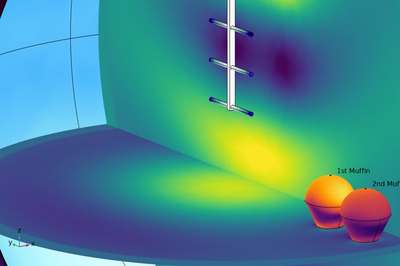
In food industries, microwave heating is gaining attention over a conventional heating treatment because of several advantages such as precise process control, speed of heating, fast turn-on and turn-off time, etc. In this model, a high directional Yagi-Uda antenna is used to heat up ... Read More
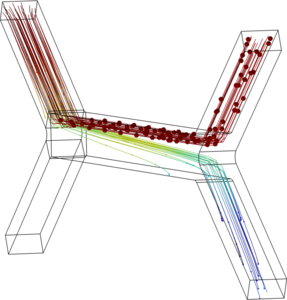
This model demonstrates continuous magnetophoretic separation of particles in a 3D microfluidic Y-channel using a permanent magnet. Separation is achieved through the balance between the magnetophoretic force and hydrodynamic drag. Read More


