
The Application Gallery features COMSOL Multiphysics® tutorial and demo app files pertinent to the electrical, structural, acoustics, fluid, heat, and chemical disciplines. You can use these examples as a starting point for your own simulation work by downloading the tutorial model or demo app file and its accompanying instructions.
Search for tutorials and apps relevant to your area of expertise via the Quick Search feature. Note that many of the examples featured here can also be accessed via the Application Libraries that are built into the COMSOL Multiphysics® software and available from the File menu.
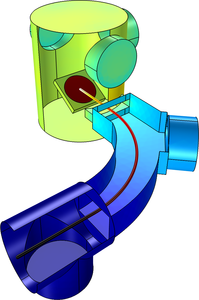
Ion implantation is used extensively in the semiconductor industry to implant dopants into wafers. Within an ion implanter, ions generated within an ion source are accelerated by an electric field to achieve the desired implant energy. Ions of the correct charge state are selected by ... Read More
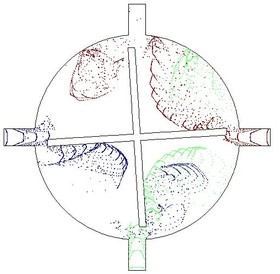
Micromixers can either be static or dynamic depending on the required mixing time and length scale. For static mixers, the Reynolds number has to be suitable high to induce turbulence enhanced mixing. Often micromixers operate in the laminar flow regime due to their small characteristic ... Read More
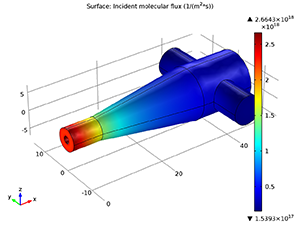
This model computes the transmission probability through an RF coupler using both the angular coefficient method available in the Free Molecular Flow interface and a Monte Carlo method using the Mathematical Particle Tracing interface. The computed transmission probability determined by ... Read More
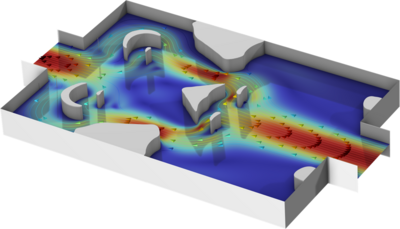
This model performs a topological optimization for a Tesla microvalve. A Tesla microvalve inhibits backwards flow using friction forces rather than moving parts. The design can be optimized by distributing a specific amount of material within the modeling domain. The goal is to maximize ... Read More
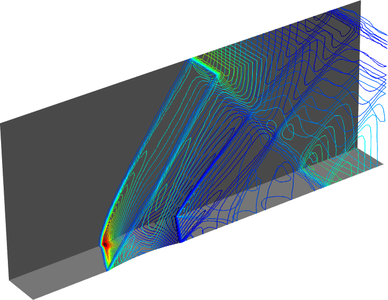
This example models 3D supersonic flow, including the effect of a shock, in a straight channel with a small obstacle on one of the walls. As the flow hits the obstacle, shock waves are diffracted from the obstacle and walls of the channel. The propagating shock waves form a pattern in ... Read More
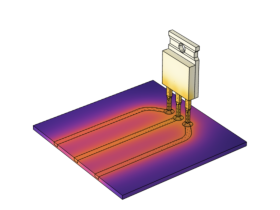
In every system where there is conduction of electric current, and where the conductivity of the material is finite, there will be electric heating. Electric heating, also referred to as Joule heating, is in many cases an undesired by-product of current conduction. This model simulates a ... Read More
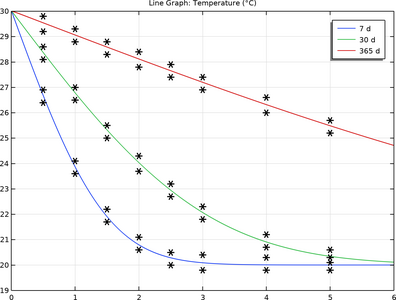
The model is defined as a benchmark case in norm 15026:2007 annex A. The purpose of the model is to calculate the temperature and moisture profiles at different times after a change in the external conditions (temperature and relative humidity) inside a wall material (kind of concrete). ... Read More
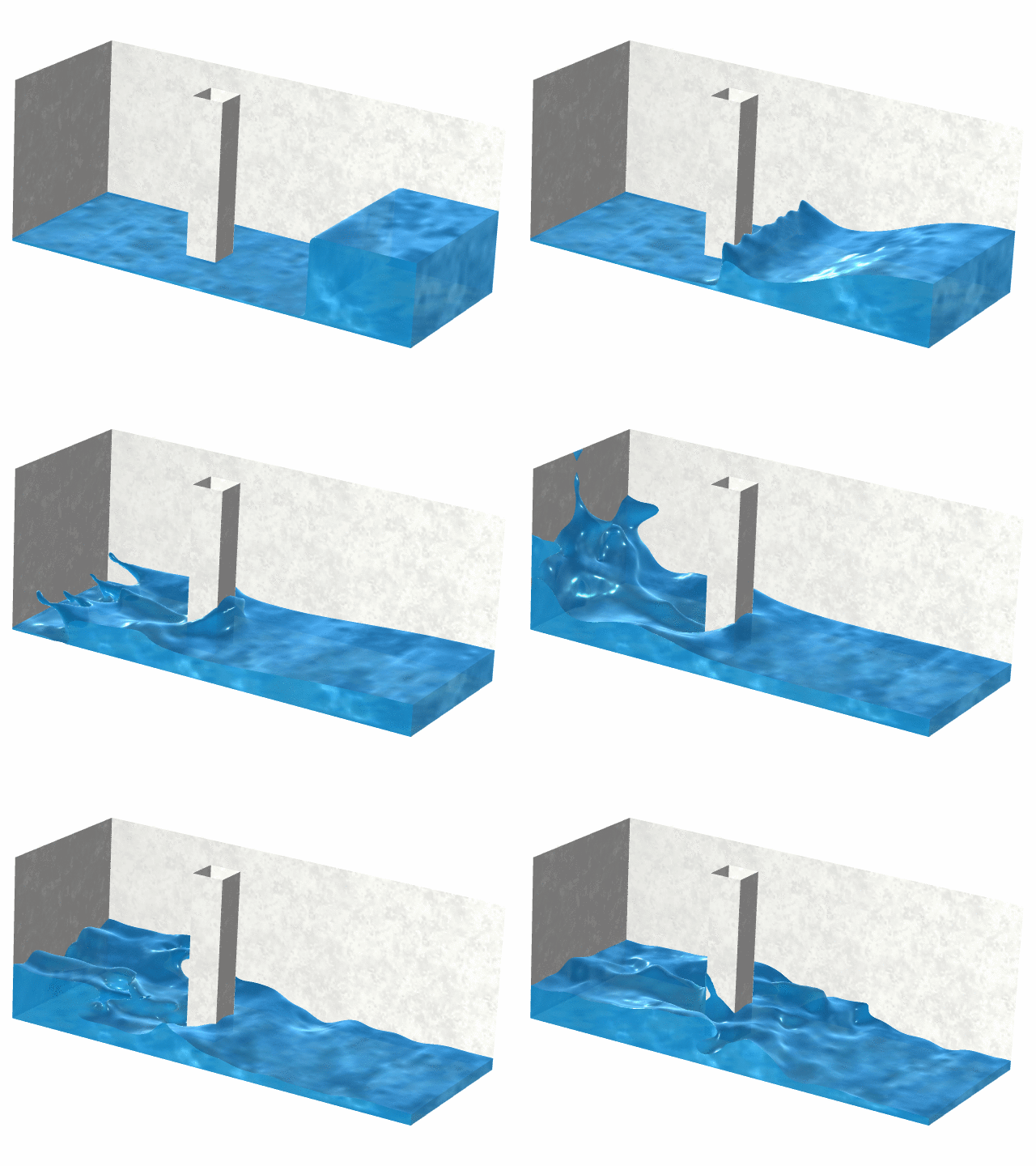
This transient model uses the Two-Phase Flow, Level Set, Laminar Flow interface to model the impact of a water wave on a column. A body of water with a height of 0.3 meters is initially contained behind a gate. At the start of the simulation, the gate is suddenly released and the body of ... Read More
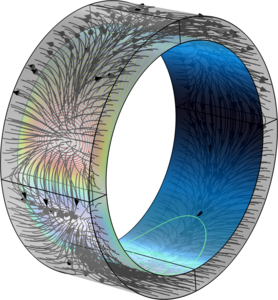
This example describes how to simulate the self-lubricating phenomenon of a liquid lubricant in a journal bearing. A porous bushing is press-fitted to a bearing and saturated with a lubricant. It acts as a reservoir for the redistribution of the thin film of lubricant between regions of ... Read More
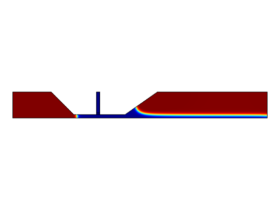
This tutorial shows how to model a slot die coating process with a power-law non-Newtonian fluid in one of the two phases. The model uses a two-phase flow phase-field method. Read More


