
The Application Gallery features COMSOL Multiphysics® tutorial and demo app files pertinent to the electrical, structural, acoustics, fluid, heat, and chemical disciplines. You can use these examples as a starting point for your own simulation work by downloading the tutorial model or demo app file and its accompanying instructions.
Search for tutorials and apps relevant to your area of expertise via the Quick Search feature. Note that many of the examples featured here can also be accessed via the Application Libraries that are built into the COMSOL Multiphysics® software and available from the File menu.
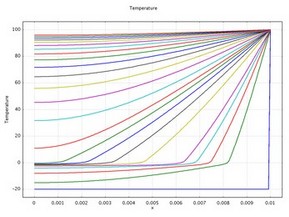
This example demonstrates how to model a phase change and predict its impact on a heat transfer analysis. When a material changes phase, for instance from solid to liquid, energy is added to the solid. Instead of creating a temperature rise, the energy alters the material’s molecular ... Read More
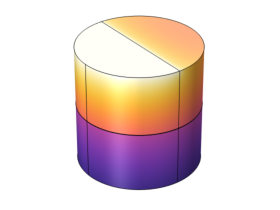
This example shows how to set up multiple sandwiched thin layers with different thermal conductivities in two different ways. First, the composite is modeled as a 3D object. In the second approach, the thin domains are modeled with thermal resistors in the Lumped Thermal System ... Read More
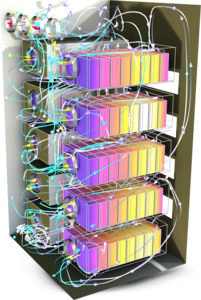
Tutorial model of an air-cooled battery energy storage system (BESS). The model includes conjugate heat transfer with turbulent flow, fan curves, internal screens, and grilles. It features several interesting aspects: Fully parameterized geometry, which can be modified for different ... Read More
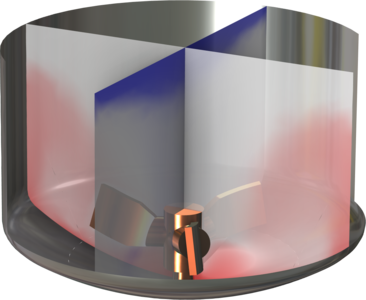
This model simulates the separation and mixing of a suspension with light and heavy particles. Initially the distribution of both particle populations is homogeneous throughout the fluid. Before the impeller starts rotating, the fluid and the two particle populations tend to separate ... Read More
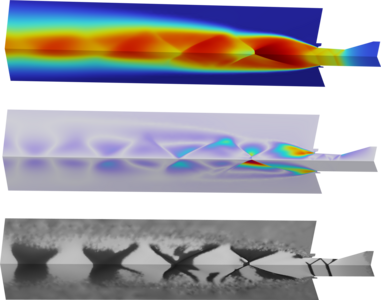
In this example, the High Mach Number Flow, Low Reynolds Number k-e interface is used to compute the compressible turbulent flow from a rectangular nozzle. Mesh refinement based on the estimation of the shock strength and the shear-layer strength is employed to achieve appropriate ... Read More
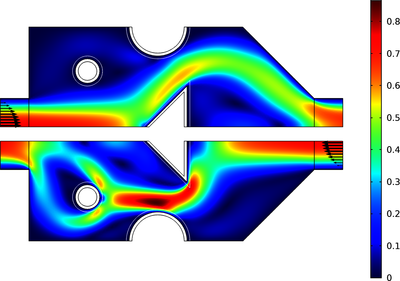
The topology optimized Tesla microvalve is used as inspiration for a parametrized geometry. The optimization of this geometry takes erosion and dilation of the geometry into account by optimizing over a parametric sweep. In this example the optimization is driven by the worst of the 3 ... Read More
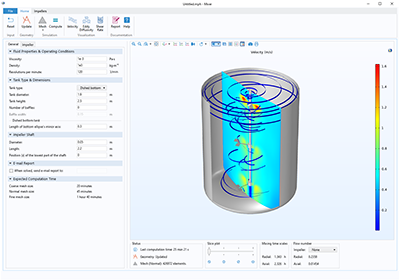
This app demonstrates the following: Multiple tabs in the ribbon Geometry parts and parameterized geometries Parts and cumulative selections can be used to automatically set domain and boundary settings in the embedded model Adding or removing geometry parts with different geometrical ... Read More
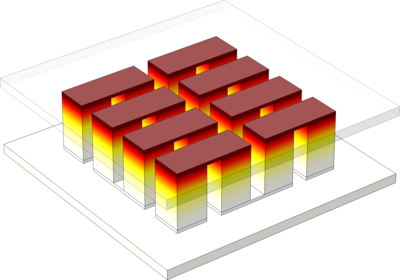
This app demonstrates the following: Visualizing material appearance, color, and texture Showing info below the graphics about geometry parameters, results and performance depending on the selected plot action Thermoelectric coolers are widely used for electronics cooling in various ... Read More

Centrifugal pumps are used in various applications and can be found in many industries. The size of the pump in this model is typical for automotive applications. This model shows how to set up rotating machinery simulations using the frozen rotor approximation for modeling centrifugal ... Read More
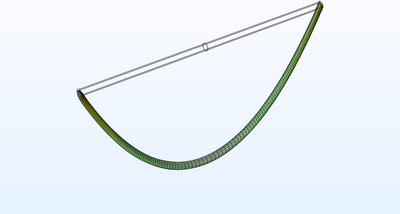
The catenary is the geometrical shape that corresponds to the curve followed by an idealized chain or cable supported at both ends and hanging under its own weight. The viscous catenary problem describes the motion of a cylinder of highly viscous fluid, supported at its ends as it flows ... Read More


