
The Application Gallery features COMSOL Multiphysics® tutorial and demo app files pertinent to the electrical, structural, acoustics, fluid, heat, and chemical disciplines. You can use these examples as a starting point for your own simulation work by downloading the tutorial model or demo app file and its accompanying instructions.
Search for tutorials and apps relevant to your area of expertise via the Quick Search feature. Note that many of the examples featured here can also be accessed via the Application Libraries that are built into the COMSOL Multiphysics® software and available from the File menu.

In this time-dependent model, a silica block of glass, coated with a thin copper layer is subjected to a heat flux. Copper is a highly conductive material, while the silica glass is of poor thermal conductivity, which sets up an highly-varied temperature differential. The model must ... Read More
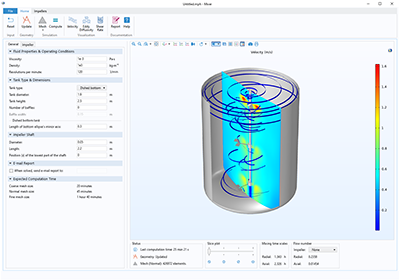
This app demonstrates the following: Multiple tabs in the ribbon Geometry parts and parameterized geometries Parts and cumulative selections can be used to automatically set domain and boundary settings in the embedded model Adding or removing geometry parts with different geometrical ... Read More
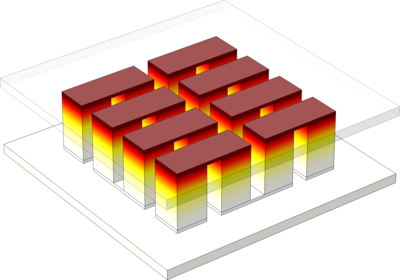
This app demonstrates the following: Visualizing material appearance, color, and texture Showing info below the graphics about geometry parameters, results and performance depending on the selected plot action Thermoelectric coolers are widely used for electronics cooling in various ... Read More
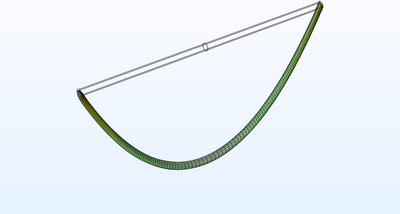
The catenary is the geometrical shape that corresponds to the curve followed by an idealized chain or cable supported at both ends and hanging under its own weight. The viscous catenary problem describes the motion of a cylinder of highly viscous fluid, supported at its ends as it flows ... Read More
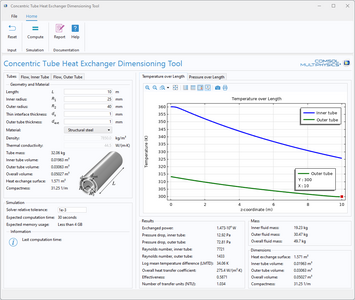
This app demonstrates the following: Selecting predefined or user-defined materials User option to switch between laminar flow or turbulent flow Changing boundary conditions using methods Visualizing temperature dependent material properties as graph plots User option to set the solver ... Read More
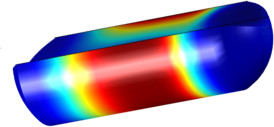
This example describes the operation of a drug delivery system that supplies a variable concentration of a water soluble drug. A droplet with a fixed volume of water travels down a capillary tube at a constant velocity. Part of the capillary wall consists of a permeable membrane ... Read More
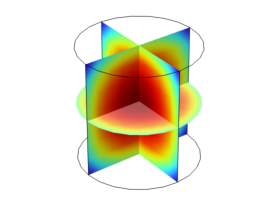
These models use the Discrete Ordinates method (DOM) and P1 approximation to solve a 3D radiative transfer problem in an emitting, absorbing, and linear-anisotropic scattering finite cylindrical medium. Using the S6 quadrature of DOM leads to accurate results, which are needed in ... Read More
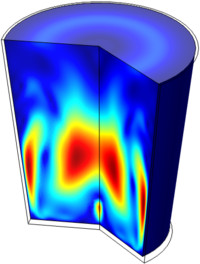
This model treats the free convection and heat transfer of a glass of cold water heated to room temperature. Initially, the glass and the water are at 5 °C and are then put on a table in a room at 25 °C. The nonisothermal flow is coupled to heat transfer using the Heat Transfer module. Read More
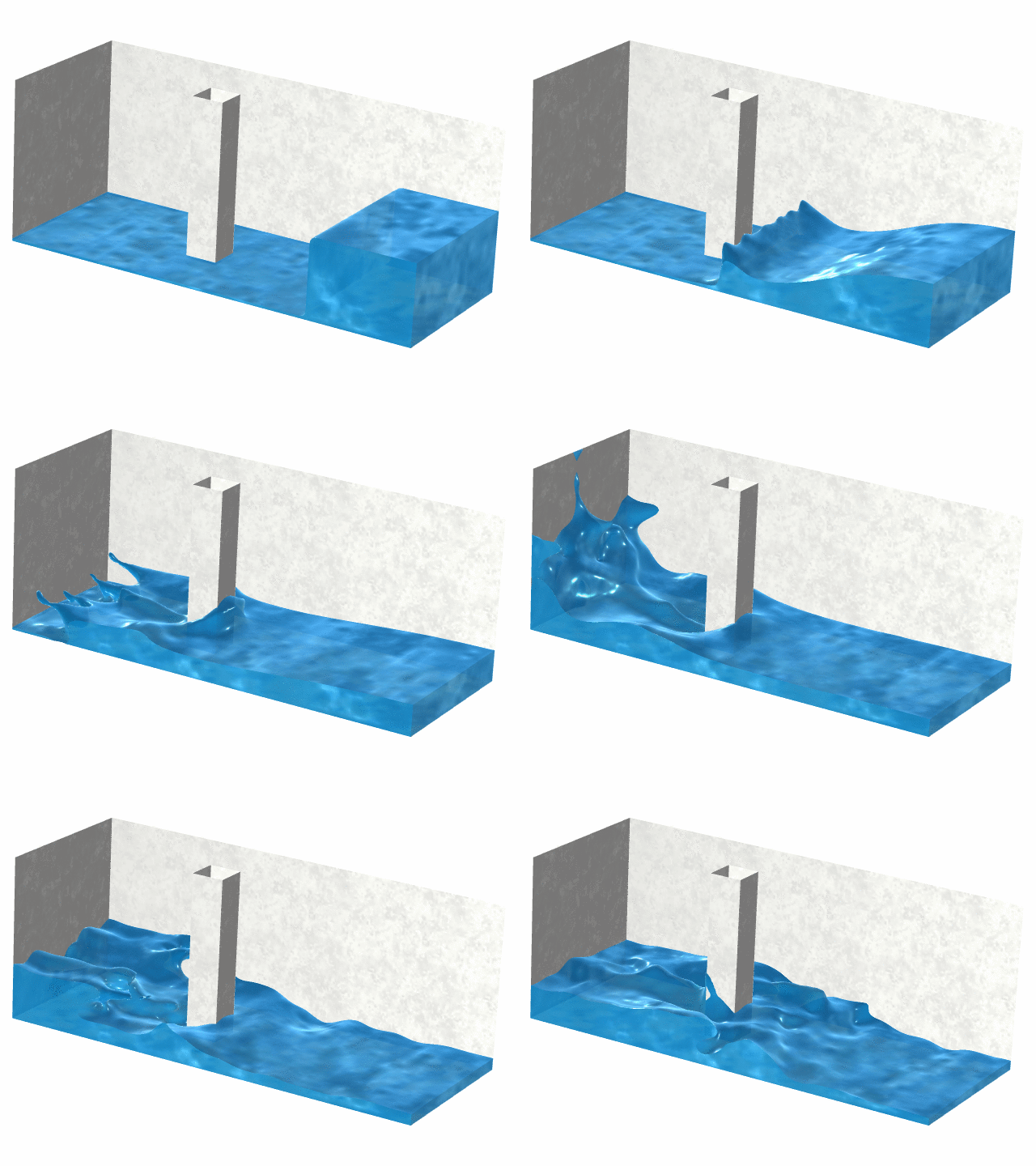
This transient model uses the Two-Phase Flow, Level Set, Laminar Flow interface to model the impact of a water wave on a column. A body of water with a height of 0.3 meters is initially contained behind a gate. At the start of the simulation, the gate is suddenly released and the body of ... Read More
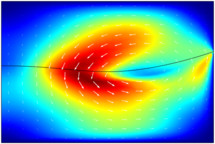
The contact angle of a two-fluid interface with a solid surface is determined by the balance of the forces at the contact point. In electrowetting the balance of forces at the contact point is modified by the application of a voltage between a conducting fluid and the solid surface. In ... Read More


