
The Application Gallery features COMSOL Multiphysics® tutorial and demo app files pertinent to the electrical, structural, acoustics, fluid, heat, and chemical disciplines. You can use these examples as a starting point for your own simulation work by downloading the tutorial model or demo app file and its accompanying instructions.
Search for tutorials and apps relevant to your area of expertise via the Quick Search feature. Note that many of the examples featured here can also be accessed via the Application Libraries that are built into the COMSOL Multiphysics® software and available from the File menu.

This model is used on "Heat Transfer with Radiation in Participating Media and the Discrete Ordinates Method" to compare quadrature sets used in the method of discrete ordinates. To assess the performance of quadrature sets in complex geometries, results of incident irradiation and ... Read More
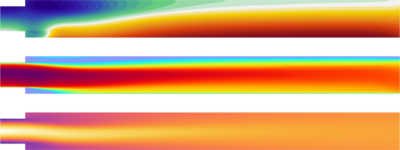
Turbulent flow, Elliptic Blending R-ε interface is used to analyze fully developed turbulent flow in a spanwise rotating channel. Due to the influence of Coriolis force on turbulence, profiles of the flow variables are skewed at moderate rotation rate. The asymmetry between cyclonic ... Read More

This study presents a two-stage discrete element method (DEM) simulation of thermal conduction in compressed granular materials. In the first stage, a granular bed composed of spherical grains is mechanically compacted by applying a constant pressure of 20 kPa through a downward moving ... Read More

This model demonstrates the filtration of grains of three different sizes as they pass through two vibrating sieves of different hole sizes. Read More
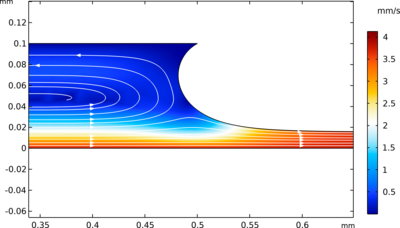
Free-surface calculations in the predefined flow interfaces are currently limited to time-dependent studies when using the built-in boundary conditions. Here, a stationary formulation following Romero et al. [1] is implemented using equation contributions. The attached slides describe ... Read More

This model presents a way to compute projected area using the Surface-to-Surface Radiation interface of the Heat Transfer Module. By computing illuminated area from a set of directions on a discretized sphere, it is possible to interpolate the projected area onto any angle of incidence. ... Read More
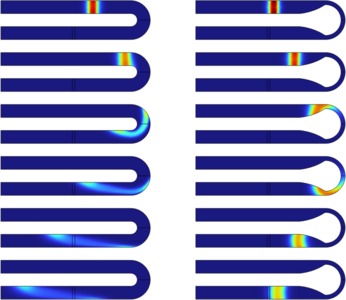
As an analyte band flows through a curved channel in an electroosmotically driven flow, dispersion of the band occurs due to gradients in the fluid velocity across the channel. These velocity gradients result from differences in the electric field acting at the walls within the curved ... Read More

At the bottom of an oil well, the pressure and temperature can differ significantly from those at the surface. As the oil mixture flows upward and the pressure decreases, phase changes may occur. At the wellbore inlet, the mixture may already contain both liquid and gas phases. ... Read More
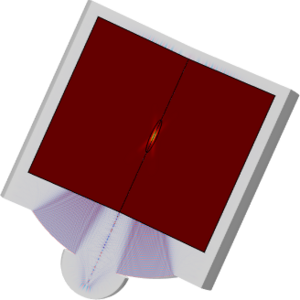
This model analyzes the uncertainty in focused ultrasound induced tissue heating. The material properties for the tissue mimicking material, including the uncertainty, are taken from the FDA Medical Device Development Tool: Tissue Mimicking Material (TMM) for Preclinical Acoustic ... Read More
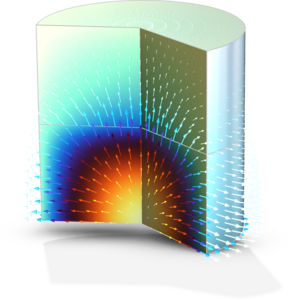
Thermally induced transformations in solids may be modeled by using an Arrhenius law to express the dependence on temperature of the transformation rate. This tutorial model shows how to use the Irreversible Transformation subfeature, available under the Solid feature of the Heat ... Read More


