
The Application Gallery features COMSOL Multiphysics® tutorial and demo app files pertinent to the electrical, structural, acoustics, fluid, heat, and chemical disciplines. You can use these examples as a starting point for your own simulation work by downloading the tutorial model or demo app file and its accompanying instructions.
Search for tutorials and apps relevant to your area of expertise via the Quick Search feature. Note that many of the examples featured here can also be accessed via the Application Libraries that are built into the COMSOL Multiphysics® software and available from the File menu.
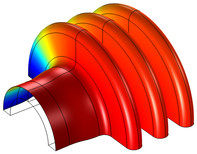
A cooling flange in a chemical process is used to cool the process fluid, which flows through the flange. The surrounding air cools the flange via natural convection. In the stationary model, the forced convection to the process fluid is modeled using a constant heat transfer ... Read More
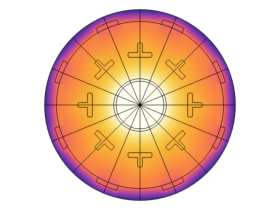
This model illustrates an application that maximizes surface-to-surface radiative fluxes and minimizes conductive heat fluxes. A thermo-photo-voltaic (TPV) cell generates electricity from the combustion of fuel and through radiation. The fuel burns inside an emitting device that ... Read More
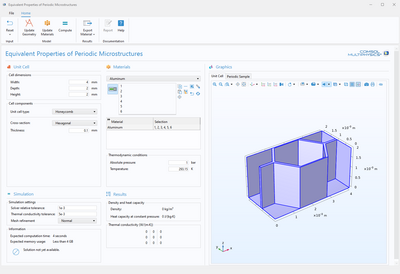
This app demonstrates the following: Visualization of a periodic structure from a unit cell Resetting some or all input parameters Export the resulting material properties as an MPH-file or an XML-file that can be imported to a COMSOL Multiphysics session Periodic microstructures are ... Read More
This tutorial shows how to use the Surface-to-Surface Radiation interface to simulate radiative heat transfer with radiation between diffuse emitters and diffuse-and-specular reflectors. This model is separated in two parts. The first part focuses on a validation test for the radiative ... Read More
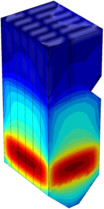
This model uses the discrete-ordinates method (DOM) to analyze the radiative heat transfer in a utility boiler with internal obstacles. DOM is one of the most useful radiation models for prediction of radiative heat fluxes on the furnace walls of a combustion chamber. With this model, ... Read More
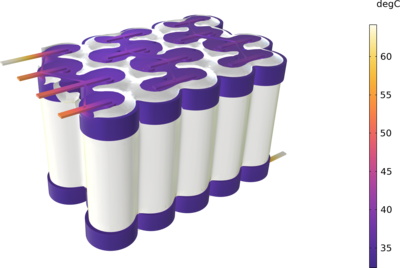
Thermal management of a battery pack is simulated considering two scenarios, air (natural convection) and phase change material (PCM) in the gap between the batteries. The PCM considered is a composite material of paraffin wax and graphite additive. Graphite is typically added for ... Read More
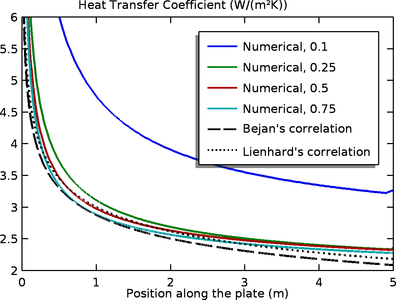
This verification model of nonisothermal turbulent flow over a flat plate compares the heat transfer coefficient obtained from simulation with theoretical values based on Nusselt number correlation functions that can be found in the literature. Read More
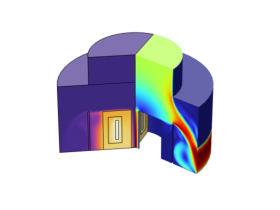
The inductor is a common component in a variety of electrical devices. Its applications include power transformation and measurements, and it can also be used together with capacitors to create oscillators. In small devices with many components, such as in laptops, heat generation can ... Read More


