
The Application Gallery features COMSOL Multiphysics® tutorial and demo app files pertinent to the electrical, structural, acoustics, fluid, heat, and chemical disciplines. You can use these examples as a starting point for your own simulation work by downloading the tutorial model or demo app file and its accompanying instructions.
Search for tutorials and apps relevant to your area of expertise via the Quick Search feature. Note that many of the examples featured here can also be accessed via the Application Libraries that are built into the COMSOL Multiphysics® software and available from the File menu.
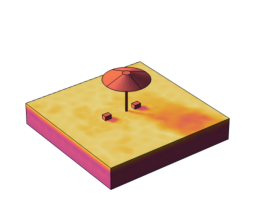
This tutorial model illustrates how to analyze the thermal effects of the sun as an external radiative source and considers wavelength-dependent surface emissivities. Specifically, the model features two coolers containing beverage cans that are exposed to ambient conditions and a beach ... Read More
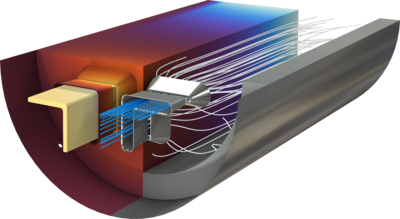
In massive forming processes like rolling or extrusion, metal alloys are deformed in a hot solid state with material flowing under ideally plastic conditions. Such processes can be simulated effectively using computational fluid dynamics, where the material is considered as a fluid with ... Read More
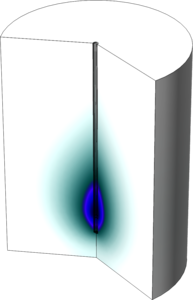
Electromagnetic heating is ideally suited for modeling in COMSOL Multiphysics. This model shows the area of hyperthermic oncology but the modeling issues and techniques are generally applicable to any problem involving electromagnetic heating. The purpose of this model is to compute the ... Read More
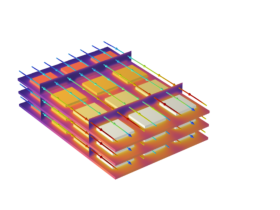
The suite of models examine the air cooling of circuit boards populated with multiple integrated circuits (ICs), which act as heat sources. Two possible cooling scenarios are depicted: vertically aligned boards using natural convection, and horizontal boards with forced convection (fan ... Read More
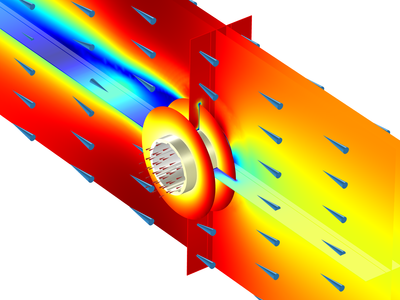
This app demonstrates the following: Geometry parts and parameterized geometry A results table form object containing outputs Finned pipes are used for coolers, heaters, or heat exchangers to increase heat transfer. They come in different sizes and designs depending on the ... Read More
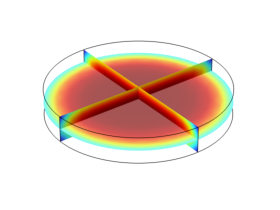
When producing glass, the glass melt is cooled down through radiation to form the final shape, subjecting it to stresses. Numerical treatment of radiative heat transfer, using the Radiative Transfer Equation (RTE), helps to optimize this process. COMSOL Multiphysics provides three ... Read More
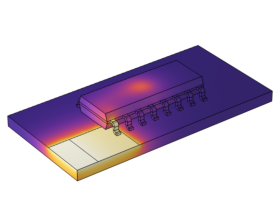
All integrated circuits (ICs) — especially high-speed devices — produce heat. In today’s dense electronic system layouts, heat sources are many times placed close to heat-sensitive ICs. Designers of printed circuit boards often need to consider the relative placement of heat ... Read More
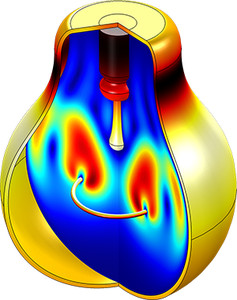
This model treats the free convection of argon gas within a light bulb. It shows the coupling of heat transport (conduction, radiation and convection) to momentum transport (non-isothermal flow) induced by density variations caused by temperature. COMSOL Multiphysics model makes it ... Read More
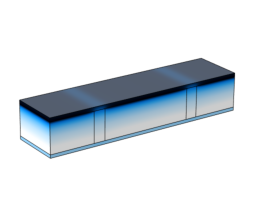
This 2D stationary model computes heat and moisture transport in a wall composed of different hygroscopic materials. A comparison with the Glaser method is given for the temperature and relative humidity solutions. The effect of the use of a vapor barrier is also investigated. Read More
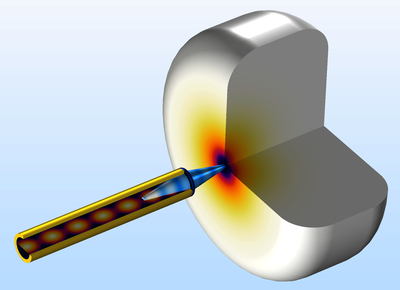
The response of a millimeter wave with frequencies of 35 GHz and 95 GHz is known to be very sensitive to water content. This model utilizes a low-power 35 GHz Ka-band millimeter wave and its reflectivity to moisture for noninvasive cancer diagnosis. Since skin tumors contain more ... Read More


