
The Application Gallery features COMSOL Multiphysics® tutorial and demo app files pertinent to the electrical, structural, acoustics, fluid, heat, and chemical disciplines. You can use these examples as a starting point for your own simulation work by downloading the tutorial model or demo app file and its accompanying instructions.
Search for tutorials and apps relevant to your area of expertise via the Quick Search feature. Note that many of the examples featured here can also be accessed via the Application Libraries that are built into the COMSOL Multiphysics® software and available from the File menu.
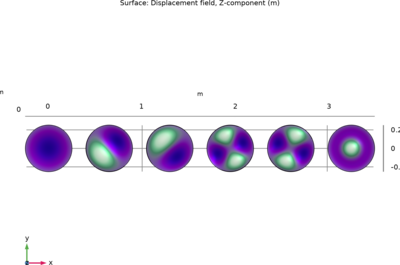
This example studies the natural frequencies of a pretensioned membrane exhibiting stress stiffening. The model results are compared with the analytical solution. Two different techniques for generating the prestress are explored. Read More
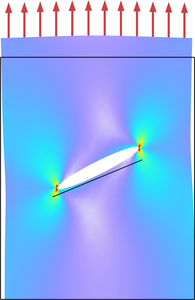
This example reproduces a NAFEMS benchmark in which a plate with an angle crack is subjected to tensile loading. The J-integral is calculated and the stress intensity factors for Mode I and Mode II are compared to the benchmark results for several crack angles. Read More
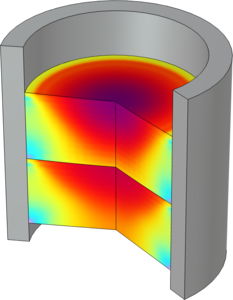
Powder compaction is a key process in powder metallurgy, where it gives the flexibility to produce quality products of complex shapes for sintering. The density of the compact is a key factor to determine the overall quality of the sintered product, as regions with lower density could ... Read More

This version of the balloon inflation example demonstrates how the Shell and Membrane interfaces can be used to model thin structures made of hyperelastic materials. The example is identical to the Model Library model 'Inflation of a spherical rubber balloon', except that the Membrane ... Read More
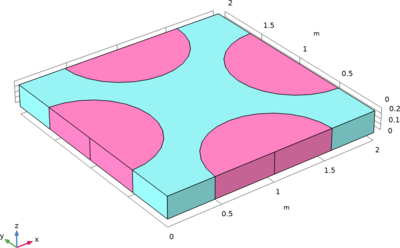
In this example, the micromechanical properties of a piezoelectric fiber composite are studied. The homogenized electromechanical properties of the composite are derived from the individual microscopic properties of matrix and fiber. Read More

The powder compaction process is becoming common in the manufacturing industry, thanks to its potential to produce components of complex shape and high strength. In this example, the compaction of iron powder to form an axisymmetric rotational flanged component is analyzed with capped ... Read More
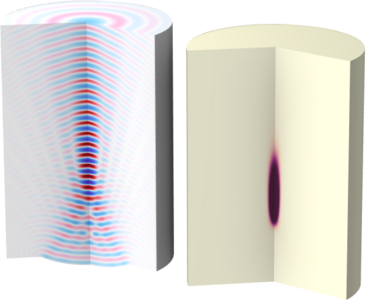
This tutorial studies tissue heating induced by high-intensity focused ultrasound (HIFU). The nonlinear propagation of the HIFU signal is modeled using the Nonlinear Pressure Acoustics, Time Explicit physics interface. In this example, the source amplitude is sufficient to generate ... Read More
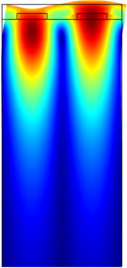
A surface acoustic wave (SAW) is an acoustic wave propagating along the surface of a solid material. Its amplitude decays rapidly, often exponentially, through the depth of the material. SAWs are utilized in many kinds of electronic components, including filters, oscillators, and ... Read More
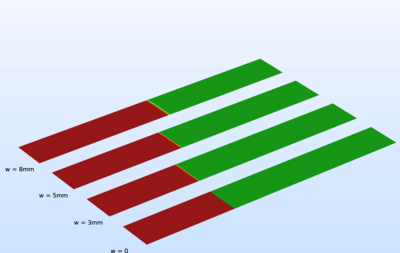
Interfacial failure or delamination in a composite material can be simulated with a cohesive zone model (CZM). A key ingredient of a cohesive zone model is a traction-separation law that describes the softening in the cohesive zone near the delamination tip. This example shows the ... Read More
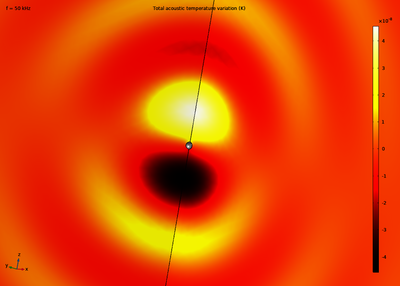
This tutorial simulates a small vibrating hemispherical particle in water. The particle has a radius of 1 mm and is oscillating in the axial direction at a frequency of 50 kHz. The vibrations induce acoustic waves in the fluid. The example demonstrates how to set up a thermoviscous ... Read More


