
The Application Gallery features COMSOL Multiphysics® tutorial and demo app files pertinent to the electrical, structural, acoustics, fluid, heat, and chemical disciplines. You can use these examples as a starting point for your own simulation work by downloading the tutorial model or demo app file and its accompanying instructions.
Search for tutorials and apps relevant to your area of expertise via the Quick Search feature. Note that many of the examples featured here can also be accessed via the Application Libraries that are built into the COMSOL Multiphysics® software and available from the File menu.

Stimulated Brillouin Scattering (SBS) describes a nonlinear interaction between light and sound. In optical fibers, SBS can be detrimental for power or communication purposes, but can be leveraged for sensing applications. The SBS gain spectrum quantifies the optic-acoustic mode ... Read More
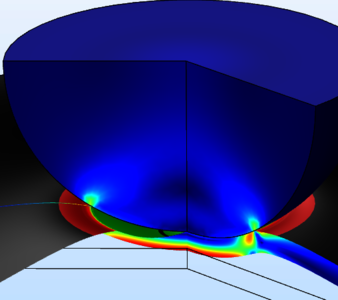
A steel ball is pressed down against a rubber membrane. When the contact pressure exceeds a certain value, the two parts start sticking together. When the ball is retracted, the membrane is pulled upwards in the bonded region. During the retraction, the bond is partially broken. This ... Read More

During manufacturing or in-service use, the geometric shape of structural components can deviate from their intended design. For example, a hole may lose its perfectly circular form, making it important to measure and control this deviation. The process of quantifying such deviations is ... Read More

This model demonstrates one way of using equation-based modeling for generative design by using the powerful mathematical expression capabilities of COMSOL Multiphysics®. Read More
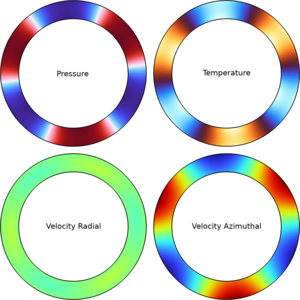
Finding acoustic eigenmodes in problems solved with linearized convected acoustic interfaces can be a challenging task. The solution will most often return several non-acoustic vorticity and entropy modes. These are highly damped waves that do not propagate at the speed of sound but with ... Read More
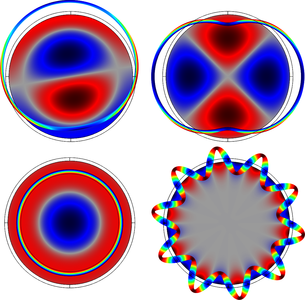
The dispersion curves for a fluid-filled pipe with elastic walls are computed and compared with the analytical results for a pure elastic and an acoustic waveguide, respectively. Results show good agreement and also provide insight into the dynamics of the fluid-filled pipe at low and ... Read More
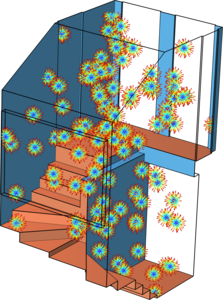
This model uses the Ray Acoustics interface to extract statistical information about a room. Two examples of rooms are analyzed: The staircase from the One-Family House Acoustics tutorial model A long corridor The models compute the mean free path as well as the reflection frequency ... Read More
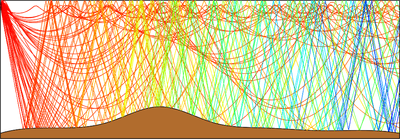
When computing ray intensity in 2D axisymmetric models, the wavefront associated with the propagating ray is treated as a spherical or ellipsoidal wave, instead of a cylindrical wave. This tutorial example illustrates how to set up several important features using the Ray Acoustics ... Read More
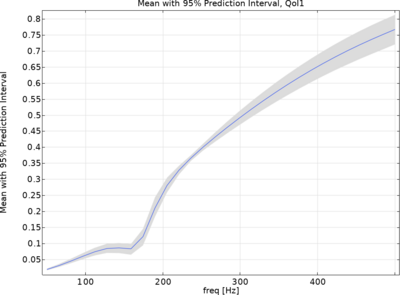
It can in many cases be difficult to get accurate material properties for porous materials. Measuring the properties to high precision can involve lengthy measurements using different techniques. It can therefore be interesting to understand how uncertainties in different material ... Read More

In direct bonding, particulate contamination at the interface can significantly reduce bonding quality. Even micron-scale particles may prevent local contact and lead to large interfacial voids. This model demonstrates a 3D simulation workflow for die-to-wafer (D2W) direct bonding. The ... Read More


