
The Application Gallery features COMSOL Multiphysics® tutorial and demo app files pertinent to the electrical, structural, acoustics, fluid, heat, and chemical disciplines. You can use these examples as a starting point for your own simulation work by downloading the tutorial model or demo app file and its accompanying instructions.
Search for tutorials and apps relevant to your area of expertise via the Quick Search feature. Note that many of the examples featured here can also be accessed via the Application Libraries that are built into the COMSOL Multiphysics® software and available from the File menu.
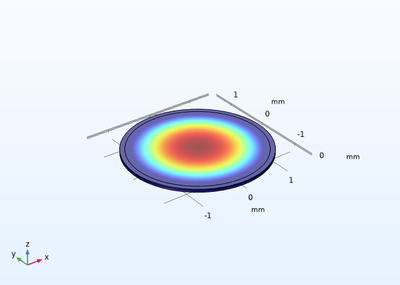
This 2D axisymmetric model demonstrates the operation of a pyroelectric detector found in instruments for measuring laser energy. A disk of lithium niobate (LiNbO3) is sandwiched between two electrodes and connected to an external circuit. The disk is mounted on a ring-shaped ... Read More
Lamb wave resonators are useful components for many radio-frequency applications. This tutorial shows how you model an aluminum nitride Lamb wave resonator and perform eigenfrequency and frequency-response analyses to characterize the device. Read More
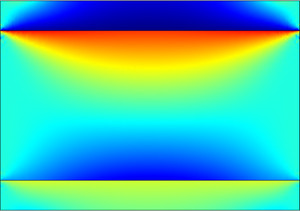
The thermal stress in a layered plate is studied in this example. A plate consisting of two layers, a coating and a substrate layer, is stress and strain free at 800 degrees C. The temperature of the plate is reduced to 150 degrees C and thermal stresses are induced due to the difference ... Read More

A solidly-mounted resonator (SMR) is a piezoelectric MEMS resonator formed on top of an acoustic mirror stack deposited on a thick substrate. This tutorial shows how to simulate an SMR in 2D. In this example, the eigenmodes were computed and the frequency response from 500 to 1200 MHz ... Read More
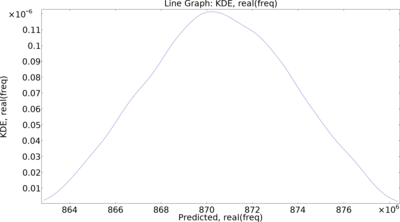
Uncertainty quantification is used to study the effect of manufacturing variation on the performance of a 2D solidly mounted resonator (2D SMR). This tutorial shows how the resonant frequency is affected by thickness variations of the piezoelectric layer and the Bragg reflector layers. ... Read More
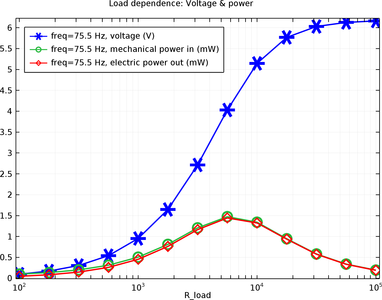
This model shows how to analyze a simple, cantilever based, piezoelectric energy harvester. A sinusoidal acceleration is applied to the energy harvester and the output power is evaluated as a function of frequency, load impedance and acceleration magnitude. Read More
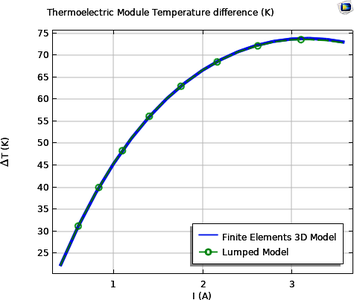
Thermoelectric coolers are widely used for electronics cooling in various application areas, ranging from consumer products to spacecraft design. The thermoelectric modules are a common application of thermoelectricity in cooling engineering. They consist of several thermoelectric legs ... Read More
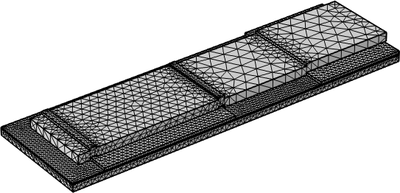
This tutorial demonstrates how to build the geometry for the 3D biased resonator from GDS file using the ECAD Import Module and the Design Module. The procedure emulates semiconductor and MEMS fabrication processes to build 3D geometry more efficiently and is more intuitive for those ... Read More
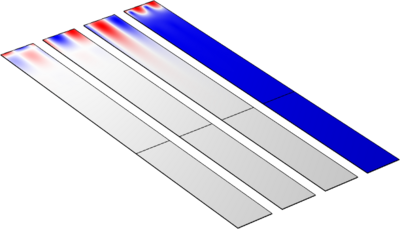
In the surface acoustic waves industry different crystal cuts of piezoelectric materials are used, e.g. 128ᵒ YX LiNbO3, AT&ST quartz, 42ᵒ YX LiTaO3, etc. Direct data isn’t available for all cuts. The standard approach is to use the so-called Euler angle rotation. COMSOL supports it ... Read More
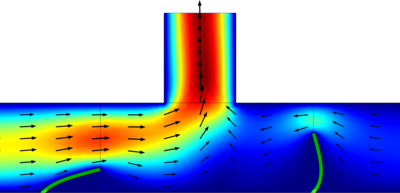
Micropumps are key components of microfluidic systems with applications ranging from biological fluid handling to microelectronic cooling. This model simulates the mechanism of a valveless micropump, that is designed to be effective at low Reynolds numbers, overcoming hydrodynamic ... Read More


