
The Application Gallery features COMSOL Multiphysics® tutorial and demo app files pertinent to the electrical, structural, acoustics, fluid, heat, and chemical disciplines. You can use these examples as a starting point for your own simulation work by downloading the tutorial model or demo app file and its accompanying instructions.
Search for tutorials and apps relevant to your area of expertise via the Quick Search feature. Note that many of the examples featured here can also be accessed via the Application Libraries that are built into the COMSOL Multiphysics® software and available from the File menu.
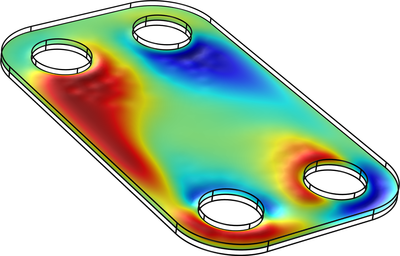
This model demonstrates how to use the built-in shape optimization functionality to improve the performance of a plate heat exchanger. The optimization reduces the path immediately in front of the inlets and outlets to increase the length of typical streamlines. This leads to a improved ... Read More
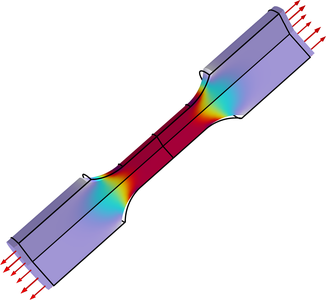
The model shows how to estimate the Young's modulus and Poisson ratio based on a tensile test. The test measures the tensile force and the radial displacement for different values of the prescribed displacement. The model is based on synthetic data generated in the model itself. It is ... Read More
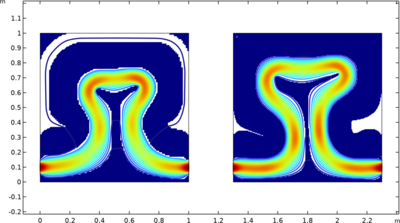
This model demonstrates topology optimization of a 2D heat exchanger with laminar flow. The flow is pressure driven and the objective is to maximize the heat transfer. The density method is used with the (now) classical approach of a single design variable and two flow interfaces. ... Read More
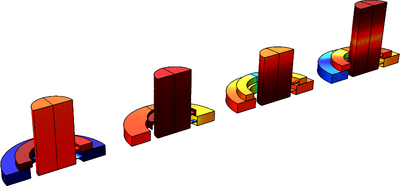
In this tutorial the geometry of an occluded ear-canal simulator is optimized to match the acoustic response of a given ear. The target data in this model stems from a simulation of an ear canal, but it can also be based on measurements, or a response specified by a standard. Read More
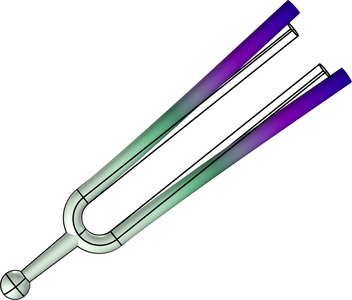
Extending the Tuning Fork model, this example shows how to set up an Optimization Study to determine the prong length at which the fork vibrates at the standard concert pitch, 440 Hz. Read More
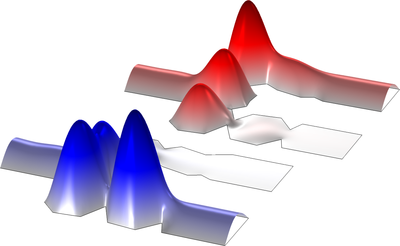
A diplexer is a device that combines or splits signals into two different frequency bands, widely used in mobile communication systems. This example simulates splitting properties using a simplified 2D geometry. The geometry is optimized using shape optimization in order to get the ... Read More
This is a simple yet powerful simulation app for designing a two-dimensional reflective metalens. This metalens consists of a array of glass nanopillars on a metal substrate. Initially, the app determines the optimal grating parameters for a specific wavelength and calculates the ... Read More

The Helmholtz filter is a popular technique for imposing a minimum length scale in structural topology optimization, but certain applications also call for a maximum length scale. This model demonstrates how to achieve this using an extra PDE filter. Read More
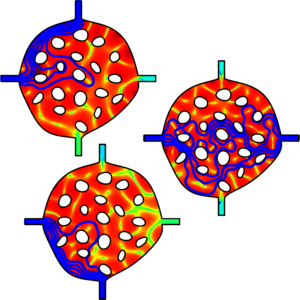
A demultiplexer is a device that directs different frequency bands to different outputs. In this tutorial model, we will design a demultiplexer by performing shape optimization on all initial circular boundaries in a sonic crystal (phononic crystal) configuration. The model uses shape ... Read More
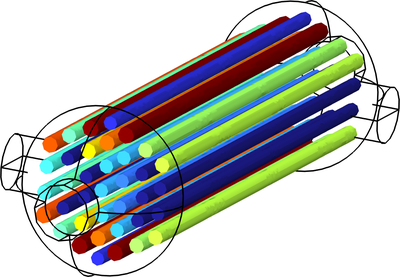
Commercial heat exchangers often feature a complex design. It is significantly easier to build a design with new CAD parameters than to build designs with novel topologies. This model demonstrate how to optimize the size and position of the tubes in a tube and shell heat exchanger. It is ... Read More


