
The Application Gallery features COMSOL Multiphysics® tutorial and demo app files pertinent to the electrical, structural, acoustics, fluid, heat, and chemical disciplines. You can use these examples as a starting point for your own simulation work by downloading the tutorial model or demo app file and its accompanying instructions.
Search for tutorials and apps relevant to your area of expertise via the Quick Search feature. Note that many of the examples featured here can also be accessed via the Application Libraries that are built into the COMSOL Multiphysics® software and available from the File menu.

The propagation of elastic waves in the ground after a seismic event is simulated using a 2D model. The effect of the ground surface topology on the wave propagation is illustrated when an ideal half-space is modified with the presence of a small mountain. The model is a variation of ... Read More
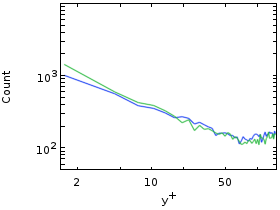
In this benchmark model, solid particles are released in a fully developed turbulent channel flow. The particles are subjected to a drag force that includes contributions from the fluid turbulence, implemented using a Continuous Random Walk (CRW) model. Because the turbulence in the ... Read More
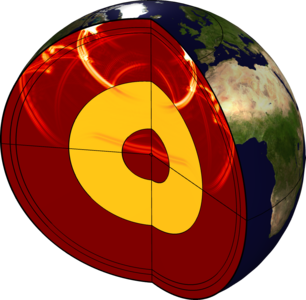
This tutorial model analyzes the propagation of seismic waves through Earth's internal structure. The model uses a 2D axisymmetric geometry to represent the material discontinuities and the variation of properties through the concentric layers of the earth. A simplified earthquake ... Read More
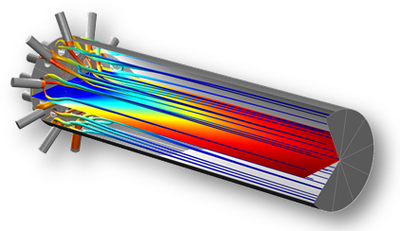
In a polymerization reactor for polyester manufacturing, the mixing in the reactor is achieved by impinging turbulent jets of reactants onto each other. The turbulence affects the reaction kinetics and quality of the polymer linkage. Turbulent flows involving rapid reaction kinetics are ... Read More
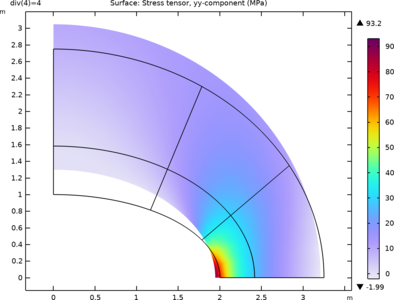
This is a benchmark model for a plane stress problem. The accuracy of the computed stress concentration is evaluated, and a mesh convergence study is performed for different element types. Read More

A magnet moving axially through the center of a coil will induce a voltage across the coil terminals. One practical application of this is in shaker flashlights, where the flashlight is vigorously shaken back and forth, causing a magnet to move through a multi-turn coil, which provides ... Read More
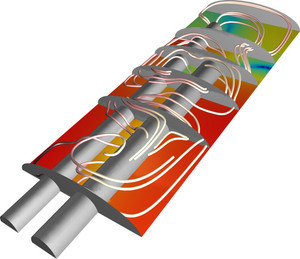
Reflective mufflers are best suited for the low-frequency range where only plane waves can propagate in the system, while dissipative mufflers with fibers are efficient in the mid- to high-frequency range. Dissipative mufflers based on flow losses, on the other hand, also work at low ... Read More
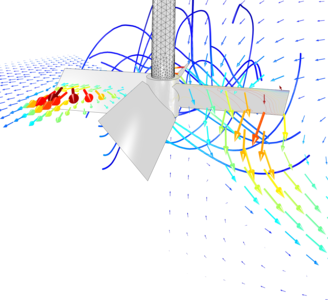
This model shows how to use simulations to predict power numbers with Power Law fluids in a mixer. It simulates the behavior of flow in a flat bottom tank with a single four-blade pitched impeller. The flow was modeled as laminar and the frozen rotor approach was used to solve the ... Read More
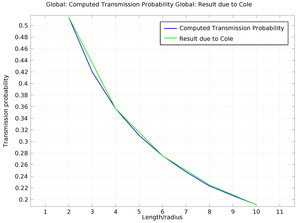
Computing molecular flows in arbitrary geometries produces complex integral equations that are very difficult to compute analytically. Analytic solutions are, therefore, only available for simple geometries. One of the earliest problems solved was that of gas flow through tubes of ... Read More

This document explains how to install and run COMSOL Multiphysics® and COMSOL Server™ with Microsoft® Azure. This requires that you have first acquired a Floating Network License (FNL) or COMSOL Server License (CSL) from COMSOL. The license manager software can run ... Read More


