
The Application Gallery features COMSOL Multiphysics® tutorial and demo app files pertinent to the electrical, structural, acoustics, fluid, heat, and chemical disciplines. You can use these examples as a starting point for your own simulation work by downloading the tutorial model or demo app file and its accompanying instructions.
Search for tutorials and apps relevant to your area of expertise via the Quick Search feature. Note that many of the examples featured here can also be accessed via the Application Libraries that are built into the COMSOL Multiphysics® software and available from the File menu.
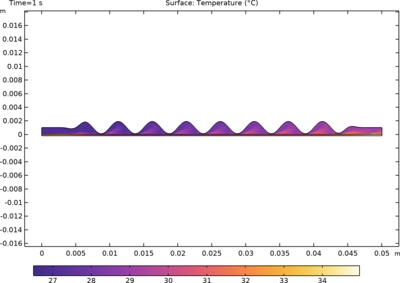
The heat exchanger in this tutorial model contains a dynamic wall with an oscillating wave shape. The deformation induces mixing in the fluid and reduces the formation of thermal boundary layers. Hence, it increases heat transfer between the walls and the fluid. In addition, the wave ... Read More
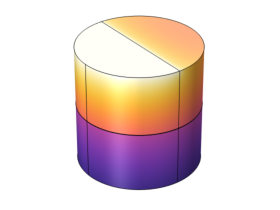
This example shows how to set up multiple sandwiched thin layers with different thermal conductivities in two different ways. First, the composite is modeled as a 3D object. In the second approach, the thin domains are modeled with thermal resistors in the Lumped Thermal System ... Read More
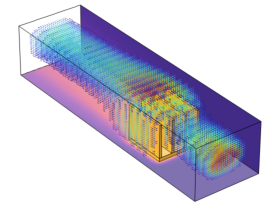
This tutorial model uses a heat sink geometry from the Part Library. The tutorial shows different approaches to heat transfer modeling when studying the cooling of an electronic chip. In the first part, only the solid parts are modeled, while the convective airflow is modeled using ... Read More
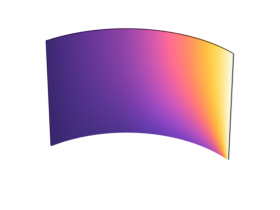
This model simulates a static analysis of heat conduction in a thin conductive shell. This is a benchmark model where the result is compared with a NAFEMS benchmark solution. Read More
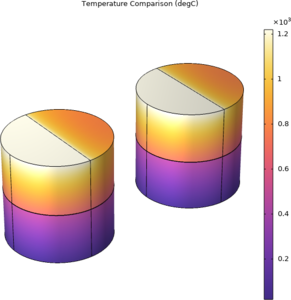
This example is a variant of the Composite Thermal Barrier tutorial and shows how to set up multiple sandwiched thin layers with different thermal conductivities in two different ways. First, the composite is modeled as a 3D object. In the second approach the Lumped Thermal System ... Read More
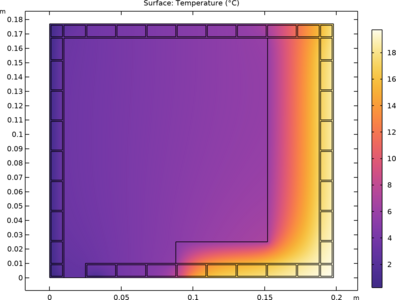
During the design of a building, environmental issues have gained considerable influence in the entire project. One of the first concerns is to improve thermal performances. In this process, simulation software are key tools to model thermal losses and performances in the building. The ... Read More
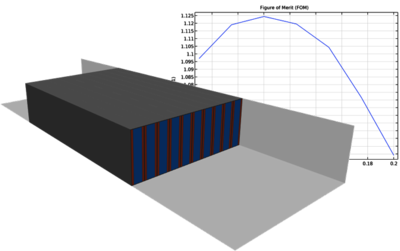
This example computes the effectiveness of a porous microchannel heat sink over a conventional microchannel heat sink. The model is fully parameterized. A parameter study on the thickness of the porous substrate is used to determine the optimal configuration. Read More
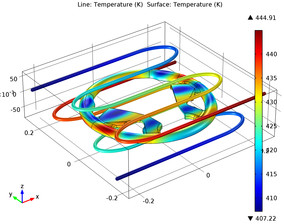
This model shows how you can use the Non-Isothermal Pipe Flow interface together with the Heat Transfer in Solids interface to model the cooling of a injection molded polyurethane part for a car steering wheel. The equations describing the cooling channels are fully coupled to the heat ... Read More
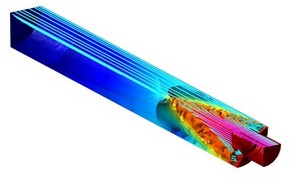
This example models the casting process of a metal rod from liquid to solid state using the Non-Isothermal Flow multiphysics interface, which combines heat transfer and fluid flow. The model describes the fluid and solid flow and heat transport, including the phase transfer from melt to ... Read More
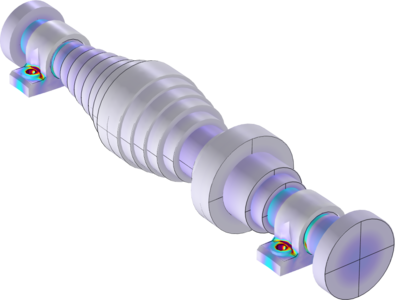
Hydrodynamic bearings generate heat due to the viscous losses in the lubricant. As a result, the temperature of the rotor increases causing deformation and thermal stresses in both the rotor and the bearing housing. This example shows how to model different physical phenomena that are ... Read More


