
The Application Gallery features COMSOL Multiphysics® tutorial and demo app files pertinent to the electrical, structural, acoustics, fluid, heat, and chemical disciplines. You can use these examples as a starting point for your own simulation work by downloading the tutorial model or demo app file and its accompanying instructions.
Search for tutorials and apps relevant to your area of expertise via the Quick Search feature. Note that many of the examples featured here can also be accessed via the Application Libraries that are built into the COMSOL Multiphysics® software and available from the File menu.
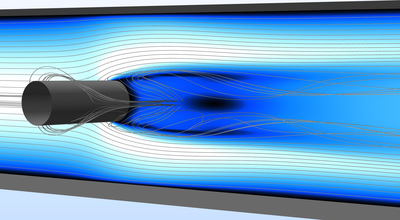
This example simulates 3D unsteady laminar flow past a cylinder in a channel. The inflow velocity profile is time-varying. The lift and drag coefficients are computed, and results show good agreement with those published in the literature. Read More

Échelle spectrographs are commonly used in astronomy for high-resolution analyses of stellar atmospheres and for precision Doppler velocimetry. This tutorial simulates a "white pupil" form of this instrument. It makes use of several parts from the COMSOL Part Library and demonstrates the ... Read More
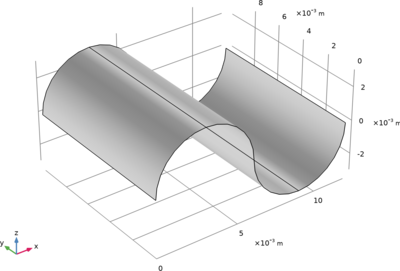
This example presents a homogenized model of a corrugated sheet based on a unit cell approach. The numerically obtained equivalent stiffness matrices are compared with various analytical models. Two corrugation profiles, trapezoidal and round, are considered in this example. Read More
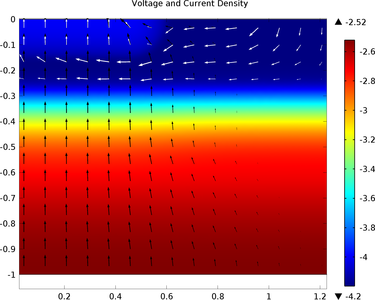
This model shows how to set up a simple Bipolar Transistor model. The output current-voltage characteristics in the common-emitter configuration are computed and the common-emitter current gain is determined. Read More
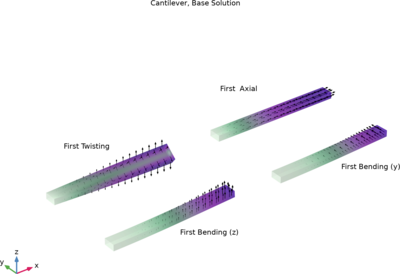
This example explores the shift in natural frequencies caused by changing the temperature. One study investigates a doubly clamped beam where both ends are fixed, while the other study looks at a cantilever beam where only one end is fixed. The following effects are studied: Stress ... Read More
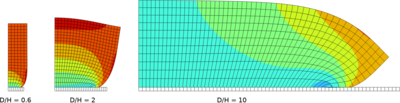
Polymer hydrogels consist of a crosslinked network of long-chained polymers that has imbibed a large number of solvent molecules. Such materials are used in many biomedical applications, such as targeted drug delivery, tissue engineering, and stimuli-sensitive actuators. This benchmark ... Read More
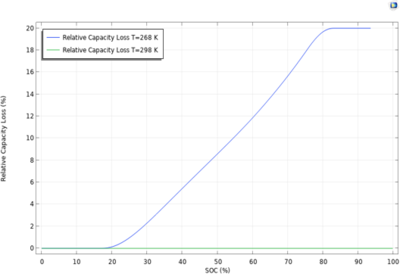
Deposition of metallic lithium on the negative electrode in preference to lithium intercalation is known to be a capacity loss and safety concern for lithium-ion batteries. Harsh charge conditions such as high currents (fast charging) and/or low temperatures can lead to lithium plating. ... Read More
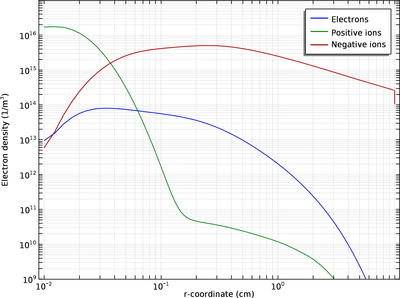
This tutorial model presents a study of a coaxial DC corona discharge in dry air at atmospheric pressure. The dimensions and operation conditions are similar to ones found in electrostatic precipitators with wire-to-plate configurations. The inner wire electrode has a 100-mm radius and ... Read More
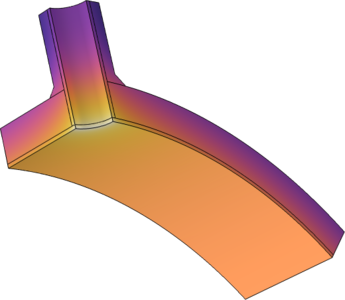
This example demonstrates how to use temperature dependent materials within the Nonlinear Structural Materials Module. A large container holds pressurized hot water. Several pipes are attached to the pressure vessel. Those pipes can rapidly transfer cold water in case of an emergency ... Read More
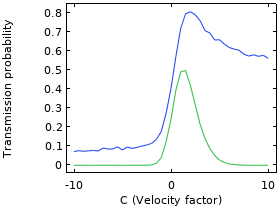
The Monte Carlo simulation of flow in a turbomolecular pump can be greatly simplified if the mean radius of the blades is much greater than the spacing between them. Under these conditions, the rotating blades of the pump can be approximated as an infinite row of blades having only ... Read More


