
The Application Gallery features COMSOL Multiphysics® tutorial and demo app files pertinent to the electrical, structural, acoustics, fluid, heat, and chemical disciplines. You can use these examples as a starting point for your own simulation work by downloading the tutorial model or demo app file and its accompanying instructions.
Search for tutorials and apps relevant to your area of expertise via the Quick Search feature. Note that many of the examples featured here can also be accessed via the Application Libraries that are built into the COMSOL Multiphysics® software and available from the File menu.
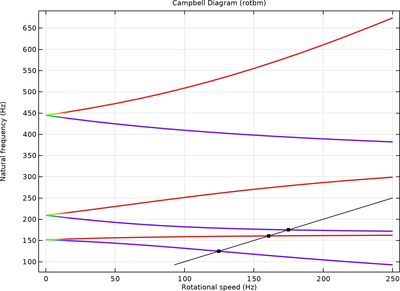
Different types of elements can be used for modeling a rotor, depending on the level of complexity and the type of the system being modeled. The modeling steps and representation of the results will vary with the type of idealization. In this tutorial model, an eigenfrequency analysis is ... Read More
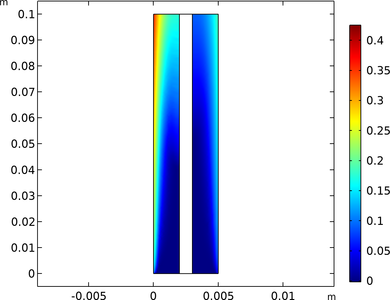
Alkaline water electrolysis is a well-established industrial process for producing hydrogen gas. In the cell, hydrogen gas is formed at the cathode whereas oxygen gas is formed at the anode. The electrolyte is an aqueous liquid, and when the evolved gases form bubbles, the effective ... Read More
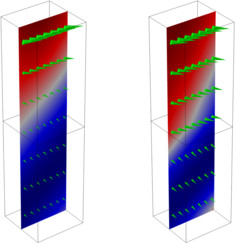
A plane electromagnetic wave propagating through free space is incident at an angle upon an infinite dielectric medium. This model computes the reflection and transmission coefficients and compares the results to the Fresnel equations. Read More
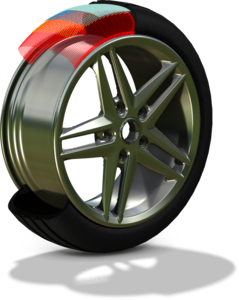
This model showcases how to use fibers in thin layers to model thin anisotropic composites embedded in a solid without explicitly drawing either the layer of material or the reinforcing fibers. Here, it is used to model steel cords in tire belts that are used to provide structural ... Read More
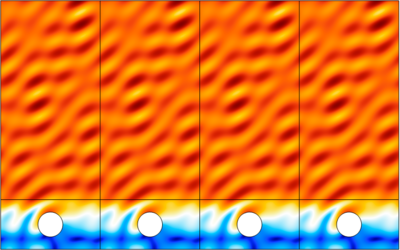
This is a model of acoustic absorption by a porous acoustic open cell foam. In porous materials the sound propagates in a network of small interconnected pores. Because the dimensions of the pores are small, losses occur due to thermal conduction and viscous friction. Acoustic foams are ... Read More
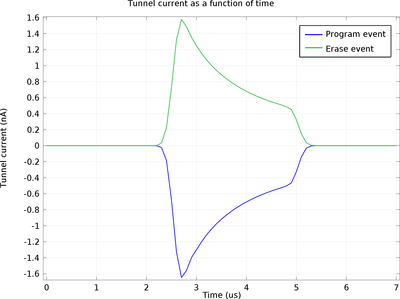
This model calculates the current and charge characteristics of a floating gate Electrically Erasable Programmable Read-Only Memory (EEPROM) device. A stationary study demonstrates the effects of varying the charge stored on the floating gate by computing Current-Voltage curves as a ... Read More
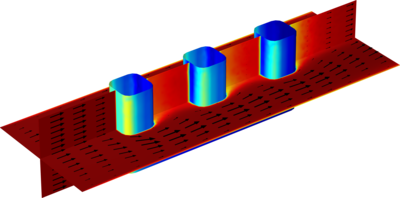
The electrochemical cell shown in this model can be regarded as a unit cell of a larger wire-mesh electrode that is common in many industrial processes. One of the most important aspects in the design of electrochemical cells is the current density distributions in the electrolyte and ... Read More
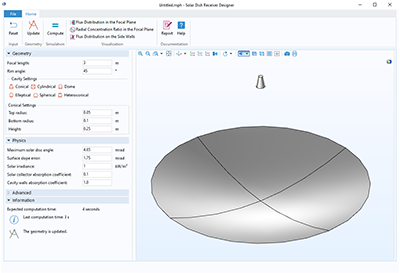
Solar concentrator/cavity receiver systems can be used to focus incident solar radiation into a small region, generating intense heat which can then be converted to electrical or chemical energy. A common figure of merit in solar thermal power systems is the concentration ratio, or the ... Read More
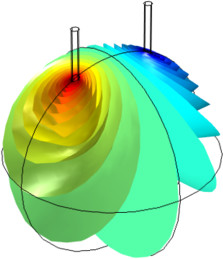
This tutorial example models the currents and the concentration of dissolved metal ions in a battery (corrosion cell) made from an orange and two metal nails. This type of battery is commonly used in chemistry lessons. Instead of an orange, lemons or potatoes can also be used. Read More
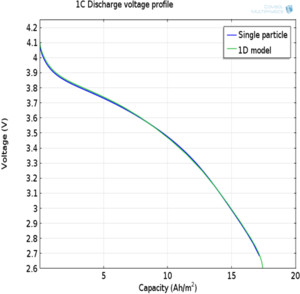
An isothermal single particle model formulation for a lithium-ion battery is presented in this work. The single particle model is a simplification of the 1D formulation for a lithium-ion battery along with a few assumptions. The model is typically valid for low-medium current scenarios. ... Read More


