
The Application Gallery features COMSOL Multiphysics® tutorial and demo app files pertinent to the electrical, structural, acoustics, fluid, heat, and chemical disciplines. You can use these examples as a starting point for your own simulation work by downloading the tutorial model or demo app file and its accompanying instructions.
Search for tutorials and apps relevant to your area of expertise via the Quick Search feature. Note that many of the examples featured here can also be accessed via the Application Libraries that are built into the COMSOL Multiphysics® software and available from the File menu.
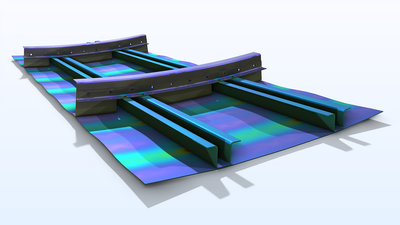
This model studies the structural deformation of an aircraft fuselage structure subjected to buckling loads. The structure is an assembly of panels and skin connected by rivets. The Fasteners feature sets up a large number of connections and computes the forces acting on each rivet. Read More
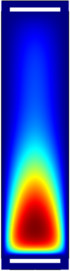
DC glow discharges in the low-pressure regime have long been used for gas lasers and fluorescent lamps. DC discharges are attractive to study because the solution is time independent. The 1D and 2D models show how to use the DC Discharge interface to set up an analysis of a positive ... Read More
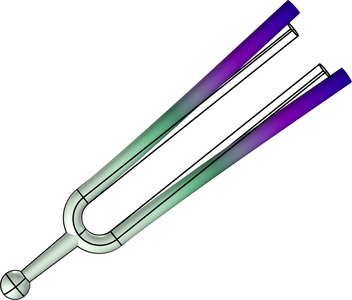
Extending the Tuning Fork model, this example shows how to set up an Optimization Study to determine the prong length at which the fork vibrates at the standard concert pitch, 440 Hz. Read More
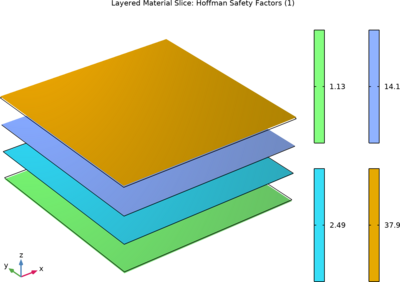
Laminated composite shells made of carbon fiber reinforced polymer (CFRP) are common in a large variety of applications due to their high strength-to-weight ratio. Evaluation of the structural integrity of a laminated composite shell for a set of applied loads is necessary to make the ... Read More
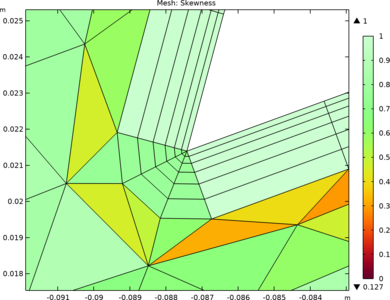
Tutorials in this series deal with creating and manipulation of boundary layer meshes. In these tutorials you will learn how to set up a boundary layer mesh and modify the settings for an automatically created boundary layer mesh. For physics-controlled meshing a boundary layer mesh is ... Read More
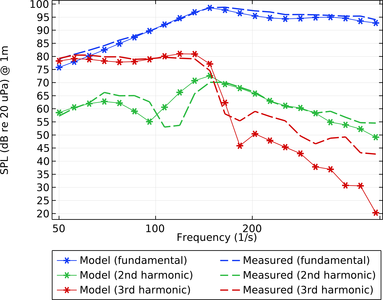
An automotive midwoofer is modeled using the lumped parameter approach. The electrical and mechanical components are modeled using a lumped electric circuit, which is coupled to a finite element model for the acoustics using the Lumped Speaker Boundary feature. The large signal ... Read More
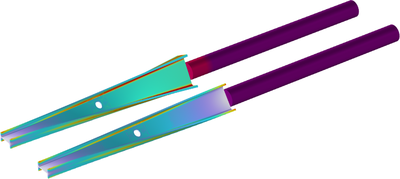
This example demonstrates the use of the Solid-Beam Connection multiphysics coupling to create transitions between the Solid Mechanics and Beam interfaces. Two different connection types are discussed, and a comparison of the stress distributions at the transition is made. Read More
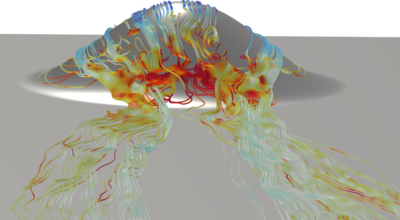
The present example simulates the turbulent flow over a 3D hill geometry using the Large Eddy Simulation (LES) interface with synthetic turbulence at the inlet boundary. Read More
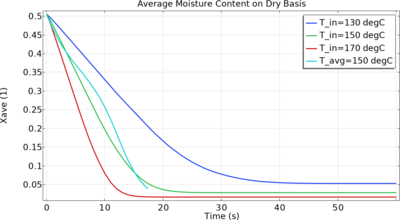
This model demonstrates how to vary the inlet temperature in a superheated steam drying process so as to minimize the time, while constraining both the energy consumption and the final moisture content. Read More

During manufacturing or in-service use, the geometric shape of structural components can deviate from their intended design. For example, a hole may lose its perfectly circular form, making it important to measure and control this deviation. The process of quantifying such deviations is ... Read More


