
The Application Gallery features COMSOL Multiphysics® tutorial and demo app files pertinent to the electrical, structural, acoustics, fluid, heat, and chemical disciplines. You can use these examples as a starting point for your own simulation work by downloading the tutorial model or demo app file and its accompanying instructions.
Search for tutorials and apps relevant to your area of expertise via the Quick Search feature. Note that many of the examples featured here can also be accessed via the Application Libraries that are built into the COMSOL Multiphysics® software and available from the File menu.
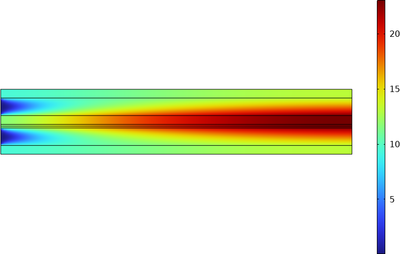
This example models co-electrolysis of H2O and CO2 using a solid oxide electrolyzer cell. The model includes the full coupling between the mass balances and gas flow in the H2 and O2 gas diffusion electrodes, the momentum balances in the H2 and O2 gas flow channels, the energy balance ... Read More
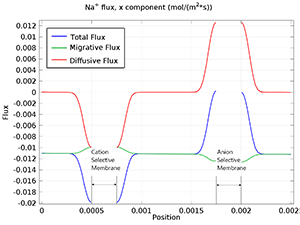
Electrodialysis is a separation process for electrolytes based on the use of electric fields and ion selective membranes. Some common applications of the electrodialysis process are: Desalination of process streams, effluents, and drinking water pH regulation in order to remove acids ... Read More
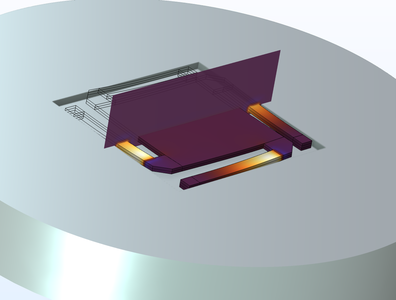
This model analyzes the operation of a micromirror in air and the effects of thermoviscous damping on the vibration response. The model includes thermal losses in the structure as well as thermoviscous acoustic phenomena. The model couples the Thermoelasticity multiphysics interface to ... Read More
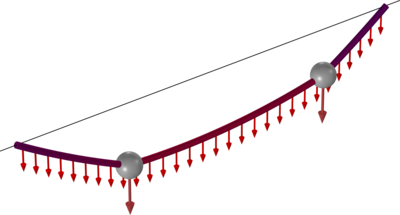
A cable is a structural member which has stiffness only in its tangential direction, but virtually no bending stiffness. When supported only at its two ends it deflects under gravitational load forming a curve known as catenary. This example shows how to model components such as cables, ... Read More

This example shows how to model prestressed bolts. The bolt geometry is taken from the Part Libraries. For comparison, one of the bolts is modeled using a thread contact formulation, whereas the other bolt is connected to the bolt hole by a pure continuity condition. The reduced ... Read More
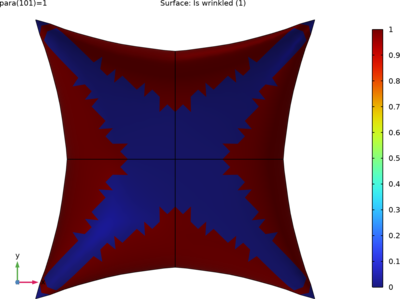
A square airbag is inflated using constant air pressure. In some regions of the airbag the material wrinkles during inflation, as negative principal stresses develop. The wrinkling membrane model within the tension field theory gives a correct description of the stress distribution and ... Read More
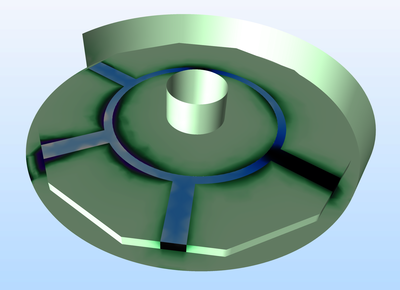
A 180° Ring Hybrid (Rat-Race Coupler) is a four-port network with 180° phase difference between two ports. It is cheaper to manufacture this type of microstrip line component compared to a wave guide 180° hybrid junction, so called magic-T. The objective of this model is to compute the S ... Read More
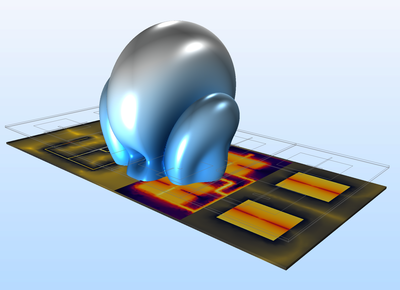
An antenna array is a group of radiating elements. By controlling the phase and magnitude of the input signal assigned to each antenna element and the number of array elements, the radiation pattern can be steered in a desired direction with a preferred level of gain. In this example, a ... Read More
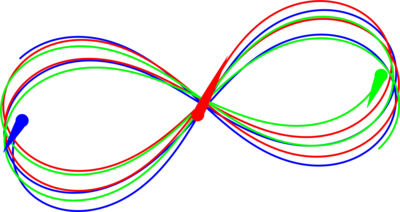
The graviational three body problem involves the calculation of the positions and velocities of three objects under mutual gravitational attraction, given their position and velocity at some initial time. While the three-body problem does not have a general analytic solution and is ... Read More
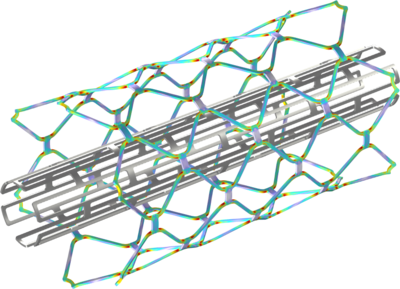
A stent is a wire-mesh tube used to open a coronary artery during angioplasty, a process for the removal or compression of plaque. Their design is of significance for percutaneous transluminal angioplasty with stenting. During this procedure, a stent is deployed into the blood vessel by ... Read More


