
The Application Gallery features COMSOL Multiphysics® tutorial and demo app files pertinent to the electrical, structural, acoustics, fluid, heat, and chemical disciplines. You can use these examples as a starting point for your own simulation work by downloading the tutorial model or demo app file and its accompanying instructions.
Search for tutorials and apps relevant to your area of expertise via the Quick Search feature. Note that many of the examples featured here can also be accessed via the Application Libraries that are built into the COMSOL Multiphysics® software and available from the File menu.

This model demonstrates how to define Earth properties that are spatially varying on the planet. A satellite in orbit experiences solar, albedo, and planetary infrared (IR) loads, where albedo and planetary IR can vary with latitude and longitude. In this example, these inputs are read ... Read More
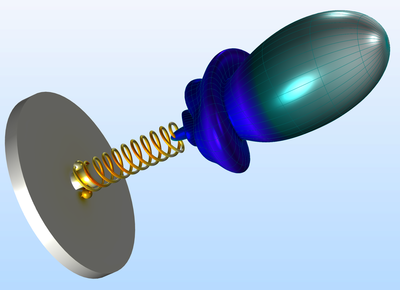
A helical antenna has two major modes. One is normal mode and the other is axial mode. When the helical antenna is operating at the normal mode, its far-field radiation pattern is similar to the torus shaped pattern of a classic dipole antenna. At the axial mode, the helical antenna is ... Read More
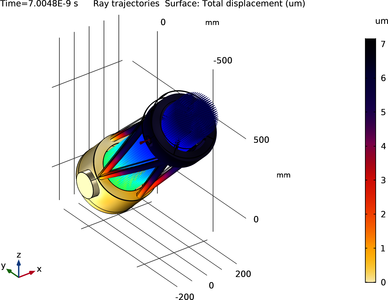
This tutorial demonstrates a structural analysis of a simple telescope. The deformation of the telescope structure under gravity is examined and the effect on image quality is demonstrated. Read More
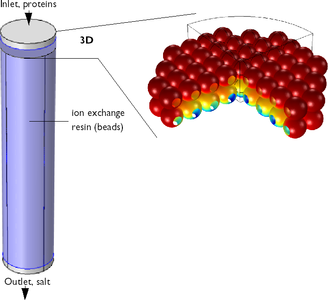
Ion-exchange is a powerful method to separate proteins from solutions and is today readily used in biotechnological and pharmaceutical industry. This model simulates an ion-exchange column for protein adsorption. The fluid phase contains four components: two proteins, solvent, and one ... Read More
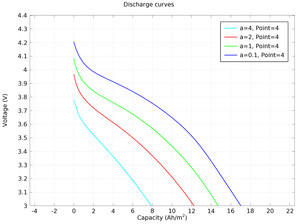
This model demonstrates the Lithium-Ion Battery interface for studying the discharge and charge of a lithium-ion battery for a given set of material properties. The geometry is in one dimension and the model is isothermal. Battery developers can use the model to investigate the influence ... Read More
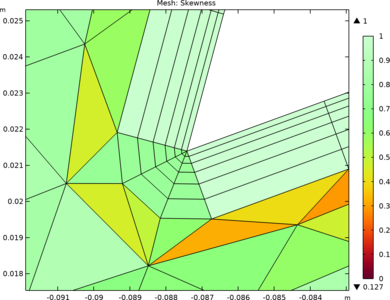
Tutorials in this series deal with creating and manipulation of boundary layer meshes. In these tutorials you will learn how to set up a boundary layer mesh and modify the settings for an automatically created boundary layer mesh. For physics-controlled meshing a boundary layer mesh is ... Read More
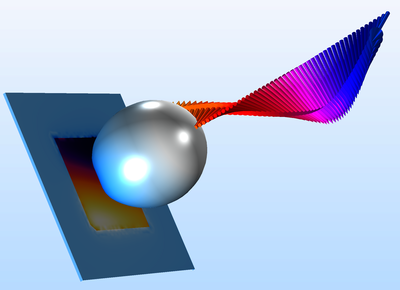
One way to generate circular polarization from a microstrip patch antenna is to truncate the patch radiator. This model is tuned around the GPS frequency range. The axial ratios are calculated to show the degree of circular polarization. Read More
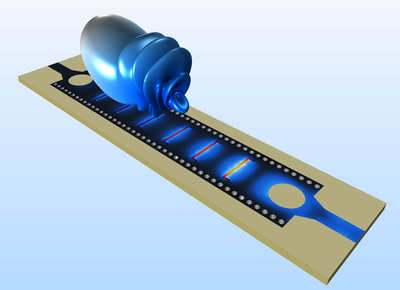
Substrate Integrated Waveguides (SIW) can be used in antenna applications. Leaky waves from a slot array on the top surface of the SIW in this model generate a beam in a certain direction that can be steered by choosing a different operating frequency. Read More
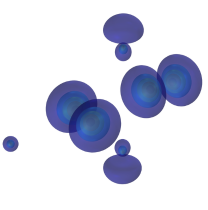
For a description of this model, see our accompanying blog post "Can COMSOL Multiphysics® Solve the Hydrogen Atom?". Read More
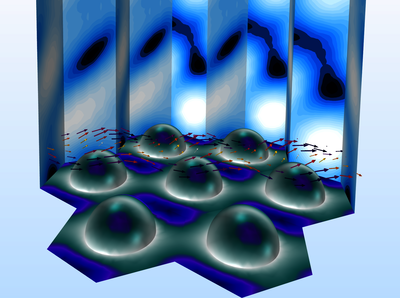
A plane wave is incident on a reflecting hexagonal grating. The grating cell consists of a protruding semisphere. The scattering coefficients for the different diffraction orders are calculated for a few different wavelengths. Read More


