
The Application Gallery features COMSOL Multiphysics® tutorial and demo app files pertinent to the electrical, structural, acoustics, fluid, heat, and chemical disciplines. You can use these examples as a starting point for your own simulation work by downloading the tutorial model or demo app file and its accompanying instructions.
Search for tutorials and apps relevant to your area of expertise via the Quick Search feature. Note that many of the examples featured here can also be accessed via the Application Libraries that are built into the COMSOL Multiphysics® software and available from the File menu.
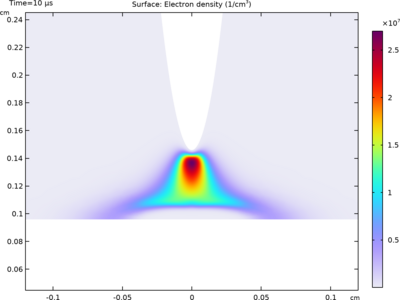
This model simulates a negative dielectric barrier discharge under a point-to-plate electrode configuration. Two solid dielectric layers are inserted into the air gap. A negative voltage of 2.5 kV is applied to the cathode electrode, initiating a corona streamer that propagates and ... Read More

This tutorial models the thermal management of a polymer electrolyte membrane (PEM) fuel cell stack. Operating the stack with a similar temperature profile for all cells is important since an uneven temperature distribution may otherwise result in nonuniform water vapor condensation and ... Read More
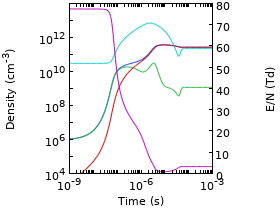
The electron energy distribution function (EEDF) plays an important role in the overall behavior of discharges. In this example, the formation period of an Argon plasma is studied with special attention paid to the EEDF. The plasma is created within a 4 cm gap by a DC source voltage of 1 ... Read More
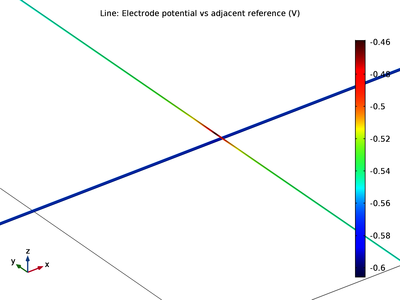
The impressed current cathodic protection (ICCP) system is often employed to mitigate corrosion of buried pipelines in the oil and gas industry. Metallic objects such as buried pipelines, which are present within the current flow of the ICCP system, may suffer from the stray current ... Read More
In an alkaline electrolyzer stack, all cells share the same electrolyte. As a result of all cells being in ionic contact, parasitic shunt currents flow between the cells through the manifolds and the electrolyte channels, on both the inlet and outlet side. This example models a ... Read More
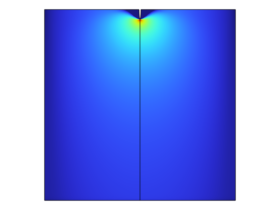
This tutorial model presents a study of a negative corona discharge in dry air at atmospheric pressure in a point-to-plane configuration. An elliptical electrode with millimeter dimensions creates a high intensity electric field where the corona discharge occurs. A ground plane is placed ... Read More
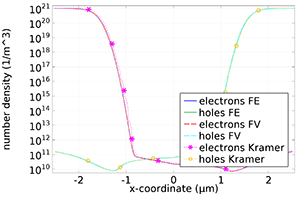
This simple benchmark model computes the potential and carrier concentrations for a one-dimensional p-n junction using both the finite element and finite volume methods. The results are compared with an equivalent device from the book, "Semiconductor Devices: A Simulation Approach," by ... Read More
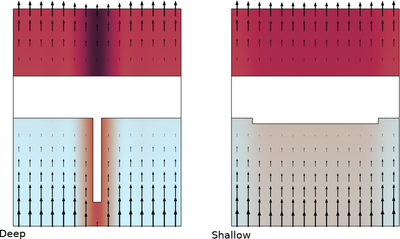
The copper current collector on negative graphite electrodes in lithium-ion batteries have been seen to dissolve at over discharge. This can be a safety concern as the dissolution damages the current collector irreversibly and dissolved copper ions can redeposit and form dendrites. ... Read More
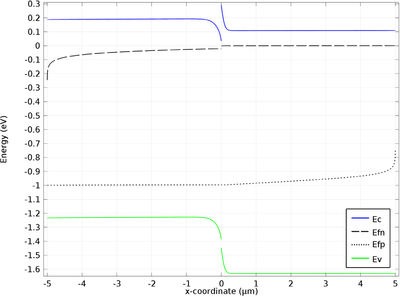
This benchmark model simulates three different heterojunction configurations under forward and reverse bias. It shows the difference in using the continuous quasi-Fermi level formulation versus the thermionic emission formulation for the charge transfer across the heterojunction. The ... Read More
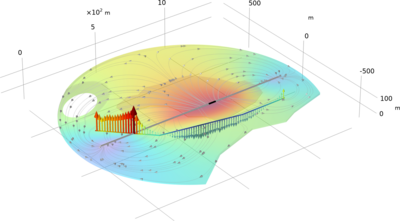
Light rail transit (LRT) systems often utilize DC power for train propulsion. In these systems the potential gradients in the rails may induce stray currents, which corrode adjacent metallic structures. In this example, the Cathodic Protection interface, using Edge Electrode nodes, is ... Read More


