
The Application Gallery features COMSOL Multiphysics® tutorial and demo app files pertinent to the electrical, structural, acoustics, fluid, heat, and chemical disciplines. You can use these examples as a starting point for your own simulation work by downloading the tutorial model or demo app file and its accompanying instructions.
Search for tutorials and apps relevant to your area of expertise via the Quick Search feature. Note that many of the examples featured here can also be accessed via the Application Libraries that are built into the COMSOL Multiphysics® software and available from the File menu.
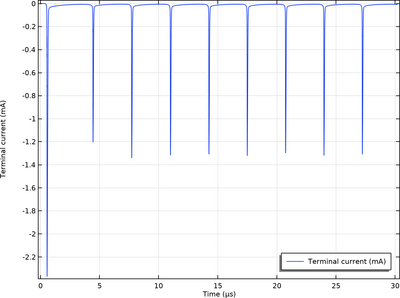
This example simulates Trichel pulses produced by negative corona discharge under a point-to-plate configuration. The electron density and the electric field are obtained, as well as the discharge current. The discharge current clearly shows the pulsating characters. Each current pulse ... Read More
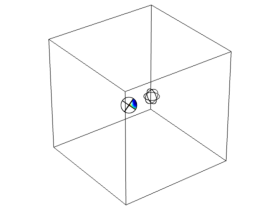
This model verifies that the onset of streamer formation between two spheres separated by atmospheric pressure dry air at a distance of 2cm occurs at 51.8kV. The electrical breakdown is detected by integrating Townsend coefficients along the electric field lines between the two spheres. ... Read More
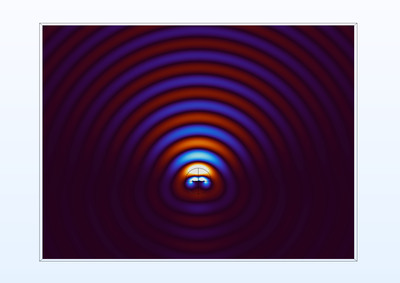
This tutorial model analysis of a microstrip patch antenna shows how to couple the finite element method (FEM) to the boundary element method (BEM) for evaluating the field outside the FEM computational domain. The model computes the S-parameter, near-field distribution, and far-field ... Read More
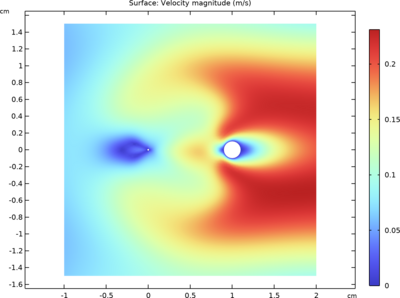
This model simulates the velocity of the ionic wind generated by a wire-to-wire corona discharge. Ionic wind, created by the movement of charged particles in an electric field, can be harnessed for various applications, including cooling electronic components and enhancing heat ... Read More
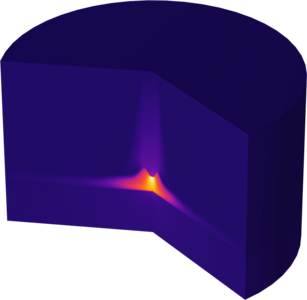
This example investigates the electrical and thermal characteristics of a welding argon arc created in a point-to-plane configuration. The discharge is assumed to be in local thermodynamic equilibrium. The electric arc is considered a conductive fluid medium and is modeled using a ... Read More
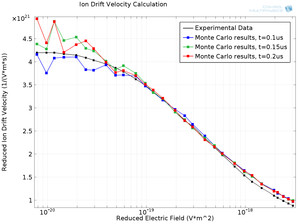
The drift velocity of Ar+ is calculated using a Monte Carlo simulation in which the elastic collisions of Argon ions with ambient neutrals are explicitly modeled. The model uses energy-dependent collision cross-section data from experiment. The average ion velocity values are consistent ... Read More
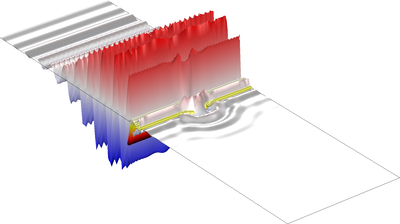
This tutorial shows how to solve the full time-dependent wave equation in dispersive media such as plasmas and semiconductors. The 2D TM in-plane wave model solves for the vector potential from the wave equation and for an auxiliary electric polarization density from an ordinary ... Read More
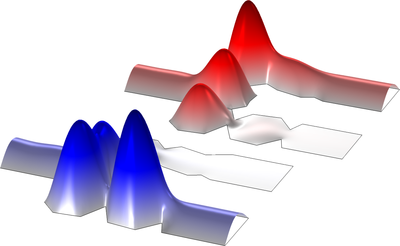
A diplexer is a device that combines or splits signals into two different frequency bands, widely used in mobile communication systems. This example simulates splitting properties using a simplified 2D geometry. The geometry is optimized using shape optimization in order to get the ... Read More
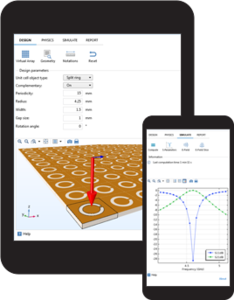
This app demonstrates the following: Designing an app for small screens such as smartphones User-interface navigation with a top menu typically used on websites Geometry parts and parameterized geometries Visualizing periodicity of a geometry with material rendering Warning messages on ... Read More
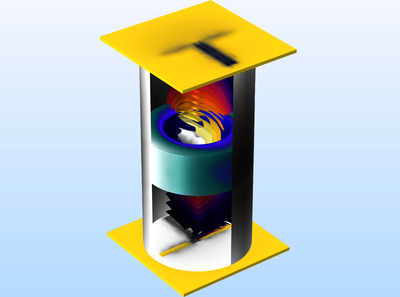
An evanescent-mode cavity filter is resonant at a frequency lower than its original fundamental mode frequency. Evanescent mode resonance can be realized by creating a discontinuity or reactance inside the cavity. The basic model was modified by the addition of a metal box at either end ... Read More


