
The Application Gallery features COMSOL Multiphysics® tutorial and demo app files pertinent to the electrical, structural, acoustics, fluid, heat, and chemical disciplines. You can use these examples as a starting point for your own simulation work by downloading the tutorial model or demo app file and its accompanying instructions.
Search for tutorials and apps relevant to your area of expertise via the Quick Search feature. Note that many of the examples featured here can also be accessed via the Application Libraries that are built into the COMSOL Multiphysics® software and available from the File menu.
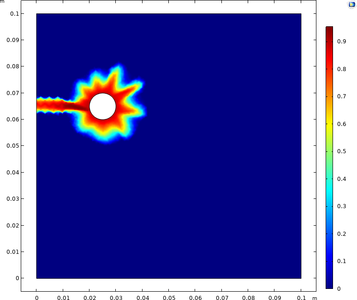
Oxide jacking is the process by which reinforced concrete cracks, due to the corrosion of the reinforcing rebar rods. The corrosion process causes growth of an oxide layer on the rebar, which in turn causes internal stresses in the concrete. If the corrosion process is allowed to ... Read More
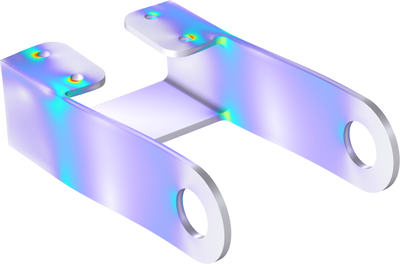
This tutorial illustrates how to use a reduced order model to compute the response of a structure subjected to three simultaneous loads having independent time histories. Reduced order models provide an efficient way to analyze problems within linear structural dynamics. Read More
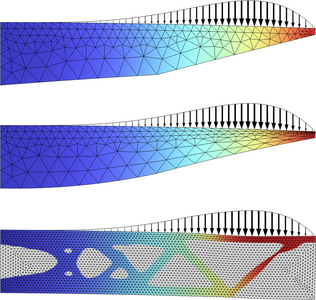
The mass of an aluminum beam is minimized subject to a displacement constraint and a distributed load. The problem is solved using parameter, shape and topology optimization. Read More
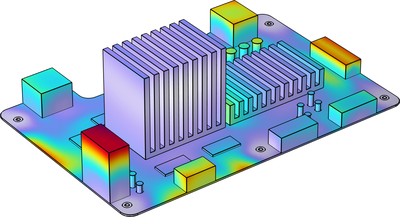
In this example, a random vibration test of electronic equipment is simulated. Three analyses are performed, one for acceleration in each global direction. Accelerations in the components and forces in clamping bolts are evaluated. Read More
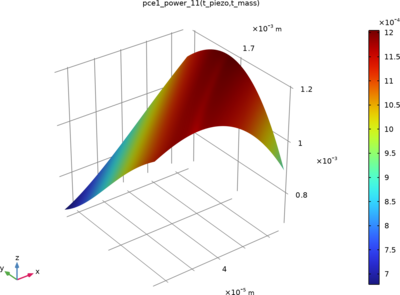
Uncertainty Quantification (UQ) is used to study the effect of manufacturing variation on the performance of Piezoelectric Energy Harvester. This tutorial shows how UQ studies are specified for a frequency domain study that calculates the energy harvester's power output. Read More
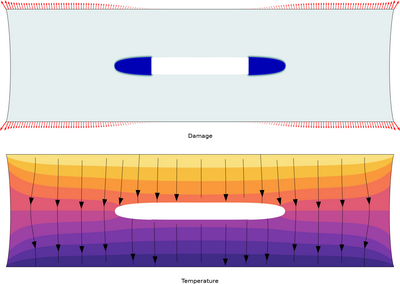
This model demonstrates how to set up a phase field damage multiphysics model to predict crack propagation in thermoelastic solids under large deformations. The crack-driving force depends on the principal stresses, which in turn depend on the temperature distribution in the solid ... Read More
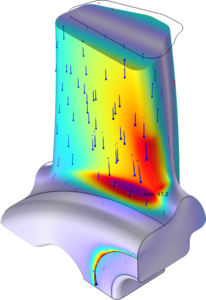
This tutorial uses the submodeling technique to accurately resolve the stress concentrations in a wheel rim. First a global model is solved to obtain the displacements, which are then used as boundary conditions in a local model of the region where the stress concentrations occur. Read More

In this tutorial model, an eigenvalue analysis of a turbocharger rotor is performed. The rotor is analyzed in an unconstrained configuration, also commonly known as free–free conditions. A rotor like this is usually intended for high-speed applications, but here the analysis is performed ... Read More
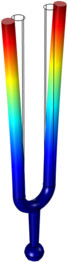
This app demonstrates the following: Playing a sound at a specific computed frequency Selecting different materials from a combo box Visualizing material appearance, color, and texture Choice of three different user interface layouts for computer, tablet, or smartphone Custom ... Read More

The thermal effects of a laser beam incident on a Semiconductor Saturable Absorber Mirror (SESAM) are simulated under a range of incident beam powers. This is done in two steps. The first study simulates the multiphysics combination of the saturated absorption of the beam on a SESAM, ... Read More


