
The Application Gallery features COMSOL Multiphysics® tutorial and demo app files pertinent to the electrical, structural, acoustics, fluid, heat, and chemical disciplines. You can use these examples as a starting point for your own simulation work by downloading the tutorial model or demo app file and its accompanying instructions.
Search for tutorials and apps relevant to your area of expertise via the Quick Search feature. Note that many of the examples featured here can also be accessed via the Application Libraries that are built into the COMSOL Multiphysics® software and available from the File menu.
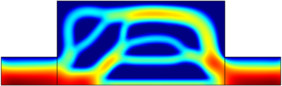
In this application, a solution is pumped through a catalytic bed where a solute species reacts as it gets in contact with the catalyst. The purpose of this example is to maximize the total reaction rate for a given total pressure difference across the bed by finding an optimal catalyst ... Read More
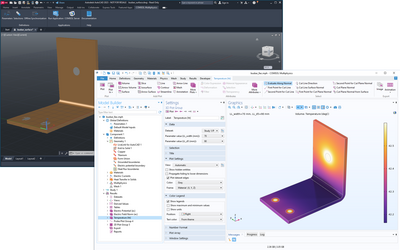
This tutorial model of the Joule heating effect in a busbar demonstrates how to synchronize geometry between the AutoCAD® software and the COMSOL Multiphysics® software, how to modify the geometry from COMSOL Multiphysics®, and how to run a geometric parametric ... Read More
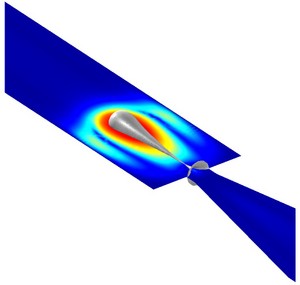
Although initially invented to be used in printers, inkjets have been adopted for other application areas, such as within the life sciences and microelectronics. Simulations can be useful to improve the understanding of the fluid flow and to predict the optimal design of an inkjet for a ... Read More
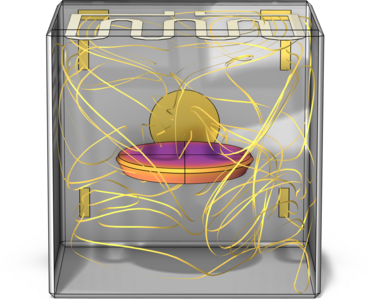
This example models the heating inside an oven with the Single Phase Flow, Heat Transfer and Surface-to-Surface Radiation interfaces. It accounts for conductive, convective and radiative heat transfer. Two computation approaches are set up: A one-way nonisothermal flow (one-way NITF) ... Read More
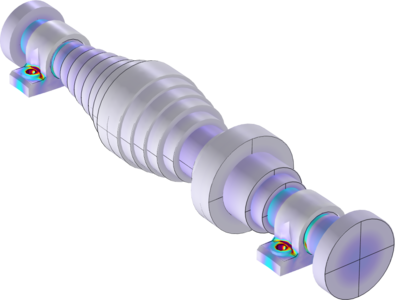
Hydrodynamic bearings generate heat due to the viscous losses in the lubricant. As a result, the temperature of the rotor increases causing deformation and thermal stresses in both the rotor and the bearing housing. This example shows how to model different physical phenomena that are ... Read More
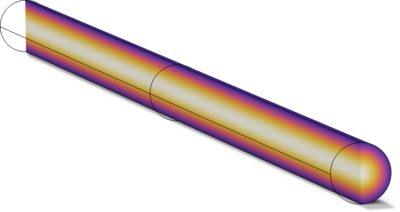
This tutorial model illustrates the use of the nucleate boiling heat flux features to compute the transient cooling of a cylindrical rod plated with nickel, and immersed in a pool of boiling water. The temperature and heat flux results obtained with a 3D time-dependent computation, with ... Read More
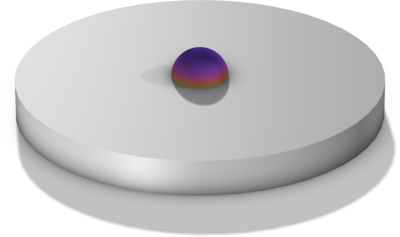
Droplet evaporation is ubiquitous in everyday life, and is essential in many industrial processes such as ink-jet printing, cleaning or coating of surfaces, and phase change heat transfer. In this model, a water droplet placed on a solid substrate evaporates in air. We solve the ... Read More

Nucleate boiling occurs when a liquid is heated by a source hotter than the saturated fluid temperature but with a heat flux below the critical heat flux. In this regime, high heat flux are possible due to the evaporation of the liquid. This model aims to demonstrate the calculation of ... Read More
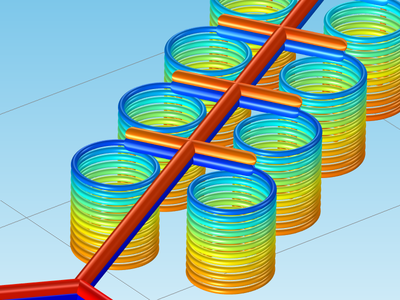
Ponds and lakes can serve as thermal reservoirs in geothermal heating applications. In this example, fluid circulates underwater through polyethylene piping in a closed system. The pipes are coiled in a slinky shape and grouped onto sleds. The Non-isothermal Pipe Flow interface sets up ... Read More
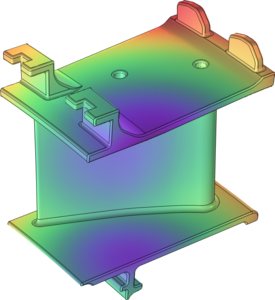
This example shows how to compute thermally induced stresses in a turbine stator blade using the Thermal Stress, Solid interface. The conditions within gas turbines are extreme. The pressure can be as high as 40 bar, and the temperature more than 1000 K. Any new component must therefore ... Read More


