
The Application Gallery features COMSOL Multiphysics® tutorial and demo app files pertinent to the electrical, structural, acoustics, fluid, heat, and chemical disciplines. You can use these examples as a starting point for your own simulation work by downloading the tutorial model or demo app file and its accompanying instructions.
Search for tutorials and apps relevant to your area of expertise via the Quick Search feature. Note that many of the examples featured here can also be accessed via the Application Libraries that are built into the COMSOL Multiphysics® software and available from the File menu.
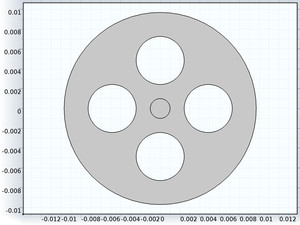
A quadrupole mass filter (QMF) is a key component of a modern mass spectrometer. A QMF uses direct current (DC) and alternating current (AC) electric fields to analyze positive or negative ions by mass to charge ratio. A QMF consists of 4 parallel rods spaced equidistantly, the ratio of ... Read More
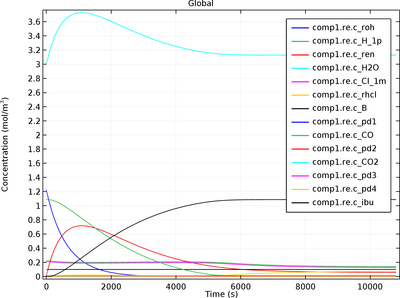
Kinetic analysis of catalytic reactions is essential for understanding rate behavior as well as the reaction mechanism. Developing knowledge of intrinsic reaction kinetics and of rate equations is central to reaction engineering studies aimed at improving reactor design. This model ... Read More
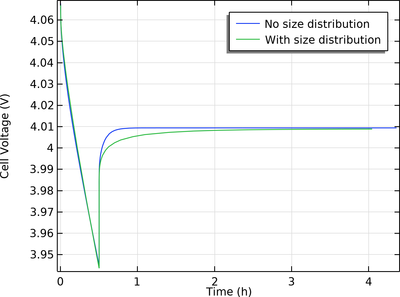
Battery electrodes featuring large heterogeneities in terms of particle sizes may sometimes not be adequately described by homogenized models using one single particle size only. As an alternative to adding multiple instances of the Additional Porous Electrode material node, this ... Read More

Induction heating is used for various metallurgical processes such as hardening. Here the 3D induction heating of a mechanical joint passing through an induction heating coil is simulated. Curie point effects and temperature dependent resistivity in the iron are taken into account. To ... Read More

This application demonstrates how you can access and include external thermodynamic and physical property calculations in your simulation, using the Thermodynamics feature. The example shows how you can easily modify the predefined Plug-flow reactor type in the Reaction Engineering ... Read More
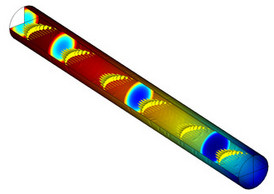
Tubular reactors are often used in continuous large-scale production, for example in the petroleum industry. One key design parameter is the conversion, or the amount of reactant that reacts to form the desired product. In order to achieve high conversion, process engineers optimize the ... Read More
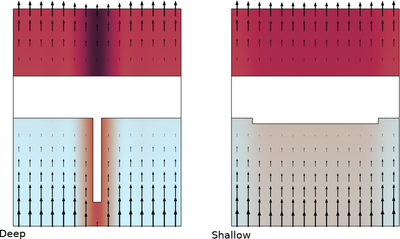
The copper current collector on negative graphite electrodes in lithium-ion batteries have been seen to dissolve at over discharge. This can be a safety concern as the dissolution damages the current collector irreversibly and dissolved copper ions can redeposit and form dendrites. ... Read More
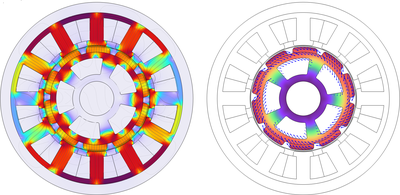
In this example, the coupling between Multibody Dynamics and Rotating Machinery, Magnetic for performing electromagnetic and mechanical analysis is demonstrated. A permanent magnet motor with 10 rotor poles and 12 stator slots is modelled in 2D. The magnets are attached to the ... Read More

The zinc bromine redox flow battery is an electrochemical energy storage technology suitable for stationary applications. Compared to other flow battery chemistries, the Zn-Br cell potentially features lower cost, higher energy densities and better energy efficiencies. In the cell ... Read More
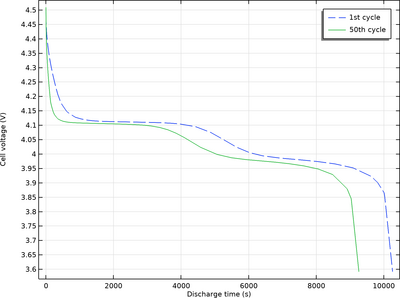
Some positive electrode materials are known to deteriorate in overcharged lithium-ion battery cells. Predominantly, manganese containing electrode materials such as LMO and NMC can loose capacity due to manganese dissolving from the materials at overcharge. This decomposition is a ... Read More


