
The Application Gallery features COMSOL Multiphysics® tutorial and demo app files pertinent to the electrical, structural, acoustics, fluid, heat, and chemical disciplines. You can use these examples as a starting point for your own simulation work by downloading the tutorial model or demo app file and its accompanying instructions.
Search for tutorials and apps relevant to your area of expertise via the Quick Search feature. Note that many of the examples featured here can also be accessed via the Application Libraries that are built into the COMSOL Multiphysics® software and available from the File menu.
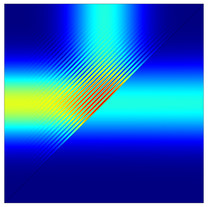
A beam splitter is used to split a single beam of light into two. One way of making a splitter is to deposit a thin layer of metal between two glass prisms. The beam is slightly attenuated within the layer, and split into two paths. In this example, the thin metal layer is modeled using ... Read More
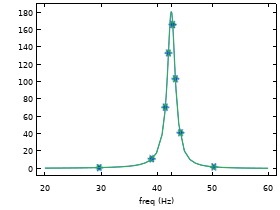
In this verification example, forced random vibrations of a simply-supported deep beam are studied. The beam is loaded by a distributed force with a uniform power spectral density (PSD). The output PSD is computed for the displacement and bending stress response. The computed values are ... Read More
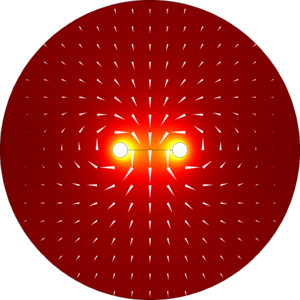
A parallel wire transmission line is composed of two conducting wires in a dielectric such as air. The fields around such a transmission line are not directly confined by the conductors, and extend to infinity, although they drop off in rapidly away from the wires. This model ... Read More
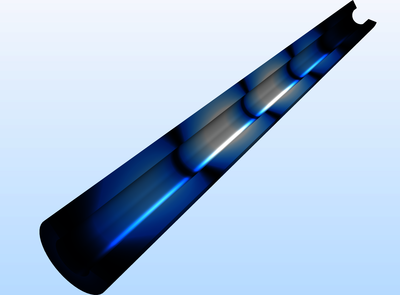
Simulation of Maxwell’s equations in the time domain is useful if the objective of the analysis is to observe a transient phenomenon, to find the time it takes a signal to propagate, or if the materials being modeled are non-linear with respect to the electric or magnetic field strength. ... Read More
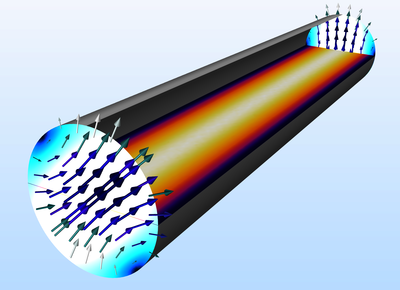
This model of a circular waveguide demonstrates how to use ports with numerical solution of the port modes. It illustrates how to align the polarization of degenerate port modes and in particular how to model and excite the TE11 mode of circular waveguides in 3D. Read More
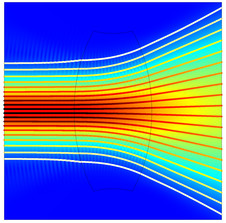
This example demonstrates how to set up a spatially varying dielectric distribution. Here, a convex lens shape is defined via a known deformation of a rectangular domain. The dielectric distribution is defined on the undeformed, original rectangular domain and is mapped onto the deformed ... Read More
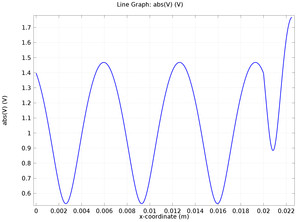
Transmission lines are used when the frequency of the electromagnetic signals is so high that the wave nature of the signals must be taken into account. A consequence of the wave nature is that the signals are reflected if there are abrupt changes of the characteristic impedance along ... Read More
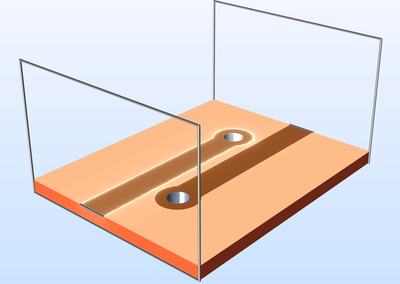
There are multiple ways to excite and terminate transmission lines using different types of port and lumped port features. In this example, transverse electromagnetic (TEM) type ports and a via type lumped port are used to simulate two adjacent microstrip lines. One via end is terminated ... Read More
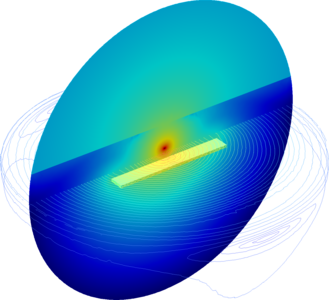
The marine controlled source electromagnetics method (CSEM) for oil prospecting has emerged as a promising technique during recent years. This model demonstrates one variant of it. It uses a mobile horizontal 1 Hz electric dipole antenna that is towed 150 m above the sea floor. An array ... Read More
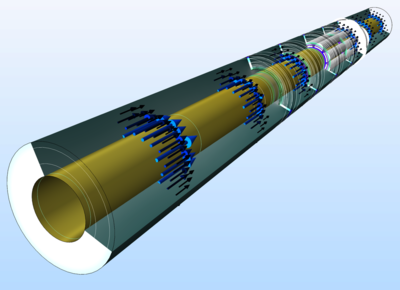
A very wide band coaxial low-pass filter is designed using a 2D axisymmetric model. To address the wide band frequency response with a fine frequency resolution, the model is built with a transient physics interface first. Then, S-parameters are calculated using a time-to-frequency ... Read More


