
The Application Gallery features COMSOL Multiphysics® tutorial and demo app files pertinent to the electrical, structural, acoustics, fluid, heat, and chemical disciplines. You can use these examples as a starting point for your own simulation work by downloading the tutorial model or demo app file and its accompanying instructions.
Search for tutorials and apps relevant to your area of expertise via the Quick Search feature. Note that many of the examples featured here can also be accessed via the Application Libraries that are built into the COMSOL Multiphysics® software and available from the File menu.
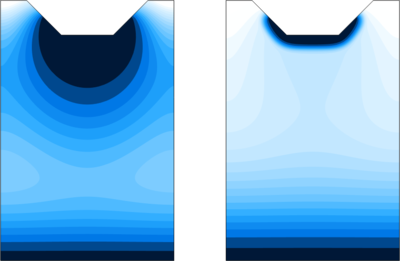
This example shows how to set up a model of furrow irrigation in a nonuniform soil column. It employs the Unsaturated Dual Permeability feature, which links two Richards' Equations through a fluid transfer function. This scenario can be regarded as a benchmark problem for dual ... Read More
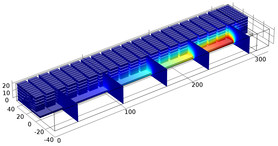
The elastic cantilever beam is one of the elementary structures used in MEMS designs. This model shows the bending of a cantilever beam under an applied electrostatic load. The model solves the deformation of the beam under an applied voltage. Read More
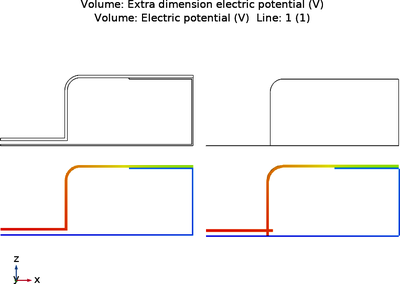
This example demonstrates a benchmark test showing that Electric Currents in Layered Shells physics interface can be used to obtain the same results as when the model is solved with the Electric Currents interface based on a solid 3D structure. Read More
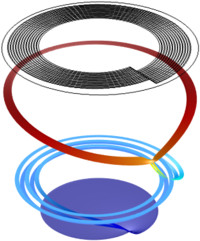
Due to the large differences in length scales in a lithium-ion battery, with the thickness of the different layers typically being several orders of magnitude smaller than the extension in the sheet direction, a lithium-ion battery is often well represented by a one-dimensional model. ... Read More
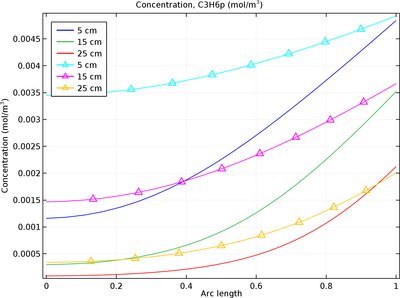
One of the most common reactors in the chemical industry, for use in heterogeneous catalytic processes, is the packed bed reactor. This type of reactor is used both in synthesis as well as in effluent treatment and catalytic combustion. The reactor consists in essence of a container ... Read More
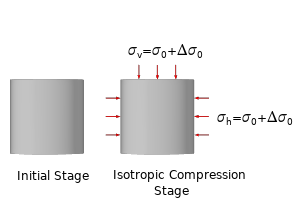
Isotropic compression is a common material test in soil mechanics. The modified Cam-Clay (MCC) model describes the relation between the void ratio and the logarithm of the pressure. In this example, a cylindrical soil sample under isotropic compression is simulated. It is verified that, ... Read More
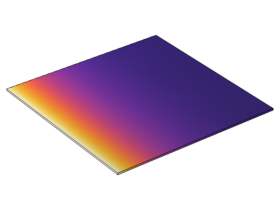
This example models heat transfer in a thin rectangular metal plate. Because the plate’s thickness is only 1/100 of its length and width, you can simulate the process using a 2D approximation. The plate has a fixed temperature at one end and is isolated at the other. A surrounding liquid ... Read More
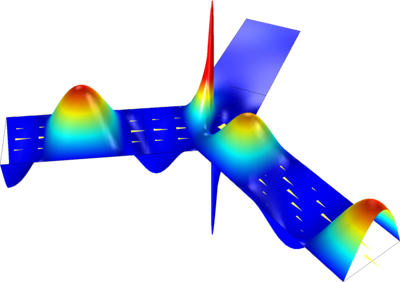
A microwave circulator is a multiport device in which a wave incident on Port 1 is coupled only into Port 2; a wave incident on Port 2 is coupled only into Port 3; and so on. Circulators are used to isolate microwave components, for example, to couple a transmitter and a receiver to a ... Read More


